
Your body needs 20 amino acids to build muscle protein. Nine of those are essential, meaning you cannot make them internally and must get them from food or supplements. Three of those nine are branched-chain amino acids (BCAAs): leucine, isoleucine, and valine. Essential amino acid (EAA) supplements contain all nine.
That distinction matters more than most supplement labels suggest. BCAAs dominated the sports nutrition market for years based on leucine’s role as the primary trigger for muscle protein synthesis (MPS). But a growing body of research questions whether BCAAs alone can sustain that process without the other six essential amino acids present.
This guide breaks down what the research actually shows, where each supplement fits, and which one makes more sense for your goals.
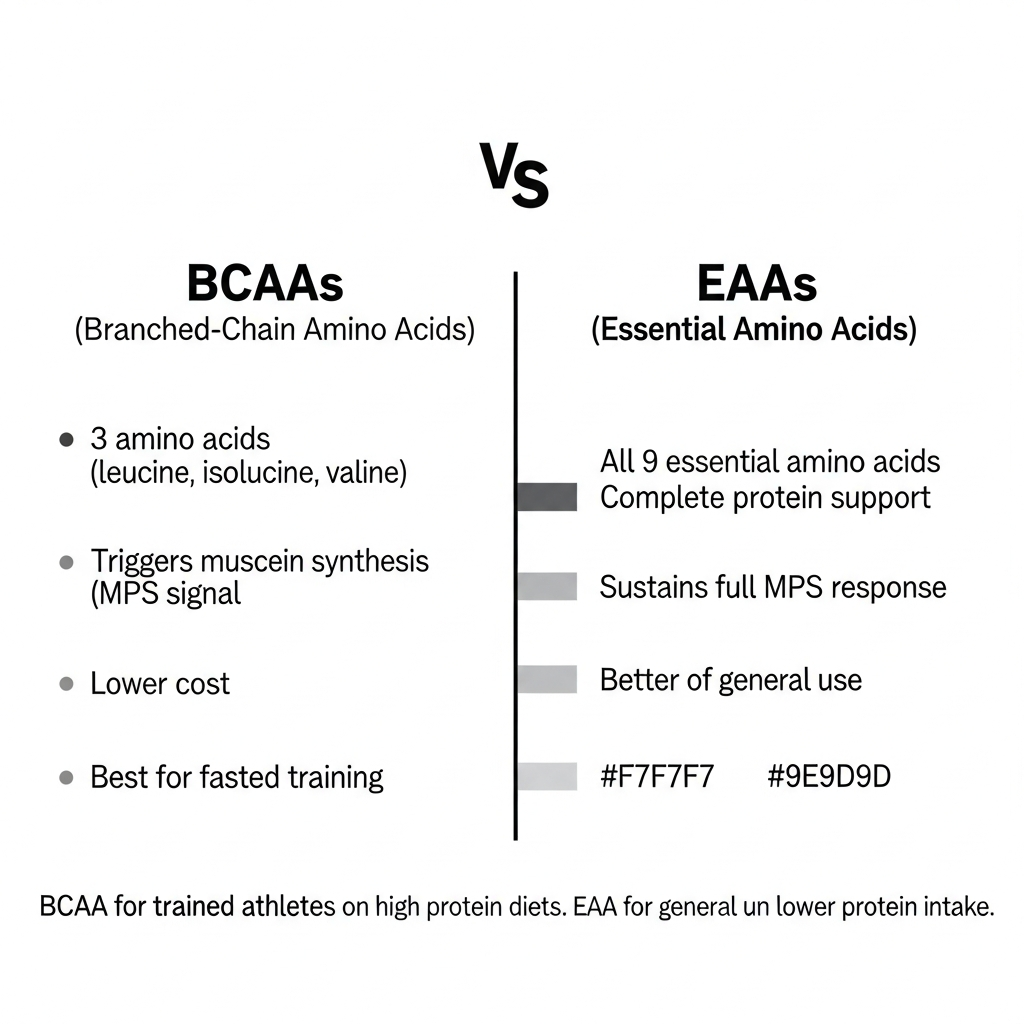
Quick Comparison
| Feature | BCAAs | EAAs |
|---|---|---|
| Amino acids included | 3 (leucine, isoleucine, valine) | All 9 essential amino acids |
| Contains leucine | Yes (typically 2:1:1 ratio) | Yes (plus 6 more) |
| Triggers MPS signal | Yes | Yes |
| Sustains full MPS response | Limited without other EAAs | Yes |
| Typical dose | 5-10 g | 10-15 g |
| Calories per serving | ~20-40 | ~40-60 |
| Best for | Fasted training, calorie-restricted athletes on high-protein diets | General muscle support, lower protein intake, older adults |
| Cost per serving | Lower | Moderate |
| Taste in water | Mild, often flavored | Stronger, bitter aminos present |
What Are BCAAs?
Branched-chain amino acids refer to leucine, isoleucine, and valine. The “branched-chain” name comes from their molecular structure, where a carbon atom branches off the main chain. Most BCAA supplements use a 2:1:1 ratio favoring leucine, since leucine is the strongest activator of the mTOR signaling pathway that initiates muscle protein synthesis.
Leucine works like a key in a lock. When blood leucine levels rise above a threshold (roughly 2-3 grams in a single dose), the mTORC1 complex activates and signals ribosomes to begin assembling new muscle protein. This “leucine trigger” concept drove the popularity of BCAA supplements for decades (Ely et al., 2023).
The problem: triggering the signal and completing the building process are two different things.
What Are EAAs?
Essential amino acid supplements contain all nine amino acids your body cannot produce:
- Leucine (the mTOR trigger)
- Isoleucine (glucose uptake, energy)
- Valine (muscle metabolism)
- Lysine (collagen synthesis, calcium absorption)
- Threonine (immune function, gut lining)
- Phenylalanine (precursor to tyrosine, dopamine)
- Methionine (antioxidant pathways, creatine synthesis)
- Tryptophan (serotonin precursor)
- Histidine (carnosine production, pH buffering)
EAA supplements typically provide the same leucine content as a BCAA product, plus the remaining six essential amino acids needed to actually build complete muscle protein.
The Research: Can BCAAs Build Muscle on Their Own?
This is where the conversation shifted.
In 2017, Robert Wolfe published a review in the Journal of the International Society of Sports Nutrition that challenged the BCAA-only model directly. The paper concluded that BCAAs alone cannot promote muscle protein synthesis to a greater degree than the normal resting rate. The reason is straightforward: building new muscle protein requires all nine essential amino acids. If only three are available, the body must break down existing muscle protein to source the missing six (Wolfe, 2017).
That same year, Jackman et al. ran a controlled trial comparing BCAA supplementation to a placebo after resistance exercise. BCAAs did activate the MPS signal, measured by phosphorylation of p70S6K (a downstream marker of mTORC1 activation). But the actual rate of myofibrillar protein synthesis was 22% lower than what you would expect from a complete protein source providing the same leucine dose (Jackman et al., 2017).
A crossover study by Moberg et al. (2016) measured this directly. Eight trained volunteers received placebo, leucine alone, BCAAs, or EAAs after resistance exercise. S6K1 activity (a downstream marker of mTOR activation) followed a clear staircase: placebo was lowest, then leucine, then BCAAs, then EAAs at the top with a 9-fold increase. EAAs produced measurably stronger translation initiation signaling than BCAAs alone (Moberg et al., 2016).
The takeaway from these studies: leucine turns the ignition, but you need all nine essential amino acids as fuel.
EAA Research: The Complete Picture
EAA supplementation performs differently. When all nine essential amino acids are present in adequate amounts, the MPS response after resistance exercise matches or approaches what you see with whole-protein sources like whey.
A 2025 study by Aguilera et al. tested a dileucine-supplemented EAA formula against resistance exercise recovery. The EAA group showed whole-body anabolic responses comparable to complete protein, with the leucine enrichment providing the mTOR activation signal while the remaining EAAs supplied the building blocks (Aguilera et al., 2025).
Gwin et al. (2025) found that whey protein enriched with additional free EAAs maintained a positive protein balance during caloric deficit after exercise, outperforming a carbohydrate-matched control. This finding is particularly relevant for anyone training while cutting calories (Gwin et al., 2025).
For older adults, the case for EAAs over BCAAs is even stronger. Age-related anabolic resistance means older muscle tissue needs a higher leucine threshold to trigger MPS, and it needs the full amino acid profile available simultaneously to complete the synthesis process. A 2022 meta-analysis by Jang et al. found that free EAA supplementation combined with resistance training synergistically improved muscle outcomes, with the balanced amino acid profile compensating for the blunted anabolic response that comes with aging (Jang et al., 2022).
When BCAAs Still Make Sense
The research does not mean BCAAs are useless. Context matters.
Fasted training: If you train in a fasted state and want to minimize caloric intake while still providing a leucine signal, BCAAs deliver the trigger in fewer calories than EAAs. The MPS response will be suboptimal compared to EAAs, but it is better than training on nothing.
High-protein diets (1.6+ g/kg/day): If your daily meals already provide all nine essential amino acids in abundance, the “missing six” problem with BCAAs becomes less relevant. Your circulating amino acid pool and muscle tissue already contain the other EAAs. In this context, BCAAs can top off the leucine signal between protein-rich meals.
Intra-workout sipping: Some athletes prefer BCAAs during training for their mild taste and quick absorption. The performance benefit is marginal, but the leucine provides an anti-catabolic signal during prolonged sessions.
Cost-sensitive use: BCAA supplements are typically cheaper per serving than EAA products. For someone already hitting high protein targets through food, the cost difference may matter more than the amino acid completeness.
A 2025 systematic review by Julea et al. examined BCAA supplementation across multiple performance outcomes. The review found modest benefits for reducing exercise-induced muscle damage markers and supporting recovery, though the magnitude of benefit varied significantly across study designs and populations (Julea et al., 2025).
When EAAs Are the Better Choice
Lower protein intake: If your daily protein intake is below 1.4 g/kg body weight, EAAs fill the gaps that BCAAs cannot. This applies to many people who eat plant-forward diets, restrict calories, or skip meals.
Older adults (40+): Anabolic resistance makes the complete amino acid profile more important with age. EAAs provide what aging muscle tissue needs to mount a full synthetic response.
Post-surgery or injury recovery: Muscle protein breakdown accelerates during immobilization. EAAs support net protein balance better than BCAAs because they provide the raw materials for tissue repair, not just the signal. A systematic review and meta-analysis by Cheng et al. (2018) found that amino acid supplementation with complete essential profiles improved clinical outcomes in older adults with acute conditions (Cheng et al., 2018).
General supplementation: If you are choosing one amino acid supplement to cover the broadest range of scenarios, EAAs are the more versatile option. You get the leucine trigger plus the other six building blocks.
Dosing Comparison
| Parameter | BCAAs | EAAs |
|---|---|---|
| Standard dose | 5-10 g per serving | 10-15 g per serving |
| Leucine content | ~2.5-5 g (2:1:1 ratio) | ~2-3 g (varies by product) |
| Timing | Pre/intra/post workout | Pre or post workout |
| Frequency | 1-2x daily around training | 1-3x daily |
| With meals | Not necessary (food provides full spectrum) | Can replace snack or supplement low-protein meals |
For either supplement, the leucine content per serving matters more than the total gram weight. Look for products that provide at least 2.5 g of leucine per dose.
Stacking With Other Supplements
Both BCAAs and EAAs pair well with creatine monohydrate, which works through an entirely separate mechanism (ATP resynthesis via phosphocreatine stores). Taking creatine alongside amino acids does not interfere with absorption or efficacy.
If you use a BCAA supplement, consider whether your overall diet already provides adequate protein. For most recreational lifters eating 1.6+ g/kg/day of protein, additional amino acid supplementation of either type provides diminishing returns.
The Bottom Line
BCAAs were the standard recommendation for a decade. The science has moved on. For most people, EAAs are the better standalone choice because they provide the complete set of building blocks needed for muscle protein synthesis, not just the signal.
BCAAs still have a narrow window of usefulness for trained athletes on high-protein diets who want a low-calorie leucine source during fasted sessions. Outside that specific scenario, EAAs deliver more for your money.
If your protein intake is already above 1.6 g/kg/day from whole-food sources, the added benefit of either supplement is small. Food first, supplement the gaps.
Frequently Asked Questions
Are BCAAs a waste of money?
Not inherently, but for most people, EAAs are a better investment. BCAAs provide only 3 of the 9 essential amino acids your muscles need. If your diet is already high in protein (above 1.6 g/kg/day), BCAAs offer marginal benefit. If your protein intake is moderate or low, EAAs outperform BCAAs because they supply the complete amino acid profile for muscle protein synthesis.
Can I take BCAAs and EAAs together?
You can, but there is no clear benefit to doing so. EAA supplements already contain leucine, isoleucine, and valine. Adding BCAAs on top increases your intake of those three without improving the overall amino acid balance. If you want more leucine, look for an EAA product with a higher leucine ratio instead.
Do EAAs break a fast?
Yes. EAAs contain calories (roughly 4 calories per gram of amino acids) and will trigger an insulin response due to the leucine content. If strict fasting is the priority, EAAs taken before training will technically end the fast. BCAAs also break a fast for the same reason, despite marketing claims to the contrary.
How much leucine do I need per serving to trigger muscle protein synthesis?
Research suggests a threshold of roughly 2 to 3 grams of leucine per meal or dose to maximally activate the mTOR signaling pathway. Both BCAA and EAA supplements typically meet this threshold at standard serving sizes. Older adults may benefit from doses closer to 3 grams per serving to overcome age-related anabolic resistance.
Are EAAs better than whey protein?
Not necessarily better, just different. Whey protein provides all essential amino acids plus non-essential amino acids, along with bioactive peptides and immunoglobulins. EAA supplements are lower in total calories and absorb faster since they do not require digestion. If you already use whey protein post-workout, an EAA supplement is generally redundant unless you need a quick-absorbing option during training.
Should I take amino acids if I already eat enough protein?
For most people eating 1.6 g/kg/day or more of protein from varied food sources, amino acid supplements provide minimal additional benefit. The amino acids from food are the same molecules as those in supplements. Supplementation makes the most difference when dietary protein is low, meal timing is spread out, or when training fasted.
What is the best time to take EAAs?
The highest-impact timing is within 1-2 hours around resistance training, either before or after. Pre-workout dosing raises circulating amino acid levels during the session. Post-workout dosing supports the MPS response in the recovery window. For older adults or those on calorie-restricted diets, taking EAAs between meals can help maintain positive protein balance throughout the day.