
Quick Answer
Allulose is usually the best keto sweetener for soft baked goods because it browns, dissolves, and holds moisture more like sugar. Erythritol is better for crisp cookies and crusts but can crystallize as baked goods cool. Pure monk fruit and stevia are too concentrated to replace sugar’s structure by themselves, so they work best in blends or tiny supporting amounts.
Keto baking is not the same as reducing sugar. Every sweetener choice changes how a recipe performs in the oven: texture, browning, moisture retention, shelf life. The four main keto-friendly sweeteners (erythritol, allulose, monk fruit, and stevia) each behave differently under heat, and picking the wrong one is why keto baked goods so often turn out crumbly, gritty, or flat. This guide covers the functional differences so you can choose based on what you are actually making.
Why Keto Baking Sweeteners Behave Differently From Sugar
First, sugar does more than sweeten. In conventional baking, sucrose contributes to structure (through creaming with butter), browning (Maillard reaction and caramelization), moisture retention, and shelf life. When you remove sugar, you remove all of these functions simultaneously. Keto sweeteners replace the sweetness but not always the functional role, and that gap is where most keto baking problems originate.
The glycemic profile of each sweetener has been separately established. A 2024 study in Scientific Reports found that replacing sucrose with erythritol in shortbread cookies significantly reduced the glycemic index of the finished product without altering perceived sweetness ratings (PMID: 38902505). A 2019 clinical study of a polyol-stevia blended sugar replacer in healthy adults confirmed a reduced postprandial glucose response compared to sucrose control (PMID: 31451273). The blood glucose advantages are real. The baking performance tradeoffs are also real, and they are separate questions.
Erythritol: Best for Crisp Textures
Erythritol is a sugar alcohol produced through fermentation of glucose. It contains roughly 0.2 calories per gram and has a glycemic index close to zero. Sweetness is about 70% that of sucrose.
Baking performance: Erythritol dissolves in liquid and provides bulk, which makes it usable for structural baking. Cookies and shortbread with erythritol produce a crisp, dry texture that holds shape well. This is a feature when crunch is the goal.
The problem is crystallization. Erythritol recrystallizes as baked goods cool, which produces a gritty mouthfeel in anything moist: cheesecakes, soft cakes, or anything refrigerated. This is not a flaw in the product; it is an inherent chemical property of the polyol. If you are making cookies that are meant to be crisp, erythritol is fine. If you are making something that should stay soft, you will either need to use allulose or blend erythritol with a humectant.
Substitution ratio: 1.3 cups erythritol per 1 cup sugar to match sweetness level. Volume-for-volume substitution works but produces a less sweet result.
Best uses: Shortbread, crisp cookies, pie crusts, keto chocolate.
Allulose: Best All-Round Baking Sweetener
Allulose is a rare sugar found in small amounts in figs, raisins, and maple syrup. It provides 0.2-0.4 calories per gram and is excluded from net carb totals on FDA nutrition labels. Sweetness is about 70% of sucrose.
Baking performance: Allulose comes closest to sugar’s functional behavior in the oven. It dissolves cleanly, retains moisture in the finished product, and undergoes the Maillard reaction, meaning it browns and caramelizes. This makes it the only keto sweetener that can replicate the golden color and slight crust of sugar-baked goods.
The tradeoff is speed: allulose browns faster than sucrose. Reduce oven temperature by 25°F and begin checking for doneness 5-10 minutes earlier than the original recipe calls for. At higher concentrations it can also produce a slightly sour or fermented flavor note in some applications.
Multiple clinical trials have examined allulose’s metabolic effects. A 2021 randomized crossover trial in BMJ Open Diabetes Research and Care found that D-allulose reduced both glucose area-under-the-curve and peak insulin response compared to sucrose in a standard oral challenge (PMID: 33637605). A 2024 study of Japanese adults found that consuming D-allulose alongside a sucrose beverage reduced postprandial glucose and insulin compared to sucrose alone (PMID: 38945885). These effects extend to whole meals: a 2023 pilot study found that a diet incorporating D-allulose reduced postprandial glucose excursions compared to a conventional diabetic diet (PMID: 37375710). The implication for keto baking is that allulose not only keeps net carbs low but may also blunt glucose response from other ingredients in a recipe.
Substitution ratio: 1:1 by volume. Reduce oven temperature by 25°F.
Best uses: Cakes, muffins, brownies, cheesecakes, soft cookies, anything requiring moisture retention or browning.
Monk Fruit: Best as a Blend Ingredient
Second, monk fruit extract. Pure monk fruit extract contains mogrosides, non-caloric compounds that are 150-250 times sweeter than sucrose. The extract itself has zero calories and a glycemic index of zero. It does not caramelize or provide bulk.
Baking performance: In pure form, monk fruit cannot substitute structurally for sugar. The concentration is too high for meaningful volume replacement. Commercial monk fruit sweeteners designed for baking are almost always blended with erythritol to provide bulk. These blends bake identically to pure erythritol with a taste advantage: monk fruit’s flavor profile is generally considered cleaner than erythritol alone, with less of the slight cooling sensation that erythritol can produce.
Monk fruit extract is heat-stable through normal baking temperatures. Steviol glycosides, the related compound from stevia, have been characterized as stable through approximately 200°C under analytical conditions (PMID: 23050630), and mogrosides behave similarly. Potency is not meaningfully reduced by oven heat.
Substitution ratio: Use the package-level instructions for the specific blend. Most monk fruit/erythritol blends are designed for 1:1 substitution.
Best uses: Any recipe that calls for erythritol, where taste is a priority. Particularly good in chocolate-based recipes and muffins.
Stevia: Supporting Role Only
Stevia extracts are 200-350 times sweeter than sugar. This concentration means that stevia cannot replace sugar structurally. A teaspoon of sugar cannot be replaced with a teaspoon of stevia; the resulting product would be extraordinarily sweet and would have none of the structural mass or moisture-retention function sugar provides.
Baking performance: Stevia works as a flavor boost in keto baking when the structural sweetener (erythritol or allulose) provides base sweetness and you want to amplify it without adding more bulk. A quarter teaspoon of liquid stevia can extend the perceived sweetness of a recipe without additional carbohydrates.
Stevia is heat-stable in the temperature ranges used in baking. It can develop a bitter aftertaste at high concentrations, which is amplified in hot applications, so use it conservatively. See why does stevia taste bitter? for the mechanism behind this.
Substitution ratio: Not a direct substitute. Use 1/4 teaspoon liquid stevia per 1 cup sugar as a flavor supplement to a bulk sweetener.
Best uses: Augmenting erythritol or allulose in beverages or light baking. Not suitable as a stand-alone baking sweetener.
Performance Comparison at a Glance
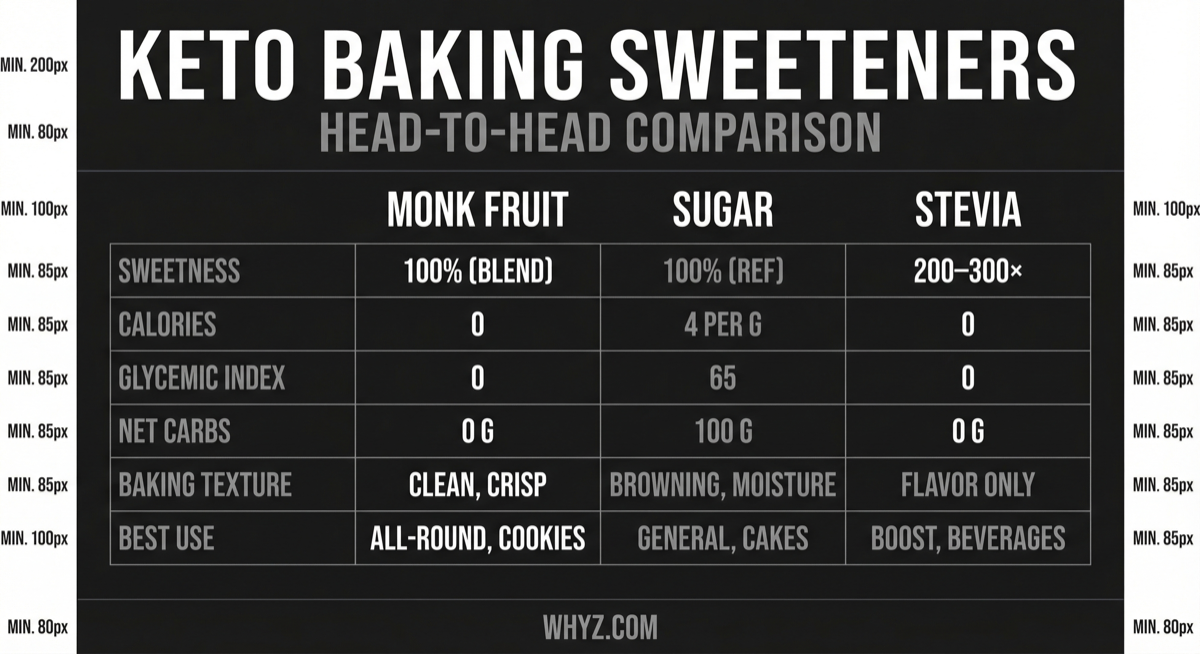
| Erythritol | Allulose | Monk Fruit Blend | Stevia | |
|---|---|---|---|---|
| Sweetness vs sugar | ~70% | ~70% | ~100%* | 200-350x |
| Net carbs | 0 | 0 | 0 | 0 |
| Browning | Minimal | Yes | Minimal | No |
| Moisture retention | Low | High | Low | N/A |
| Crystallizes | Yes | No | Yes | N/A |
| 1:1 sub ratio | No (1.3:1) | Yes | Yes* | No |
| Best for | Crisp cookies | Cakes, moist baking | Cookies, muffins | Flavor boost |
*Depends on specific product formulation.
Practical Blending Strategy
Third, most experienced keto bakers do not use a single sweetener. Common practical combinations:
Allulose + erythritol (50:50): The allulose provides moisture retention and browning while erythritol reduces the browning speed and improves structure. This blend handles most baking scenarios without the extreme browning risk of pure allulose.
Erythritol + monk fruit: Addresses erythritol’s cooling aftertaste with monk fruit’s clean sweetness while maintaining the structural properties of erythritol. Most commercial monk fruit sweeteners are already formulated this way.
Allulose + stevia: For recipes where very low sweetener volume is desirable. Allulose provides functional properties; stevia boosts sweetness without bulk.
For comparison of these sweeteners outside the baking context, see monk fruit vs erythritol and best sweeteners for keto.
What This Means for Common Keto Recipes
Cookies: Erythritol or monk fruit/erythritol blend for crisp. Allulose or allulose blend for chewy.
Cakes and muffins: Allulose is the top choice. The moisture retention produces results closest to conventional baking.
Cheesecake: Allulose for the filling (prevents crystallization). Erythritol can work in the crust.
Brownies: Allulose or an allulose blend. Browning behavior mimics the fudgy caramelization that makes brownies distinct.
Pie crust: Erythritol or monk fruit blend (crisp texture is the goal).
Fat bombs and chocolate: Monk fruit blend or pure erythritol. No moisture retention needed.
Related Guides
- Best Sweeteners for Keto: The Full Comparison
- Monk Fruit vs Erythritol: Which Is Better?
- Does Monk Fruit Break a Fast?
- Why Does Stevia Taste Bitter?
- Monk Fruit on Keto: The Complete Guide
References
- Raczkowska E, et al. (2024). Modulation of the glycaemic index value of shortbread cookies by the use of erythritol and inulin. Sci Rep. PMID: 38902505
- Ng CY, et al. (2019). A polyol-stevia blended sugar replacer exhibits low glycemic response among human subjects. Clin Nutr ESPEN. PMID: 31451273
- Franchi F, et al. (2021). Effects of D-allulose on glucose tolerance and insulin response to a standard oral sucrose load: results of a prospective, randomized, crossover study. BMJ Open Diabetes Res Care. PMID: 33637605
- Buranapin S, et al. (2024). Effects of D-Allulose with Sucrose Beverage on Glucose Tolerance and Insulin Levels among Healthy Subjects. J Nutr Sci Vitaminol. PMID: 38945885
- Fukunaga K, et al. (2023). A Pilot Study on the Efficacy of a Diabetic Diet Containing the Rare Sugar D-Allulose in Patients with Type 2 Diabetes. Nutrients. PMID: 37375710
- Shah RK, et al. (2012). Simultaneous determination of steviol and steviol glycosides by liquid chromatography-mass spectrometry, with implications for stability under processing and thermal conditions. Food Addit Contam Part A Chem Anal Control Expo Risk Assess. PMID: 23050630