
Home > Learn > Beta-Alanine Tingling: Is It Normal and How to Stop It
You take your pre-workout, and within 15 minutes your skin starts prickling. Face, ears, neck, hands. It feels like a low-voltage current running just beneath the surface. If you have ever taken beta-alanine, you know this sensation. It is called paresthesia, and it happens to the majority of people who take beta-alanine in standard doses.
The tingling is one of the most commonly asked-about side effects in sports nutrition. It feels alarming the first time, but decades of clinical research confirm it is harmless. The International Society of Sports Nutrition (ISSN) identifies paresthesia as the only consistently reported side effect of beta-alanine supplementation, and notes that it can be reduced with simple dosing adjustments Trexler et al. (2015, PMID 26175657). Here is what causes it, whether it means anything, and how to manage it.
What Is Beta-Alanine?
Beta-alanine is a non-essential amino acid that the body uses to produce carnosine. Unlike most amino acids, beta-alanine is not incorporated into proteins. Its primary role is as the rate-limiting precursor to carnosine, a dipeptide stored in skeletal muscle that buffers hydrogen ions during high-intensity exercise.
When you supplement with beta-alanine at 4 to 6 grams per day for at least four weeks, muscle carnosine concentrations increase by 20 to 80% depending on baseline levels and dietary habits Harris et al. (2006, PMID 16554972). Vegetarians and vegans tend to have lower baseline carnosine and may see larger relative increases. The increased carnosine helps buffer the acidity that builds up during intense efforts lasting 60 to 240 seconds, which is why beta-alanine is popular among sprinters, CrossFit athletes, and high-intensity interval trainers. For a full overview of this ingredient, see the WHYZ beta-alanine page.
What Causes the Tingling?
The paresthesia you feel after taking beta-alanine is triggered by the amino acid binding to sensory nerve receptors in the skin. Research points to MrgprD (Mas-related G-protein-coupled receptor D) as the primary receptor involved. These receptors sit on cutaneous sensory neurons, and when beta-alanine binds to them, they fire rapidly, producing the prickling or itching sensation.
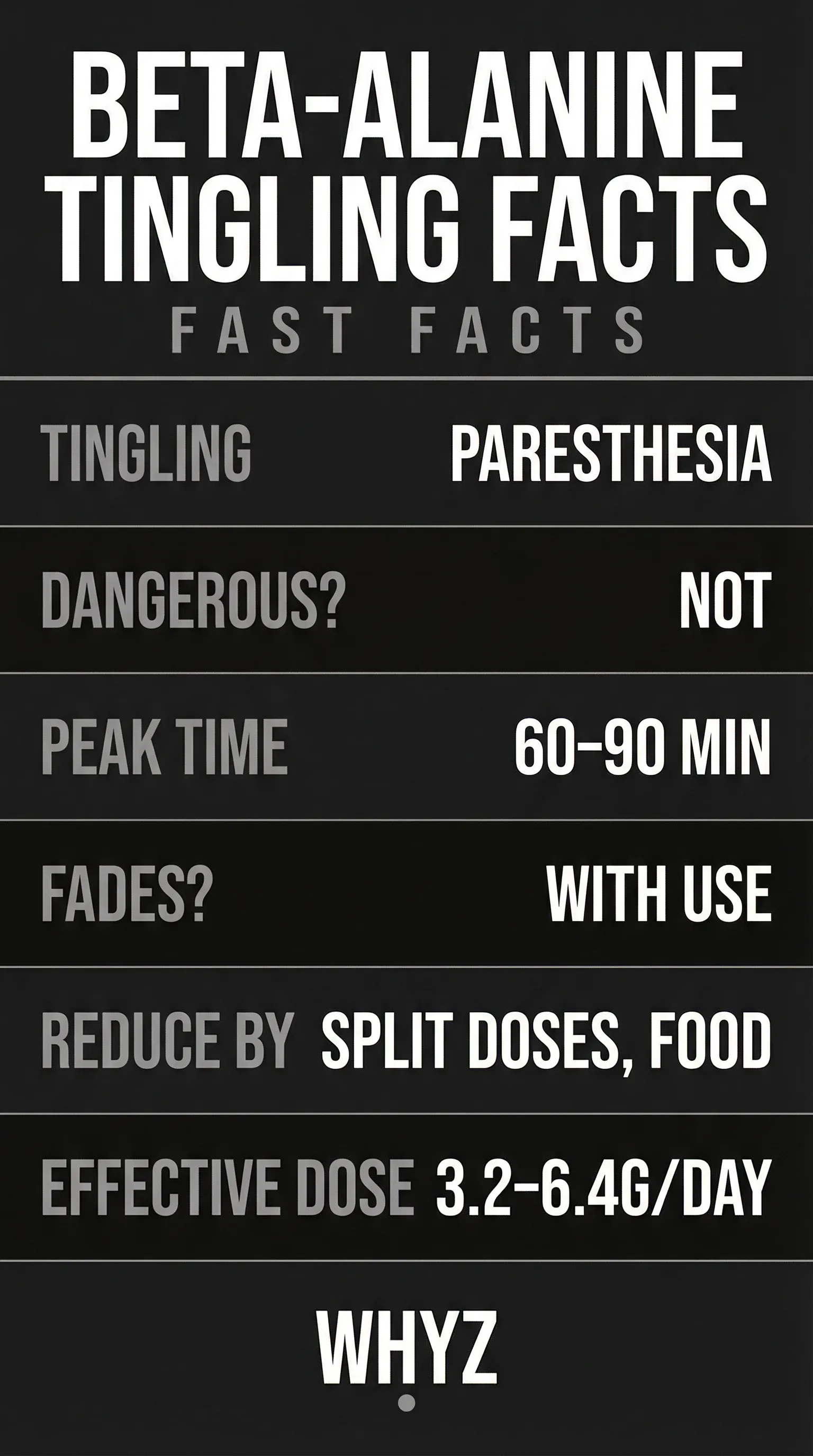
The intensity of the tingling is dose-dependent. A single 800 mg dose may produce no noticeable effect. At 1.6 grams, most people begin to feel it. At 3.2 grams taken at once, the sensation is hard to ignore. Peak plasma concentration of beta-alanine occurs roughly 30 to 45 minutes after ingestion, which is when the tingling tends to be strongest. The sensation typically fades within 60 to 90 minutes as plasma levels decline.
Is Beta-Alanine Tingling Dangerous?
No. Paresthesia from beta-alanine is not an allergic reaction, a sign of nerve damage, or an indication of any health risk. The ISSN position stand on beta-alanine reviewed the available safety literature and concluded that the supplement is safe in healthy populations at recommended doses, with paresthesia being the only reported side effect Trexler et al. (2015, PMID 26175657).
The tingling is a transient sensory phenomenon. It does not reflect inflammation, histamine release, or tissue damage. It is mechanistically similar to the “pins and needles” feeling you get when a limb falls asleep, except it is triggered by a chemical stimulus rather than pressure on a nerve. Once plasma beta-alanine levels drop, the sensation resolves completely. No study has identified lasting effects from repeated episodes of beta-alanine paresthesia.
Does Tingling Mean It Is Working?
This is one of the most common misconceptions about beta-alanine. The tingling does not indicate that the supplement is building muscle carnosine. Paresthesia is a side effect of acute plasma beta-alanine spikes acting on skin receptors. Carnosine synthesis, the actual performance-relevant outcome, happens gradually over weeks of consistent dosing inside muscle cells.
A sustained-release beta-alanine tablet can deliver the same total daily dose without producing any noticeable tingling, while still increasing muscle carnosine at the same rate. People who experience strong tingling are not getting a better training effect than those who feel nothing. The two processes, sensory nerve activation in skin and carnosine loading in muscle, are biologically independent of each other.
How to Reduce or Eliminate the Tingling
Five strategies can reduce or eliminate beta-alanine paresthesia, and you can combine them.
First, split your daily dose into smaller servings. The ISSN notes that doses of 1.6 grams or less significantly attenuate paresthesia Trexler et al. (2015, PMID 26175657). If your target is 6.4 grams per day, take four doses of 1.6 grams spread across the day rather than two large servings.
Second, take beta-alanine with food. Eating slows gastric emptying and reduces the speed at which beta-alanine enters the bloodstream, which lowers peak plasma concentration and blunts the tingling response.
Third, use a sustained-release formulation. Sustained-release tablets deliver beta-alanine slowly over several hours, keeping plasma levels below the threshold that triggers receptor activation. Studies confirm that sustained-release forms produce equivalent muscle carnosine increases with reduced or absent paresthesia.
Fourth, lower your single-dose amount gradually. If you currently take 3.2 grams pre-workout, try dropping to 2 grams and adding a second dose later in the day.
Fifth, give it time. Some users report that the tingling diminishes after several weeks of consistent use as sensory receptors adapt to regular beta-alanine exposure.
How Long Does the Tingling Last?
After a single dose, tingling typically begins within 15 to 20 minutes, peaks at 30 to 60 minutes, and resolves within 60 to 90 minutes. The timeline tracks closely with the pharmacokinetic profile of oral beta-alanine absorption.
Higher doses produce longer and more intense tingling. A 1.6 gram dose may produce mild prickling lasting 20 to 30 minutes. A 3.2 gram dose on an empty stomach may cause noticeable tingling for a full hour. Taking it with a carbohydrate-rich meal can extend the absorption window but flatten the peak, trading a shorter intense tingle for a longer mild one. Neither pattern affects carnosine loading.
Beta-Alanine Dosage and Timing
The evidence-based dosing protocol for beta-alanine is 3.2 to 6.4 grams per day, taken daily for a minimum of four weeks to achieve meaningful carnosine loading. A 2012 meta-analysis of 15 studies confirmed that supplementation at these doses improves exercise performance, with the largest effects seen in activities lasting 60 to 240 seconds Hobson et al. (2012, PMID 22270875).
Timing relative to exercise does not matter for carnosine loading. Beta-alanine is not an acute performance enhancer. It works through chronic accumulation. Taking it pre-workout is popular because it is often included in pre-workout blends, but taking it with breakfast, lunch, or dinner is equally effective. Consistency matters more than timing. The loading period is four to ten weeks, and maintenance requires continued daily intake. Carnosine levels return to baseline within six to fifteen weeks after stopping supplementation Sale et al. (2010, PMID 20091069).
Who Should Avoid Beta-Alanine?
Beta-alanine is considered safe for healthy adults at recommended doses. However, certain groups should exercise caution. Pregnant and breastfeeding women lack sufficient safety data for beta-alanine supplementation, so avoidance is the standard recommendation until more research exists.
People taking medications that affect nerve function or sensory perception should consult a healthcare provider before adding beta-alanine. The paresthesia effect, while benign in healthy individuals, could complicate symptom monitoring for conditions involving neuropathy. Those with taurine deficiency concerns should note that beta-alanine competes with taurine for renal reabsorption, though clinically meaningful taurine depletion has not been documented at standard supplementation doses Artioli et al. (2010, PMID 20479615).
Frequently Asked Questions
Is beta-alanine tingling an allergic reaction? No. The tingling is paresthesia caused by beta-alanine activating sensory nerve receptors in the skin. It is not an immune response, does not involve histamine release, and resolves on its own within 60 to 90 minutes. If you experience hives, swelling, or difficulty breathing, those would indicate a separate allergic reaction to another ingredient in your supplement.
Does the tingling mean beta-alanine is working? No. Tingling reflects acute plasma beta-alanine levels hitting skin receptors. Carnosine loading, which is the performance-relevant mechanism, happens slowly in muscle cells over weeks. Sustained-release forms produce the same carnosine increase with minimal or no tingling.
How do I stop beta-alanine tingling? Split your daily dose into servings of 1.6 grams or less, take it with food, or switch to a sustained-release formulation. All three strategies lower peak plasma concentration and reduce receptor activation in the skin.
How long does beta-alanine tingling last? Typically 60 to 90 minutes after a standard dose. The onset is 15 to 20 minutes post-ingestion, with peak intensity at 30 to 60 minutes. Taking it with food extends the absorption window but reduces peak tingling intensity.
Is beta-alanine safe to take every day? Yes. The ISSN position stand confirms that daily supplementation at 4 to 6 grams is safe in healthy populations. Daily intake is required for carnosine loading, which takes a minimum of four weeks. The tingling side effect is the only consistently reported adverse effect.
References
- Trexler ET, Smith-Ryan AE, Stout JR, et al. (2015). International Society of Sports Nutrition position stand: Beta-Alanine. J Int Soc Sports Nutr. PMID: 26175657
- Harris RC, Tallon MJ, Dunnett M, et al. (2006). The absorption of orally supplied beta-alanine and its effect on muscle carnosine synthesis in human vastus lateralis. Amino Acids. PMID: 16554972
- Hobson RM, Saunders B, Ball G, et al. (2012). Effects of beta-alanine supplementation on exercise performance: a meta-analysis. Amino Acids. PMID: 22270875
- Sale C, Saunders B, Harris RC. (2010). Effect of beta-alanine supplementation on muscle carnosine concentrations and exercise performance. Amino Acids. PMID: 20091069
- Artioli GG, Gualano B, Smith A, et al. (2010). Role of beta-alanine supplementation on muscle carnosine and exercise performance. Med Sci Sports Exerc. PMID: 20479615