
Home > Learn > Creatine and Tongkat Ali
Hundreds of millions of dollars are spent annually on testosterone-support supplements and creatine combined. Creatine monohydrate is one of the best-studied ergogenic compounds in sports nutrition. Tongkat Ali (Eurycoma longifolia) has emerged as a leading botanical option for supporting healthy testosterone levels in men. Stack them together and the theoretical case looks compelling. But does the evidence hold up?
This guide breaks down what each compound actually does, what the research says about combining them, and whether this stack makes sense for your goals.
What Does Creatine Do for Muscle Growth?
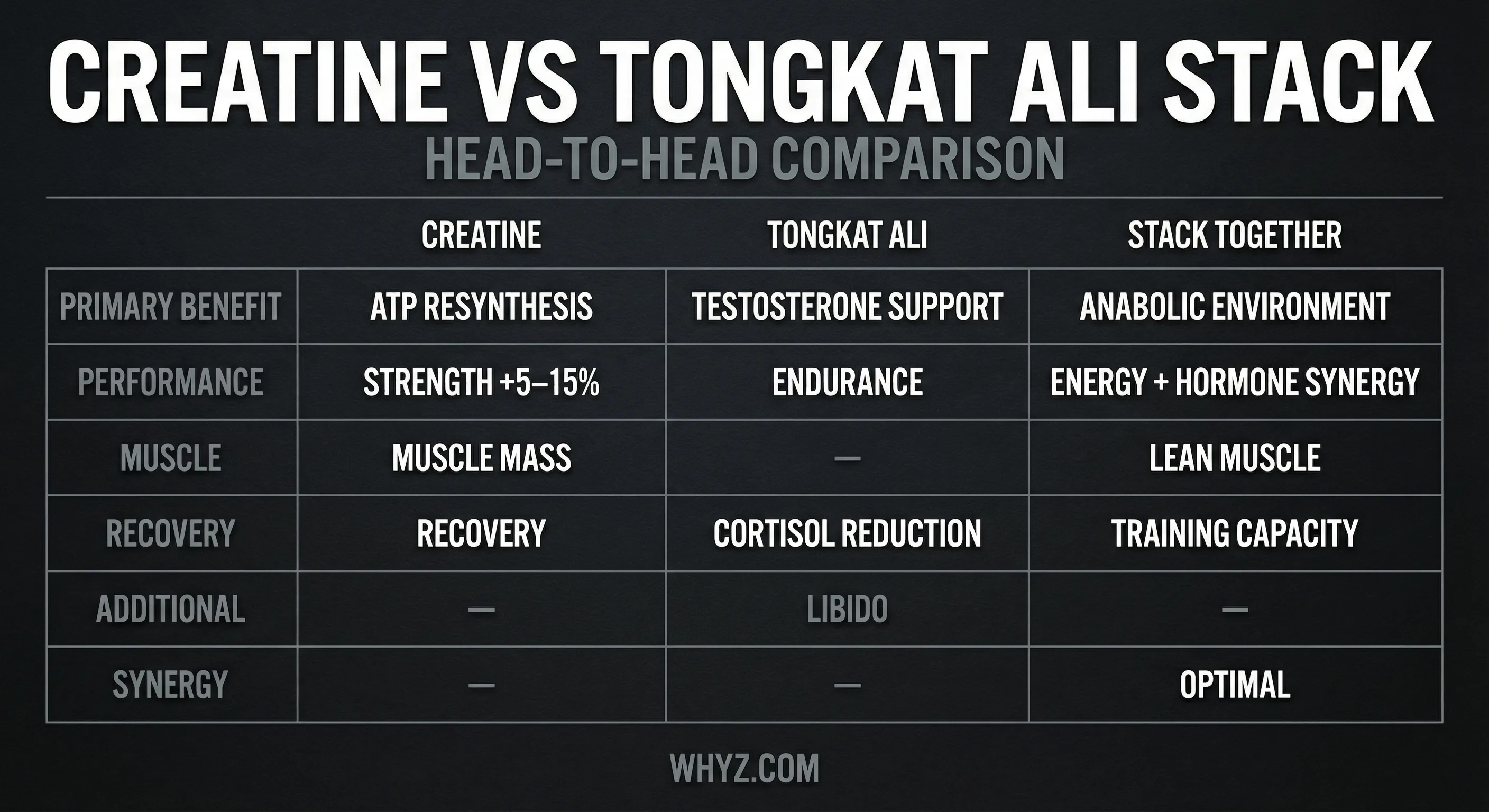
3 to 5 grams of creatine monohydrate per day is enough to saturate muscle phosphocreatine stores over one to four weeks. That phosphocreatine acts as a rapid phosphate donor during high-intensity, short-duration effort, regenerating ATP faster than other metabolic pathways can. The result is more reps, more power output, and faster recovery between sets.
The performance benefit is modest but reliable. Across hundreds of randomized controlled trials, creatine supplementation produces a typical strength and power improvement of around 5 to 15% on maximal efforts. Rawson and Volek (2003) summarized early evidence showing creatine increased lean body mass and upper body strength in trained individuals. A 2017 position stand by the International Society of Sports Nutrition confirmed creatine monohydrate as the most effective ergogenic nutritional supplement available for increasing high-intensity exercise capacity and lean body mass.
First, creatine increases the capacity for work. Second, it may reduce post-exercise muscle damage. Third, emerging research suggests benefits for cognitive function and bone health, though these effects are less established than the performance data. The muscle-building effect of creatine is indirect: by letting you train harder and recover faster, it creates conditions where hypertrophy can occur at a greater rate.
See our full breakdown at /learn/ingredients/creatine/.
What Does Tongkat Ali Do for Testosterone?
Tongkat Ali, the root extract of Eurycoma longifolia, contains bioactive quassinoids, primarily eurycomanone, that are thought to modulate the hypothalamic-pituitary-gonadal (HPG) axis. The practical effect is a modest increase in free and total testosterone, particularly in men whose baseline levels are low or borderline-low.
A 2013 pilot study by Tambi et al. found that 200 mg of standardized Tongkat Ali extract daily for one month improved the testosterone/LH ratio and serum testosterone in 76 men with late-onset hypogonadism. A separate study by Hamzah and Yusof (2003) found improved lean body mass and strength in recreationally trained athletes using Tongkat Ali over 5 weeks compared to placebo.
Tongkat Ali also appears to reduce cortisol. Cortisol and testosterone exist in inverse relationship under chronic stress conditions. By attenuating the cortisol response, Tongkat Ali may create a more favorable anabolic hormonal environment. A 2013 study by Talbott et al. noted improvements in the testosterone-to-cortisol ratio in moderately stressed adults given 200 mg of Tongkat Ali extract for 4 weeks.
The key caveat: most Tongkat Ali studies involve men with low baseline testosterone, older adults, or individuals under elevated stress. Evidence for healthy eugonadal men in their 20s and 30s is less consistent. The research suggests Tongkat Ali works better as a testosterone normalizer than as a testosterone amplifier.
Can You Take Creatine and Tongkat Ali Together?
Yes. The two compounds operate through completely different mechanisms. Creatine works in muscle cells via phosphocreatine energy systems. Tongkat Ali works through HPG axis modulation and adaptogenic cortisol management. There is no identified pharmacological conflict between them, no shared metabolic pathway, and no clinical literature suggesting an adverse interaction.
Taking both simultaneously is common in the sports supplement market, and while no RCT has studied the specific combination, the absence of a known interaction, combined with independent safety profiles for each, supports concurrent use. Standard doses apply: 3 to 5 grams of creatine monohydrate daily and 200 to 400 mg of standardized Tongkat Ali extract daily.
If you are interested in other creatine stacking research, see Creatine and Caffeine: Can You Take Them Together?
What Does the Research Say About This Stack?
No randomized controlled trial has studied creatine and Tongkat Ali as a combined intervention. The “stack” rationale is built on mechanistic reasoning: creatine supports the training stimulus and recovery, Tongkat Ali may support the hormonal environment needed for adaptation. Both have individual evidence bases. Whether they are additive or synergistic in combination is genuinely unknown.
The theoretical case is plausible. Testosterone is an anabolic hormone that promotes muscle protein synthesis. Creatine improves the capacity to deliver a training stimulus. If Tongkat Ali modestly raises free testosterone and lowers cortisol, the body may respond to the training stimulus more efficiently. But this is a theoretical chain, not a tested clinical claim.
One related data point: Willoughby and Rosene (2001) found that creatine supplementation combined with resistance training increased myosin heavy chain expression and muscle fiber size more than training alone. Separately, the Hamzah and Yusof (2003) Tongkat Ali study found improved lean body mass in resistance-trained men. Neither study tested the combination, but the directional evidence from each is consistent.
What the research does not support: calling this a “clinically proven” stack, or implying that combining these two ingredients is categorically superior to creatine alone. The honest framing is that both have individual rationale, and combining them is reasonable, with the caveat that synergistic effects have not been demonstrated in controlled conditions.
How to Take Creatine and Tongkat Ali Together
| Parameter | Creatine Monohydrate | Tongkat Ali Extract |
|---|---|---|
| Daily dose | 3–5 g | 200–400 mg (standardized 1:200) |
| Loading phase | Optional: 20 g/day for 5–7 days | Not applicable |
| Timing | Any time; consistency matters | Morning or pre-workout |
| With food? | Not required; with carbs may aid uptake | Preferred for GI tolerance |
| Onset of benefit | 1–4 weeks (muscle saturation) | 4–12 weeks (hormonal) |
| Cycle | Year-round maintenance | Some cycle 5 days on, 2 off |
First, establish your creatine baseline. Daily supplementation builds phosphocreatine stores over time, so consistency matters more than precise timing. Second, add Tongkat Ali and allow 4 to 8 weeks before evaluating hormonal or recovery effects. Third, assess performance markers at 8 to 12 weeks: strength progression, workout volume, recovery quality, and body composition trends.
Who Should Consider This Stack?
Men over 30 are the primary candidate group. Testosterone naturally declines at roughly 1% per year after age 30, and this is precisely the population where Tongkat Ali’s evidence is strongest. Combining it with creatine creates a stack that addresses both energy system capacity and hormonal environment.
Men under stress may also benefit. Elevated cortisol from work, sleep deprivation, or overtraining can suppress testosterone. The Talbott et al. (2013) study suggests Tongkat Ali may help normalize this hormonal disruption. Creatine’s role in training recovery becomes even more relevant when recovery capacity is already compromised.
Athletes focused on strength sports, powerlifting, or physique work who want to cover both energy and hormonal bases without relying on pharmaceuticals are another reasonable candidate. This is not a replacement for training quality or caloric management, but as a supplement stack, both compounds address physiologically relevant factors.
This stack is less likely to be meaningful for young men with already-optimal testosterone, or for women (Tongkat Ali has not been well-studied in female populations for muscle outcomes).
Are There Any Side Effects?
Creatine monohydrate has one of the most thoroughly documented safety records in all of sports nutrition. The most common side effect is water retention during the initial loading phase, which resolves as the body adjusts. Gastrointestinal discomfort may occur at doses above 5 grams taken at once; splitting doses or taking with food typically resolves this. Long-term use at 3 to 5 grams daily has not been associated with kidney, liver, or cardiovascular harm in healthy individuals.
Tongkat Ali is generally well-tolerated at doses up to 400 mg/day. Reported side effects from higher doses include insomnia and mild irritability, likely related to the stimulatory effect on hormone levels. Some users report increased energy and libido as expected effects rather than side effects. Restlessness at higher doses is the most commonly reported issue.
Neither compound should be used by individuals on hormone therapy, those with hormonally sensitive conditions, or without medical clearance during pregnancy. Anyone with pre-existing kidney or liver conditions should consult a physician before using creatine.
This article is for informational purposes only. It does not constitute medical advice. Consult a qualified healthcare provider before beginning any new supplement protocol.