
Quick Answer
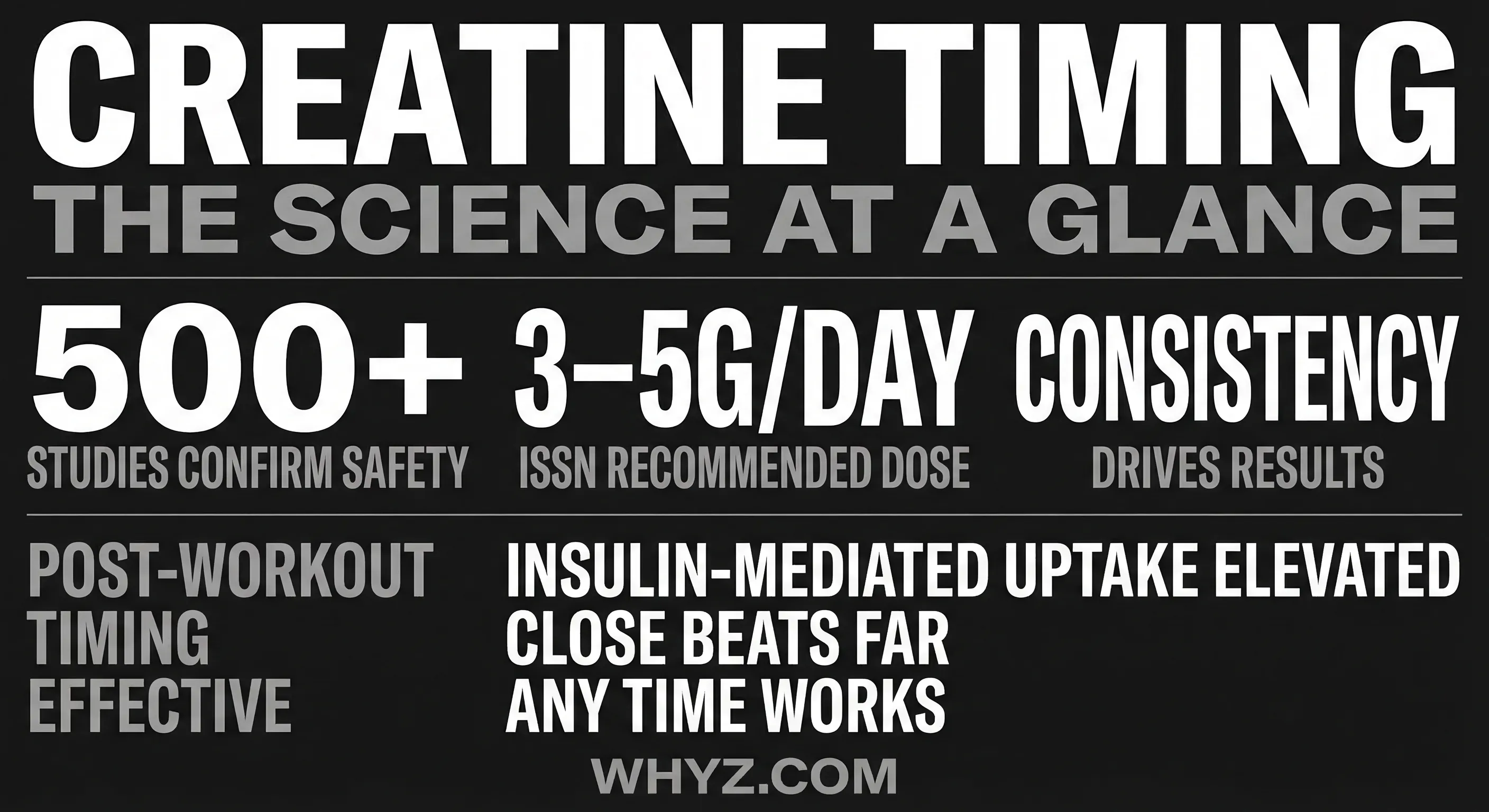
Take creatine after your workout if that is easy, ideally with a meal or shake. Research slightly favors post-workout timing, but the difference is small and daily consistency matters more. If post-workout is inconvenient, taking 3 to 5 g of creatine at any consistent time still saturates muscle stores and produces the main benefits.
The debate over creatine timing has generated more gym-floor arguments than almost any other supplement question. Should you take it before training to boost performance? After, to accelerate recovery? At a set time unrelated to your workout? The research has an answer, though it is more nuanced than the fitness industry usually admits.
How Creatine Works: Why Timing Is Different Than You Think
Creatine does not work like caffeine. Caffeine crosses the blood-brain barrier within 30 to 60 minutes and creates an acute performance effect that demands precise timing. Creatine operates on a fundamentally different timeline.
The mechanism is saturation-based. Creatine monohydrate must accumulate inside muscle cells as phosphocreatine before it produces any performance benefit. This saturation process takes three to four weeks at 3 to 5 g/day, or five to seven days at the higher loading dose of 20 g/day. Once your muscles are saturated, you are essentially topping off the tank daily to maintain that saturation level.
The International Society of Sports Nutrition (ISSN) position stand, the most comprehensive review of creatine evidence published, confirms that the primary driver of creatine’s effectiveness is total daily accumulation, not acute pre-workout timing (PMID: 28615996). You are supplementing to maintain intramuscular stores that are already performing at capacity.
This context matters for interpreting every timing study. When researchers compare pre-workout versus post-workout creatine, they are measuring a relatively small variation around a well-established baseline. The differences, when found, tend to be small.
The Best Direct Evidence: Antonio and Ciccone (2013)
The most frequently cited study on creatine timing was published by Antonio and Ciccone in 2013 in the Journal of the International Society of Sports Nutrition (PMID: 23919405). Nineteen recreational male bodybuilders were randomized to take 5 g of creatine monohydrate either immediately before or immediately after resistance training for four weeks.
The post-workout group showed a trend toward greater lean mass gain and strength improvement. The pre-workout group also improved, but to a lesser degree. The differences were not statistically significant, which means the study cannot conclude with confidence that post-workout is objectively superior — only that it trended in that direction.
This is an honest reading of the data. One small study with 19 subjects showing a non-significant trend does not establish a rule. What it does establish is that taking creatine close to training — whether before or after — appears to be more effective than taking it at a time far removed from exercise.
Nutrient Timing and the Exercise Window
Cribb and Hayes (2006) published research suggesting that combining creatine with protein and carbohydrates close to a training session produced superior results to taking those nutrients far from training (PMID: 16416332). While this study focused on a nutrient stack rather than creatine alone, it reinforced the concept of a peri-workout window where nutrient uptake and muscle signaling are heightened.
The mechanism proposed is insulin-mediated creatine transport. Creatine uptake into muscle cells is enhanced by insulin. Resistance training itself stimulates GLUT4 translocation and increases insulin sensitivity in trained muscle for 30 to 60 minutes post-exercise. Taking creatine immediately after training, when muscle cells are actively recovering and insulin sensitivity is elevated, may support slightly more efficient uptake compared to taking it at rest.
This does not mean you need to choke down creatine the moment you drop your last weight. The insulin sensitivity window extends well beyond the final set. But it does provide a biological basis for the “close to training beats far from training” observation.
What Happens if You Take It Far From Your Workout?
If you prefer to take creatine with breakfast or before bed — far from your training window — the evidence says you will still saturate your muscles and capture the full performance benefit over time. The ISSN confirms this explicitly: daily creatine supplementation at any time of day is effective for maintaining muscle saturation once baseline loading is achieved (PMID: 28615996).
A meta-analysis examining creatine timing effects found that the magnitude of benefit from supplementation was robust across different dosing windows, with the most critical variable being consistency of daily intake rather than the hour of ingestion. The practical implication: missing your post-workout window is not a reason to skip the dose entirely. Taking it later is always better than skipping.
The Real Variable: Consistency Over Months
The evidence for long-term creatine supplementation is overwhelming and does not hinge on timing precision. Rawson and Persky (2007) found that consistent creatine supplementation over 12 weeks produced meaningful improvements in strength and lean mass that dwarfed any potential timing effect observed in four-week studies.
Smith-Ryan et al. (2021) confirmed that lower baseline creatine stores — more common in vegetarians, women, and older adults — predict a larger response to supplementation, regardless of timing protocol (PMID: 33557850). In other words, who is taking creatine and their baseline saturation level matters far more than when they take it on a given day.
The Practical Recommendation
Based on the available evidence, a ranked recommendation looks like this:
First choice: Take creatine immediately after your workout, with your post-workout meal or shake. This aligns with the trend from the Antonio and Ciccone study, takes advantage of elevated post-exercise insulin sensitivity, and fits naturally into post-workout nutrition habits.
Second choice: Take creatine immediately before your workout, 10 to 30 minutes pre-session. Also effective, consistent with research, and convenient for athletes who do not eat post-workout.
Third choice: Take creatine at any consistent daily time, even far from training. Slightly less optimized based on current evidence, but still fully effective for muscle saturation and long-term performance gains.
The key word across all three options is consistent. Creatine taken every day at a suboptimal time will outperform creatine taken at the optimal time on training days only.
Does the Form of Creatine Change Timing Rules?
Creatine HCL and creatine monohydrate have different solubility profiles but similar absorption kinetics. No studies have established that creatine HCL or other forms benefit more specifically from timing precision than monohydrate. The evidence base on timing is almost entirely built on creatine monohydrate studies, and the ISSN recommendation defaults to monohydrate as the evidence standard (PMID: 28615996).
For comparison of monohydrate versus HCL beyond timing, see the creatine monohydrate vs HCL guide.
Does Creatine Timing Matter on Rest Days?
On non-training days, the peri-workout window is irrelevant. Take your maintenance dose with any meal. Taking it with a carbohydrate-containing meal may support uptake via insulin signaling, but the effect size is small on rest days when muscle cells are not in an acutely receptive state.
Some athletes choose to skip creatine entirely on rest days. This is not recommended. The goal is consistent daily saturation. Skipping rest-day doses undermines the steady-state accumulation that drives long-term results.
Creatine and Other Supplements: Stacking Considerations
If you stack creatine with protein, carbohydrates, or a pre-workout containing caffeine, the timing interaction is worth noting. Caffeine and creatine may have slightly antagonistic acute effects at very high caffeine doses, though this is based on older research and not supported by most current evidence. Taking creatine separately from high-dose caffeine (600+ mg) is a reasonable precaution, but standard pre-workout formulas at normal caffeine levels (150 to 300 mg) do not meaningfully interfere with creatine function.
See the WHYZ creatine ingredient page for a full breakdown of mechanisms, safety data, and stacking guidance.
Frequently Asked Questions
Is creatine more effective before or after a workout? The evidence slightly favors post-workout based on one four-week randomized trial, but the difference was not statistically significant. Both windows produce effective results. Consistency of daily intake matters more than the specific timing window.
Can I take creatine on rest days? Yes — and you should. Creatine builds up over days and weeks. Skipping rest-day doses disrupts muscle saturation over time and reduces the long-term benefit.
Should I take creatine with food or on an empty stomach? With food is generally recommended, particularly food containing carbohydrates. Insulin release from carbohydrates enhances creatine transport into muscle cells via the creatine transporter (CrT). On an empty stomach, absorption still occurs but may be slightly slower.
Does creatine timing matter for cognitive benefits? No evidence suggests timing precision affects the cognitive benefits of creatine, which develop over the same multi-week saturation timeline as the physical benefits. Take it consistently; time of day is unlikely to matter for brain creatine stores.
Does creatine expire if I don’t take it around a workout? No. Creatine monohydrate is chemically stable in the body once ingested. Intramuscular phosphocreatine does not degrade meaningfully over hours. There is no “expiry” window for a dose taken at an inconvenient time.
References
- Kreider RB, Kalman DS, Antonio J, et al. (2017). International Society of Sports Nutrition position stand: safety and efficacy of creatine supplementation in exercise, sport, and medicine. J Int Soc Sports Nutr. PMID: 28615996
- Antonio J, Ciccone V. (2013). The effects of pre versus post workout supplementation of creatine monohydrate on body composition and strength. J Int Soc Sports Nutr. PMID: 23919405
- Cribb PJ, Hayes A. (2006). Effects of supplement-timing and resistance exercise on skeletal muscle hypertrophy. Med Sci Sports Exerc. PMID: 16416332
- Smith-Ryan AE, Cabre HE, Eckerson JM, Candow DG. (2021). Creatine supplementation in women’s health: a lifespan perspective. Nutrients. PMID: 33557850