
Creatine monohydrate is one of the most studied supplements on the market, with over 500 peer-reviewed trials spanning 30 years of research. Yet a persistent concern still holds people back from using it: bloating. Roughly 5 to 7 percent of users report gastrointestinal discomfort when beginning creatine, most of it tied to one specific protocol — the high-dose loading phase. The good news is that bloating from creatine is largely avoidable with the right approach, and the puffy, waterlogged look many people fear is a misunderstanding of how creatine actually works inside the body.
Does Creatine Actually Cause Bloating?
Creatine can cause gastrointestinal discomfort in some people, particularly at high doses. The symptoms include nausea, cramping, loose stools, and a feeling of fullness. These are real side effects reported in clinical trials, but they are dose-dependent and not universal. A 2021 review in the Journal of the International Society of Sports Nutrition — which examined common misconceptions about creatine — found that GI complaints at standard maintenance doses (3 to 5 g/day) are rare and typically transient (Antonio et al., 2021).
The distinction matters: GI bloating (nausea, cramping, gas) is different from the visual “puffiness” many people associate with creatine. These are two separate phenomena with different causes. The GI effects are real but manageable. The visual puffiness is largely a myth built on a misunderstanding of where creatine’s water ends up.
Why Does the Loading Phase Make It Worse?
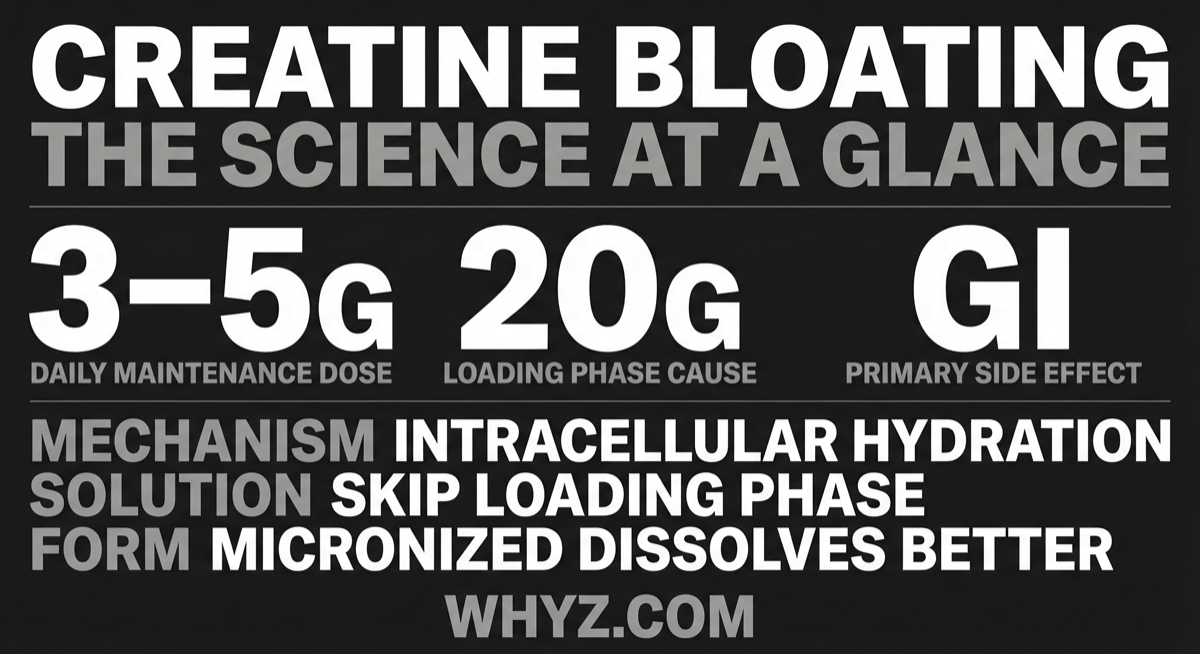
The loading protocol — 20 grams per day split into four 5-gram doses for five to seven days — accelerates muscle saturation but substantially increases GI risk. At 5 grams per dose, creatine is near the threshold where incomplete dissolution in the gut can cause osmotic effects, drawing water into the intestinal lumen and causing loose stools or cramping.
The International Society of Sports Nutrition position stand confirms that loading-phase GI complaints are among the most consistently reported side effects of creatine use, and that they resolve when dose is reduced (Kreider et al., 2017). Critically, the loading phase is optional. Skipping it and using 3 to 5 g/day reaches full muscle saturation within three to four weeks instead of one week. The end result is identical — fully saturated phosphocreatine stores — just without the front-loaded GI stress.
If you are currently on a loading phase and experiencing bloating, reducing to 3 to 5 g/day is the first and most effective fix available.
What Is Really Happening With Creatine and Water Retention?
This is where most of the fear around creatine and bloating originates. Creatine does cause water retention, but the location of that water is what matters.
Creatine draws water into the intracellular space inside muscle cells. This is called intracellular hydration, and it is actually a sign that creatine is working. When muscle cells are more hydrated, they appear fuller, harder, and more voluminous. This is the opposite of the soft, puffy look that people associate with subcutaneous water retention — the water that sits between the skin and the muscle.
Subcutaneous water retention is what makes someone look bloated or “soft.” Creatine does not cause this type of retention in any meaningful way. The 1 to 2 kilograms of water weight gained in the first week or two of creatine use is intramuscular, not subcutaneous. Once phosphocreatine stores are saturated, that water weight stabilizes and does not continue accumulating.
A 2013 review by Trojian and Bateganya confirmed that total body water increases with creatine use reflect intracellular compartment shifts, not generalized fluid retention, and that this distinction is important for understanding creatine’s physical effects (Trojian, 2013). For athletes concerned about aesthetics, this is the key finding: creatine makes muscles look fuller and denser, not bloated and soft.
How to Take Creatine Without Bloating
Five adjustments eliminate most creatine-related GI discomfort for most people.
First, skip the loading phase. There is no clinical evidence that loading produces better long-term outcomes than maintenance dosing alone. Reaching muscle saturation in 28 days instead of 7 days is a reasonable trade for avoiding the GI stress that 20 g/day creates.
Second, take creatine with food. Consuming creatine alongside a meal slows gastric emptying and allows the powder to dissolve more completely before reaching the small intestine. This reduces the osmotic load that causes cramps and loose stools.
Third, split your dose if you do choose to load. If you want the faster saturation timeline, use four 5-gram doses spaced evenly throughout the day rather than two 10-gram doses. Spreading intake reduces the peak concentration in the GI tract at any one time.
Fourth, stay well hydrated. Creatine draws water into muscle cells, which slightly increases total fluid demand. Under-hydration while taking creatine can concentrate the powder in the gut and worsen GI symptoms. Aim for at least 2.5 to 3 liters of water daily when starting creatine supplementation.
Fifth, switch to micronized creatine if standard creatine monohydrate continues to cause issues. Micronized creatine has a smaller particle size and dissolves more completely in water, which may reduce the undigested powder that contributes to osmotic GI effects.
Does Creatine Cause Face Bloating?
This question comes up often on fitness forums and social media, and the short answer is no. Facial puffiness is caused by subcutaneous fluid retention — the kind driven by high sodium intake, alcohol, hormonal shifts (particularly cortisol and estrogen fluctuations), and sleep disruption. Creatine does not cause subcutaneous retention to a meaningful degree.
If someone notices facial puffiness after starting creatine, the more likely culprits are the lifestyle changes that often accompany starting a supplement regimen — changes in training intensity, sleep, diet, and hydration all affect how much subcutaneous water the face holds. Creatine’s water goes into muscle cells, not the face or under the skin.
The ISSN position stand is clear that creatine-associated water retention is compartmentalized to skeletal muscle, not distributed systemically to subcutaneous tissue (Kreider et al., 2017). Face bloating blamed on creatine is almost certainly a coincidental correlation.
Micronized vs Regular Creatine: Does It Matter for Bloating?
Standard creatine monohydrate powder has particle sizes typically in the range of 200 to 400 micrometers. Micronized creatine is processed to reduce particle size to 50 to 100 micrometers or smaller. The practical difference is dissolution speed and completeness.
In water, micronized creatine dissolves faster and more completely than standard monohydrate. Undissolved creatine particles passing through the GI tract are the primary mechanical cause of osmotic GI distress. Reducing particle size reduces the amount of undissolved creatine reaching the intestine at any given time.
A 2025 comparative study evaluating micronized creatine monohydrate found that the micronized form showed improved absorption and safety profile compared to standard creatine monohydrate in healthy male adults, with the tolerability advantage being most notable in participants who had previously reported GI sensitivity to standard monohydrate (Verma et al., 2025). If you have tried standard monohydrate and experienced bloating despite using maintenance dosing, micronized is a worthwhile switch.
Both forms have identical effectiveness at equivalent doses. The only practical difference is GI tolerability, and micronized wins on that measure for sensitive users. For more on forms and what the evidence shows, see the WHYZ creatine ingredient page.
Bottom Line
Creatine bloating is real but avoidable. The loading phase is the main driver of GI distress, not creatine itself at maintenance doses. The water weight associated with creatine goes into muscle cells, not subcutaneous tissue, so it does not cause the puffiness that many users fear. Skipping the loading phase, taking creatine with food, staying hydrated, and switching to micronized creatine if needed will eliminate bloating for most people. The research is clear that 3 to 5 g/day is safe, effective, and well-tolerated long term.
Frequently Asked Questions
Does creatine cause bloating? At standard maintenance doses (3 to 5 g/day), creatine causes bloating in a small minority of users. The loading phase (20 g/day) is far more likely to cause GI discomfort including cramping, nausea, and loose stools. Skipping the loading phase eliminates most creatine-related bloating.
How long does creatine bloating last? GI discomfort during a loading phase typically resolves within the first week as the gut adapts. If bloating persists beyond two weeks at maintenance doses, consider switching to micronized creatine, taking it with food, or spreading your daily dose across two smaller servings.
Does creatine cause water retention and a puffy look? Creatine draws water into muscle cells (intracellular hydration), not under the skin (subcutaneous retention). Muscles appear fuller and harder, not soft or puffy. Initial water weight of 1 to 2 kg stabilizes within two weeks and does not continue accumulating.
Is micronized creatine better for avoiding bloating? For users who experience GI distress on standard creatine monohydrate, micronized creatine’s smaller particle size dissolves more completely and may reduce osmotic GI effects. Both forms are equally effective; the difference is tolerability for sensitive users.
Can I take creatine on an empty stomach? Yes, but taking it with food reduces GI symptoms for most people. Food slows gastric emptying and allows creatine to dissolve more fully before reaching the intestine. If you are sensitive to creatine on an empty stomach, shift your dose to a meal.
References
- Antonio J, Candow DG, Forbes SC, et al. (2021). Common questions and misconceptions about creatine supplementation: what does the scientific evidence really show? J Int Soc Sports Nutr. PMID: 33557850
- Kreider RB, Kalman DS, Antonio J, et al. (2017). International Society of Sports Nutrition position stand: safety and efficacy of creatine supplementation in exercise, sport, and medicine. J Int Soc Sports Nutr. PMID: 28615996
- Trojian TH, Bateganya MH. (2013). Creatine supplementation. Curr Sports Med Rep. PMID: 23851411
- Verma MK, et al. (2025). Enhanced Absorption and Safety of MuscleBlaze CreAMP: A Comparative Analysis With Regular Micronized Creatine Monohydrate in Healthy Male Adults. Cureus. PMID: 40182172