
Creatine is the most studied sports supplement in history, with over 500 peer-reviewed trials. Yet the majority of that research was conducted in men. The assumption that creatine is “a guy’s supplement” persists in fitness culture despite growing evidence that women may benefit from it in unique and significant ways. Below is a complete breakdown of what the research shows about creatine supplementation for women.
Why Creatine Is Not Just for Men
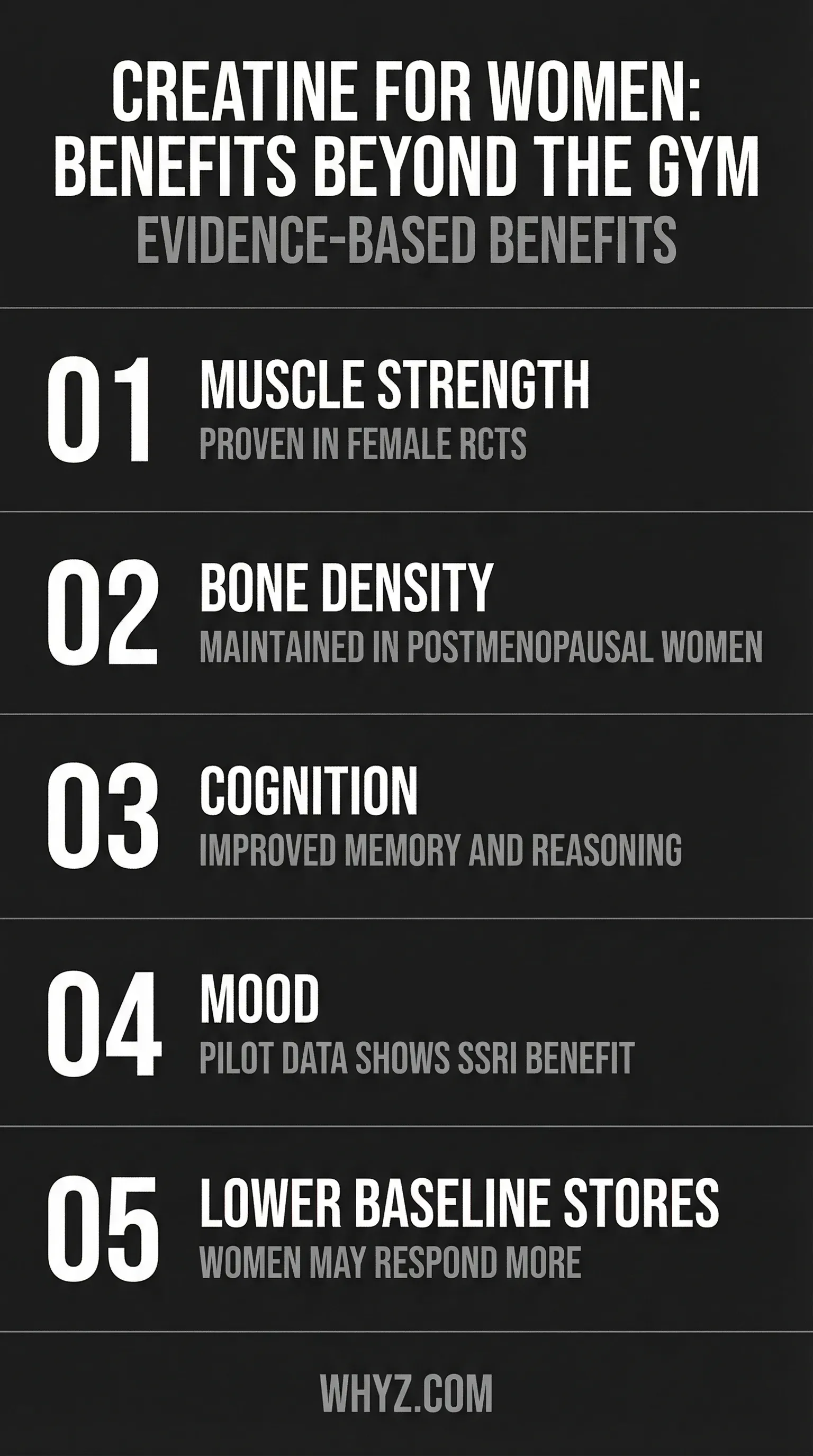
Women have approximately 70 to 80% lower endogenous creatine stores than men, driven by lower dietary intake (less red meat on average) and differences in muscle mass distribution (Smith-Ryan et al., 2021; PMID: 33557850). This lower baseline means women may experience a proportionally larger response to supplementation because the gap between current stores and saturation is wider.
The International Society of Sports Nutrition position stand on creatine (Kreider et al., 2017) makes no distinction between male and female dosing recommendations, confirming that 3 to 5 grams of creatine monohydrate daily is effective and safe regardless of sex (PMID: 28615996).
Muscle Strength and Exercise Performance
The performance benefits of creatine for women are well-supported. A 2022 systematic review by Forbes and Candow examined female-specific creatine trials and found consistent improvements in upper-body and lower-body strength when creatine was combined with resistance training (PMID: 35885899). Effect sizes tend to be smaller than in men, which researchers attribute to differences in baseline muscle mass and training history rather than a reduced biological response to creatine.
Creatine works by increasing intramuscular phosphocreatine stores, allowing faster ATP regeneration during high-intensity efforts. This mechanism is identical in men and women. The practical result: more reps at a given weight, faster recovery between sets, and greater total training volume over time.
Bone Density and Postmenopausal Health
One of the most compelling areas of creatine research for women involves bone health after menopause. Estrogen decline during menopause accelerates bone mineral density loss, increasing fracture risk.
Chilibeck et al. (2015) conducted a 12-month randomized controlled trial in postmenopausal women combining creatine supplementation with resistance training. The creatine group maintained bone mineral density at the hip while the placebo group experienced significant bone loss (PMID: 25293435). A follow-up analysis confirmed these findings were sustained across the full study period.
The proposed mechanism involves creatine’s role in osteoblast energy metabolism. Bone-forming cells (osteoblasts) require ATP for mineralization, and creatine enhances intracellular energy availability. This is an active area of research with growing interest from osteoporosis prevention investigators.
Cognitive Function and Brain Health
Creatine is not only stored in muscle. The brain accounts for roughly 20% of daily energy expenditure and relies heavily on phosphocreatine for ATP regeneration during demanding tasks. Women may benefit disproportionately from brain creatine supplementation because of their lower baseline stores.
Avgerinos et al. (2018) conducted a systematic review and meta-analysis showing that creatine supplementation improved short-term memory and reasoning ability, with effects strongest under conditions of stress or sleep deprivation (PMID: 29704637). Rae et al. (2003) found particularly strong cognitive benefits in vegetarians, a group that skews female and has especially low dietary creatine intake (PMID: 14561278).
A 2023 meta-analysis by Prokopidis et al. confirmed that creatine improves memory performance across healthy adults of all ages, with no sex-based exclusion of benefit (PMID: 35984306).
Does Creatine Cause Weight Gain or Bloating in Women?
This is the most common concern women raise about creatine. The answer requires nuance.
Creatine increases intracellular water content in muscle cells. This is a cellular-level effect that supports muscle function, not subcutaneous water retention that causes visible bloating. The distinction matters. Creatine draws water into the muscle cell, not under the skin.
During the first one to two weeks of supplementation, scale weight may increase by 0.5 to 1.5 kg (1 to 3 pounds). This reflects increased muscle hydration, not fat gain. Most women using a standard 3 to 5 g/day dose (no loading phase) report no perceptible bloating after the initial adaptation period.
The loading protocol (20 g/day for five to seven days) produces more noticeable water retention and is unnecessary. Starting at 3 to 5 g/day reaches saturation within three to four weeks without the gastrointestinal discomfort or water weight spike associated with loading.
Mood, Depression, and Mental Health
Emerging research suggests creatine may have antidepressant properties, with particular relevance for women. Kious et al. (2019) reviewed the neurobiological rationale for creatine as an adjunct treatment for depression and found preliminary evidence supporting its use, noting that brain creatine metabolism differs between sexes (PMID: 31450297).
A small pilot study by Lyoo et al. (2012) found that adding 5 g/day of creatine to SSRI treatment accelerated response in women with major depressive disorder, with significant improvement as early as two weeks compared to SSRI plus placebo (PMID: 22864465).
These findings are preliminary. Creatine is not a treatment for depression, and anyone managing a mood disorder should work with a healthcare provider. But the signal is strong enough that larger trials are underway.
Dosing for Women
The ISSN recommends the same creatine dose for women as for men: 3 to 5 grams of creatine monohydrate per day (PMID: 28615996). No study has found that women need a different dose based on sex alone.
Body weight can inform dose selection within this range. Women under 55 kg (121 lbs) may find 3 g/day sufficient. Women over 70 kg (154 lbs) or those engaged in heavy resistance training may benefit from 5 g/day.
Timing is flexible. Creatine builds up over days and weeks; the time of day you take it does not affect saturation. Taking it with a meal may improve absorption slightly due to insulin-mediated creatine uptake, but the practical difference is small.
Cycling is unnecessary. There is no evidence that cycling on and off creatine provides any advantage. Continuous daily use maintains muscle saturation and supports consistent benefits.
Creatine and Pregnancy
Animal studies suggest creatine may protect developing brains during oxygen deprivation events, and some researchers have proposed it as a potential neuroprotective agent for complicated pregnancies (Dickinson et al., 2014; PMID: 24505395). Human clinical trials are now underway in Australia (the CRADLE trial).
At this time, creatine is not recommended during pregnancy by any major medical organization. The preclinical data is promising, but human safety and efficacy data is insufficient for a formal recommendation. Pregnant women should consult their OB-GYN before starting any new supplement.
Creatine and PCOS
Polycystic ovary syndrome (PCOS) involves insulin resistance, hormonal disruption, and metabolic dysfunction. Creatine’s potential insulin-sensitizing effects and cognitive benefits may be relevant for women with PCOS, though no clinical trial has specifically studied creatine in this population.
Women with PCOS who are interested in creatine may also benefit from inositol supplementation, which has stronger clinical evidence for PCOS management.
Frequently Asked Questions
Is there a “best creatine for women”? No. Creatine monohydrate is the most studied and most cost-effective form for everyone, regardless of sex. Products marketed specifically “for women” are the same compound with different packaging and a higher price.
Will creatine make me look bulky? No. Creatine supports strength and lean muscle development, but it does not cause dramatic muscle hypertrophy without heavy resistance training and caloric surplus. The amount of muscle gained from creatine supplementation in women is modest and typically described as “toned” rather than “bulky.”
Can I take creatine if I’m on birth control? Yes. No interaction between creatine and hormonal contraceptives has been identified in clinical research.
Does creatine affect the menstrual cycle? No study has demonstrated an effect of creatine supplementation on menstrual cycle regularity, duration, or symptoms.
How long until I notice results from creatine? At 3 to 5 g/day without a loading phase, muscle creatine stores reach saturation in approximately three to four weeks. Strength improvements typically become noticeable within four to eight weeks when combined with resistance training.
References
- Smith-Ryan AE, Cabre HE, Eckerson JM, Candow DG. (2021). Creatine supplementation in women’s health: a lifespan perspective. Nutrients. PMID: 33557850
- Kreider RB, Kalman DS, Antonio J, et al. (2017). ISSN position stand: safety and efficacy of creatine supplementation. J Int Soc Sports Nutr. PMID: 28615996
- Forbes SC, Candow DG. (2022). Creatine supplementation in females: a review of the current literature. Nutrients. PMID: 35885899
- Chilibeck PD, Candow DG, Landeryou T, Kaviani M, Paus-Jenssen L. (2015). Effects of creatine and resistance training on bone health in postmenopausal women. Med Sci Sports Exerc. PMID: 25293435
- Avgerinos KI, Spyrou N, Bougioukas KI, Kapogiannis D. (2018). Effects of creatine supplementation on cognitive function. Exp Gerontol. PMID: 29704637
- Rae C, Digney AL, McEwan SR, Bates TC. (2003). Oral creatine monohydrate supplementation improves brain performance. Proc R Soc B. PMID: 14561278
- Prokopidis K, Giannos P, Troebs M, et al. (2023). Effects of creatine supplementation on memory in healthy individuals. Nutr Rev. PMID: 35984306
- Kious BM, Kondo DG, Renshaw PF. (2019). Creatine for the treatment of depression. Biomolecules. PMID: 31450297
- Lyoo IK, Yoon S, Kim TS, et al. (2012). Creatine augmentation of SSRI in treatment-resistant depression. Am J Psychiatry. PMID: 22864465
- Dickinson H, Bain E, Wilkinson D, Middleton P, Crowther CA, Walker DW. (2014). Creatine for women in pregnancy for neuroprotection of the fetus. Cochrane Database Syst Rev. PMID: 24505395