
The idea that creatine causes hair loss has spread through fitness forums, Reddit threads, and TikTok videos for over 15 years. It originates from a single study published in 2009 that measured a hormone called DHT. That study did not measure hair loss. No study has. Separating these two facts is the starting point for understanding this topic.
Does Creatine Cause Hair Loss?
No clinical trial has documented hair loss as an outcome of creatine supplementation. The International Society of Sports Nutrition reviewed over 500 studies on creatine and found no evidence linking it to hair loss (PMID: 28615996). The concern traces back to a single biomarker finding in a 2009 trial that has not been consistently replicated.
What Did the 2009 Van der Merwe Study Actually Find?
Van der Merwe and colleagues recruited 20 male college rugby players in South Africa and gave them creatine monohydrate: 25 g/day for seven days (loading phase), then 5 g/day for 14 days (maintenance phase) (PMID: 19741313). They measured testosterone and dihydrotestosterone (DHT) at baseline and at the end of each phase.
Three findings emerged. First, DHT levels rose approximately 56% during the loading phase. Second, DHT remained roughly 40% above baseline during maintenance. Third, the ratio of DHT to testosterone increased significantly.
The researchers concluded creatine might increase conversion of testosterone to DHT. They did not claim creatine caused hair loss. No participant reported hair changes. No scalp assessments, hair counts, or follicle evaluations were performed.
How DHT Connects to Hair Loss
DHT (dihydrotestosterone) is an androgen produced from testosterone by the enzyme 5-alpha reductase. In hair follicles on the scalp, DHT binds to androgen receptors and, over years, shrinks the follicle in a process called miniaturization. This is the mechanism behind androgenetic alopecia, commonly known as male pattern baldness.
The critical variable is genetics. Not everyone’s follicles respond to DHT the same way. The AR gene on the X chromosome controls androgen receptor sensitivity in scalp tissue. Men who inherit high-sensitivity variants lose hair when DHT levels rise. Men without these variants can have elevated DHT for decades with no noticeable hair change (PMID: 11555962).
This means even if creatine did reliably increase DHT, only individuals with specific genetic susceptibility would face any risk.
Why One Study Does Not Settle This Question
The van der Merwe study has five structural limitations that prevent it from establishing a causal link between creatine and hair loss.
Sample size was 20 participants. Statistical power to detect hormonal changes in 20 young men is marginal. Outliers in small samples can drive group averages substantially.
Duration was three weeks. Androgenetic alopecia progresses over months to years. A three-week snapshot of hormone levels cannot predict long-term hair outcomes.
No hair loss was measured. The study tracked a biomarker (DHT), not a clinical outcome (hair loss). Elevated DHT is a risk factor for hair loss in genetically susceptible individuals, not a guarantee of it.
The loading dose was five times the standard dose. Participants took 25 g/day during loading. Most long-term users take 3 to 5 g/day. Whether standard doses produce the same DHT response is unknown.
The finding has not been consistently replicated. A 2021 systematic review and meta-analysis by Luo et al. examined 22 creatine trials measuring testosterone and DHT. The pooled analysis found no statistically significant effect of creatine on either hormone (PMID: 34370845).
What the Broader Evidence Shows
The creatine research base is one of the largest for any supplement. Over 500 peer-reviewed studies have examined creatine supplementation across populations ranging from elite athletes to elderly adults.
First, the 2021 meta-analysis by Luo et al. pooled data from 22 studies and found no significant changes in testosterone, free testosterone, or DHT from creatine supplementation (PMID: 34370845). This is the most comprehensive hormonal analysis to date and directly challenges the 2009 finding.
Second, the ISSN position stand (Kreider et al., 2017) reviewed the entire creatine safety literature and identified no hormonal disruptions or adverse reproductive effects across short- and long-term studies (PMID: 28615996).
Third, long-term safety studies spanning up to five years have not reported hair loss as a side effect in any population studied. The most commonly reported side effects are mild gastrointestinal discomfort and transient water retention, both of which resolve with continued use or dose adjustment.
Who Might Want to Be Cautious
If you are experiencing active androgenetic alopecia and already taking steps to manage it (finasteride, minoxidil, or similar), the theoretical concern about DHT is reasonable to acknowledge. The evidence does not confirm it, but incomplete evidence is not the same as disproven risk.
If you have no personal or family history of male pattern baldness, the published data provides no basis for concern about creatine and hair.
If hair preservation is a primary goal, the interventions with strong clinical evidence are finasteride (a 5-alpha reductase inhibitor that directly reduces DHT at the follicle), minoxidil (a vasodilator that extends the hair growth phase), and early intervention. These have evidence bases orders of magnitude stronger than any creatine-hair hypothesis.
The Bottom Line
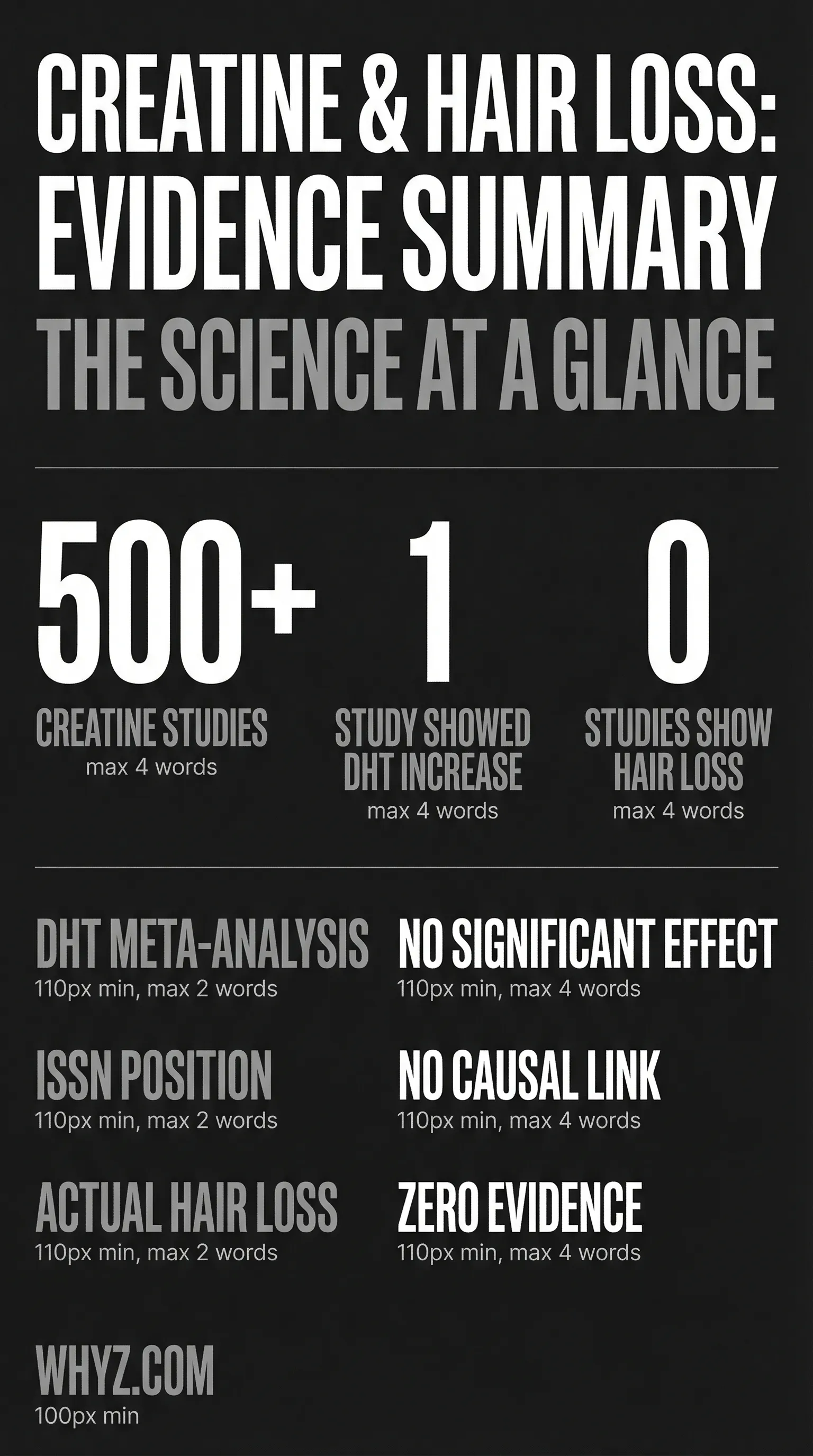
One study of 20 rugby players found a transient increase in DHT after a high-dose creatine protocol. That finding has not held up in pooled analyses of 22 subsequent trials. No study has ever measured actual hair loss from creatine supplementation. The theoretical pathway from creatine to DHT to follicle miniaturization requires multiple unconfirmed links and depends entirely on individual genetics.
Creatine monohydrate remains one of the most effective and most studied supplements available for strength, performance, and cognitive function. The hair loss concern, while understandable, is not supported by the weight of current evidence.
Frequently Asked Questions
Does creatine increase DHT? One 2009 study found a 56% increase in DHT during a high-dose loading phase. A 2021 meta-analysis of 22 studies found no statistically significant effect on DHT from creatine supplementation.
Has anyone lost hair from creatine in a clinical trial? No. Zero clinical trials have measured or documented hair loss as an outcome of creatine supplementation.
Should I stop taking creatine if I’m losing hair? If you are losing hair, the cause is almost certainly genetic (androgenetic alopecia) or related to stress, nutrition, or hormonal factors unrelated to creatine. Consult a dermatologist for evidence-based treatment options like finasteride or minoxidil.
Does the type of creatine matter for DHT? The 2009 study used creatine monohydrate. No studies have compared different creatine forms (HCL, buffered, etc.) for hormonal effects. There is no reason to expect different forms would behave differently regarding DHT.
Is creatine safe long-term? The ISSN classifies creatine monohydrate as safe for long-term use based on studies lasting up to five years, with no clinically significant adverse effects on hormonal, renal, or hepatic function (PMID: 28615996).
References
- van der Merwe J, Brooks NE,”; KM. (2009). Three weeks of creatine monohydrate supplementation affects dihydrotestosterone to testosterone ratio in college-aged rugby players. Clin J Sport Med. PMID: 19741313
- Kreider RB, Kalman DS, Antonio J, et al. (2017). International Society of Sports Nutrition position stand: safety and efficacy of creatine supplementation in exercise, sport, and medicine. J Int Soc Sports Nutr. PMID: 28615996
- Luo Y, Trevino CL, McCabe SE, et al. (2021). Impact of creatine supplementation on androgen levels: a systematic review and meta-analysis. Complement Ther Med. PMID: 34370845
- Bhasin S, Woodhouse L, Casaburi R, et al. (2001). Testosterone dose-response relationships in healthy young men. Am J Physiol Endocrinol Metab. PMID: 11555962