
Creatine causes water retention. That part is true. What most people get wrong is where the water goes and what that actually means for how you look and perform.
The word “water retention” carries baggage from dieting culture, where it usually refers to puffy ankles, bloated midsection, or visible swelling beneath the skin. Creatine’s water retention is fundamentally different. Understanding the distinction turns a concern into a feature.
How Does Creatine Cause Water Retention?
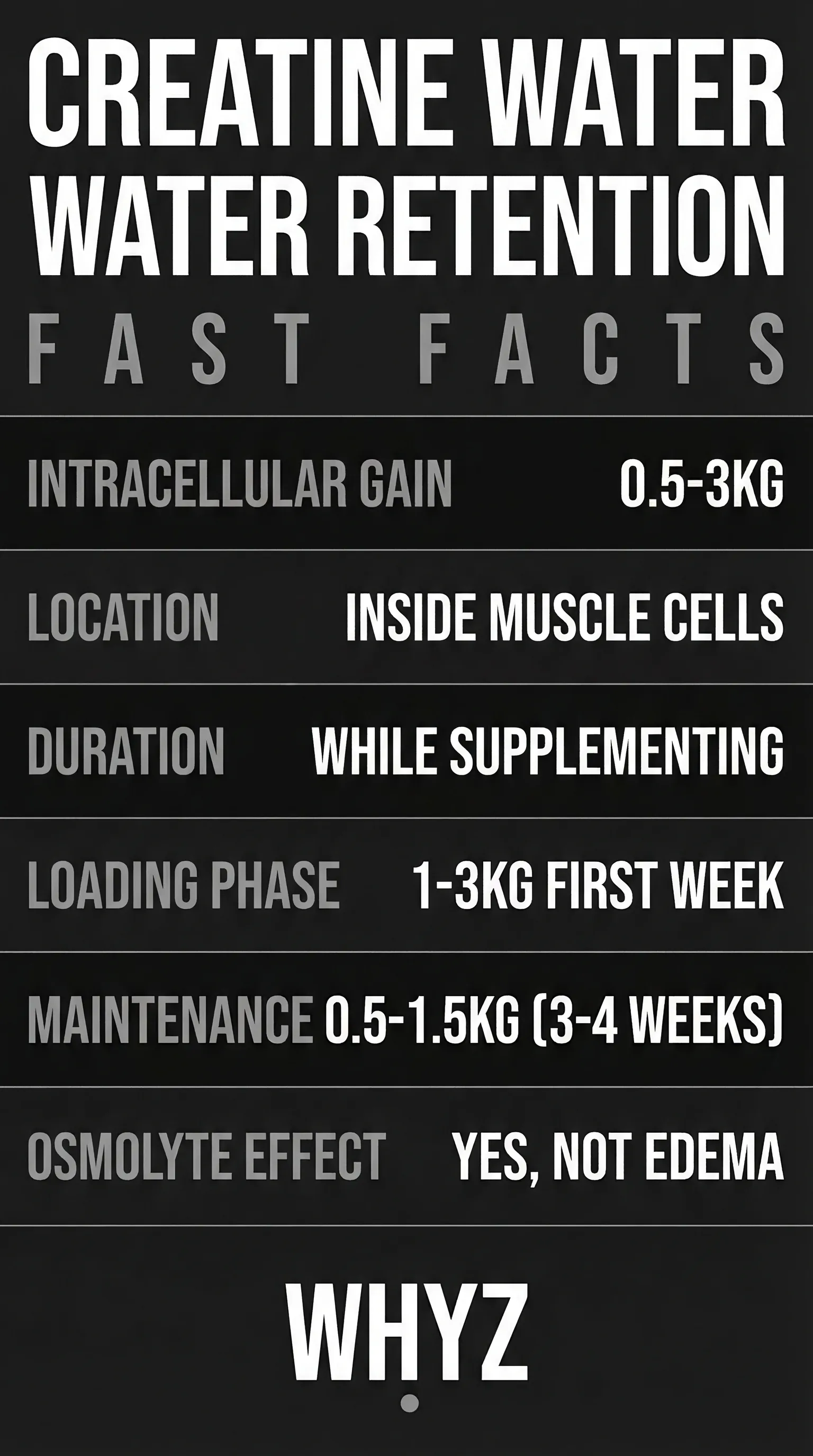
Creatine is an osmolyte. This means it draws water into whatever compartment it occupies. When creatine is taken orally and absorbed into muscle tissue, it pulls water into the muscle cell itself — intracellular fluid, not subcutaneous fluid under the skin.
The International Society of Sports Nutrition position stand, which reviewed over 500 creatine studies, confirms that creatine supplementation increases total body water primarily through increases in intracellular fluid content (Kreider et al., 2017). This is the key distinction: the water ends up inside muscle cells, not between your skin and muscle.
The mechanism is driven by osmolality. When muscle creatine concentrations rise, the intracellular environment becomes more concentrated relative to surrounding fluids. Water follows the osmotic gradient inward, hydrating the cell from within.
How Much Water Weight Does Creatine Add?
During a loading phase — typically 20 grams per day for five to seven days — body weight commonly increases by 1 to 3 kilograms. Research on both men and women has documented this rapid initial weight gain at the start of supplementation (Vandenberghe et al., 1997).
At a standard maintenance dose of 3 to 5 grams per day without a loading phase, the weight gain accumulates more gradually and tends to be smaller in magnitude — often 0.5 to 1.5 kilograms over three to four weeks as muscle creatine stores reach saturation.
This weight is real. It shows up on the scale. But it is not fat, and it is not the subcutaneous puffiness associated with excess sodium or hormonal fluid shifts. The additional grams of water sit inside muscle cells.
Is Creatine Water Retention the Same as Bloating?
No. These are two distinct phenomena that often get conflated.
Intracellular water retention is the normal physiological consequence of creatine’s osmotic action inside muscle cells. It is responsible for the scale weight increase and may contribute to fuller-looking muscles. It does not cause visible puffiness or GI discomfort.
Gastrointestinal bloating is a separate issue that some users experience, primarily during the loading phase, when large doses of undissolved creatine cause osmotic effects in the gut. This feels like nausea, cramping, or a bloated stomach — and it resolves when dose is reduced. The GI issue and the intracellular water issue are related only in that both involve water and creatine; mechanically, they are completely different.
Does Creatine Cause Subcutaneous Water Retention?
The evidence does not support this. Multiple body composition studies using dual-energy X-ray absorptiometry and multi-compartment modeling have found that creatine’s water increase is intracellular. One frequently cited meta-analysis examining creatine’s effects on body composition and performance found that the weight gained during supplementation was attributable to lean mass and fluid, not subcutaneous fat or extracellular water accumulation (Rawson and Volek, 2003).
The “puffy” look sometimes associated with creatine is not supported by the physiology. If anything, fuller muscle cells can give a more toned appearance in individuals with low body fat. The subcutaneous bloat narrative appears to persist because people observe scale weight going up and assume visible swelling must follow.
Will You Look Puffy or Bloated After Starting Creatine?
Most users will not. The scale weight increase is real, but your visual appearance is determined largely by subcutaneous fat and skin thickness — not by intracellular muscle water.
For lean individuals, the increase in intracellular water can make muscles appear slightly fuller. For individuals carrying more body fat, the intracellular change will not be visible through the subcutaneous layer regardless. In neither case does the physiology produce the puffy, waterlogged appearance that the misconception describes.
Does the Water Retention Go Away If You Stop Taking Creatine?
Yes. Creatine must be taken continuously to maintain elevated muscle phosphocreatine stores. When supplementation stops, muscle creatine concentrations decline over approximately four to six weeks, and the associated intracellular fluid follows. The scale weight gained during supplementation will return toward baseline as creatine washes out.
This is sometimes framed negatively — as if creatine’s benefits disappear the moment you stop. Accurately stated: the water component disappears, but any actual muscle mass built during the supplementation period (through training) remains. The strength and mass gains earned during creatine use are not lost when you discontinue.
Does Creatine Cause Subcutaneous Edema?
Edema, or pathological fluid accumulation in interstitial spaces, is not a documented side effect of creatine supplementation in healthy individuals. The ISSN position stand, after reviewing the full body of creatine research, identifies no credible evidence linking creatine supplementation to edema in healthy populations (Kreider et al., 2017).
Edema has real causes — heart failure, kidney disease, liver disease, certain medications — and creatine is not among them in the research record.
How Does Intracellular Hydration Affect Performance?
This is where the water retention story shifts from neutral to positive. Cell hydration is not just a cosmetic byproduct; it is mechanistically linked to protein synthesis and muscle function.
Well-hydrated muscle cells maintain optimal conditions for the enzymatic reactions involved in energy production and recovery. The increased intracellular water from creatine may itself contribute to performance benefits beyond phosphocreatine resynthesis. Research has also shown that creatine supplementation prior to carbohydrate loading enhances muscle glycogen supercompensation, and this interaction involves the osmotic properties of creatine within muscle tissue (Op ‘t Eijnde et al., 2001).
The water is not just passive freight. It is part of the cellular environment in which the real performance work happens.
Loading Phase vs. No-Load: Does It Change Water Retention?
The loading phase saturates muscle creatine stores faster, and it also produces a faster and larger initial weight gain. Most of the 1 to 3 kg increase documented in loading studies occurs in the first week.
Skipping the loading phase and using 3 to 5 g/day produces the same eventual muscle saturation — it just takes longer (three to four weeks instead of one). The water retention is the same at saturation; it simply accumulates more gradually. For anyone concerned about rapid scale weight increases or GI discomfort during loading, the no-load approach reaches an identical endpoint with fewer side effects along the way.
Creatine and Water Retention in Women
Research specifically examining creatine in women shows similar mechanisms with somewhat different magnitudes. A landmark study by Vandenberghe and colleagues found that female subjects on creatine supplementation gained body weight consistent with increased water and lean mass during resistance training, while achieving significantly greater strength gains than placebo (Vandenberghe et al., 1997).
The water retention mechanism is the same across sexes, but women may show a smaller absolute weight increase due to lower baseline muscle mass and creatine stores. The functional benefits — improved performance, accelerated recovery, potential cognitive and bone health effects — are well-supported in women by the existing literature.
How to Minimize Unwanted Water Weight From Creatine
If scale weight increase is a concern — common for athletes competing in weight-class sports — there are practical strategies:
Skip the loading phase. Using 3 to 5 g/day without loading produces a slower, smaller initial weight increase while reaching full saturation within a month.
Time supplementation strategically. If you have a competition or weigh-in, it is possible to temporarily discontinue creatine three to four weeks before the event to allow creatine stores and associated water to normalize.
Stay consistently hydrated. This sounds counterintuitive, but adequate hydration supports optimal creatine uptake and reduces the likelihood of GI complaints.
Dissolve it fully. Taking creatine dissolved in warm water and consuming adequate fluid afterward reduces undissolved creatine reaching the gut, which is the primary driver of GI-related bloating.
The Bottom Line
Creatine causes water retention by drawing water into muscle cells. The scale weight increase is real — typically 0.5 to 3 kilograms depending on the protocol — but the water is intracellular, not subcutaneous. It does not produce visible puffiness or edema.
The intracellular hydration associated with creatine is a normal feature of how the supplement works. It may itself contribute to the performance benefits creatine is known for. The concern about water retention is understandable, but it is built on a conflation of intracellular muscle hydration with the subcutaneous bloating associated with other causes entirely.
If you are gaining weight on creatine and feeling discouraged about it, the scale is reflecting muscle hydration, not fat, not edema, and not anything that will persist once you build the training adaptations that creatine makes possible.
References
- Kreider RB, et al. International Society of Sports Nutrition position stand: safety and efficacy of creatine supplementation in exercise, sport, and medicine. J Int Soc Sports Nutr. 2017;14:18. PMID: 28615996
- Vandenberghe K, et al. Long-term creatine intake is beneficial to muscle performance during resistance training. J Appl Physiol. 1997;83(6):2055-63. PMID: 9390981
- Rawson ES, Volek JS. Effects of creatine supplementation and resistance training on muscle strength and weightlifting performance. J Strength Cond Res. 2003;17(4):822-31. PMID: 14636102
- Op ‘t Eijnde B, et al. Muscle glycogen supercompensation is enhanced by prior creatine supplementation. J Physiol. 2001;537(Pt 1):295-301. PMID: 11445755
- Earnest CP, et al. Effect of creatine supplementation on body composition and performance: a meta-analysis. Int J Sport Nutr Exerc Metab. 2003;13(2):198-226. PMID: 12945830