
Cutting — the process of reducing body fat while preserving as much muscle mass as possible — is one of the most demanding phases in any body composition program. Caloric restriction creates a catabolic environment that threatens both muscle tissue and strength output. Many athletes wonder whether creatine supplementation belongs in a cutting phase or whether the associated water retention undermines the goal of looking leaner. The research provides a clear answer.
The Core Problem with Cutting: Muscle Loss
When calories drop below maintenance, the body does not exclusively burn fat. It draws on protein stores in muscle tissue as well, particularly during high-intensity exercise when glycolytic demand outpaces fat oxidation. This is why bodybuilders, physique athletes, and anyone dieting while training resistively wrestle with the muscle-preservation problem throughout a cut.
Muscle loss during a deficit is accelerated by two primary factors. First, reduced caloric intake lowers the energy available for ATP regeneration during resistance training. Second, lower training volume and intensity — both common consequences of fatigue from dieting — reduce the anabolic stimulus that keeps muscle mass signaled for retention.
Creatine addresses both factors directly.
How Creatine Helps During a Caloric Deficit
Creatine’s mechanism during a cut is the same as at any other time. By increasing intramuscular phosphocreatine stores, creatine extends the capacity for rapid ATP regeneration during high-intensity efforts. This means you can maintain training intensity — the primary driver of the anabolic signal that preserves muscle — even when overall caloric intake is reduced.
The International Society of Sports Nutrition position stand confirms that creatine monohydrate increases total work output across short, intense bouts of exercise and supports greater lean mass retention in conditions of muscular stress (PMID: 28615996). A deficit is precisely that kind of condition.
A 2017 systematic review and meta-analysis by Lanhers et al. pooled data across multiple resistance training trials and found creatine supplementation produced statistically significant improvements in upper-body strength compared to placebo (PMID: 26828112). Strength preservation during a cut directly supports the neural and mechanical stimulus required to maintain muscle tissue when calories are restricted.
Does Creatine Cause Visible Bloating During a Cut?
This is the most common reason athletes drop creatine when dieting: fear of looking waterlogged. The concern is understandable but conflates two different types of water retention.
Creatine draws water into the intracellular space inside muscle cells. This is cellular hydration — it makes muscle tissue fuller and more voluminous. It is not subcutaneous water retention, which sits between the skin and the muscle and creates the soft, blurry appearance athletes try to eliminate during a cut.
The distinction matters aesthetically. Intracellular water from creatine makes muscles look larger and harder, not softer and bloated. Athletes who understand this often find their physique looks better on creatine during a cut, not worse — fuller muscles against a leaner frame creates more visual definition.
The initial water weight associated with creatine — typically 0.5 to 1.5 kg in the first one to two weeks — reflects increased muscle hydration. Once saturation stabilizes, scale weight from creatine holds steady. During a cut where fat loss is producing ongoing scale drops of 0.25 to 0.5 kg per week, the creatine water weight is a one-time adjustment, not a continuous accumulation.
Creatine and Muscle Mass Preservation: What the Trials Show
Antonio and Ciccone (2013) found that creatine monohydrate supplementation during a four-week resistance training program produced measurable improvements in lean body mass (PMID: 23919405). While this study was not explicitly a cutting study, it demonstrates creatine’s lean mass-sparing properties in a resistance training context.
More directly relevant are studies examining creatine during energy restriction in older adults. This population is highly susceptible to muscle loss during caloric deficits and serves as a high-sensitivity model for the muscle preservation question. Multiple trials have shown creatine supplementation combined with resistance training preserves fat-free mass in older adults undergoing caloric restriction, with effect sizes that are meaningful relative to placebo.
The Forbes and Candow (2022) systematic review, which examined sex-specific creatine evidence, confirmed that body composition improvements from creatine are robust across populations and not dependent on a caloric surplus (PMID: 35885899). Creatine supports muscle retention whether calories are at maintenance or below it.
Strength Preservation: The Key Downstream Benefit
Muscle mass follows the training signal. If your training intensity deteriorates during a cut — fewer reps at the same weight, skipped sessions due to fatigue, reduced total volume — the anabolic signal for muscle retention weakens and catabolism accelerates.
Creatine combats performance deterioration during a deficit by maintaining phosphocreatine availability for high-intensity work. Athletes who maintain their training intensity through a cut preserve more muscle than those who allow intensity to drop, regardless of protein intake and other factors. Creatine’s role in sustaining that intensity is one of its most practical benefits during a cutting phase.
A well-run cut with creatine supplementation allows you to train at roughly the same intensity you were achieving before the deficit. A cut without creatine often produces a gradual decline in training quality as glycolytic capacity is compromised by reduced caloric intake and lower carbohydrate availability.
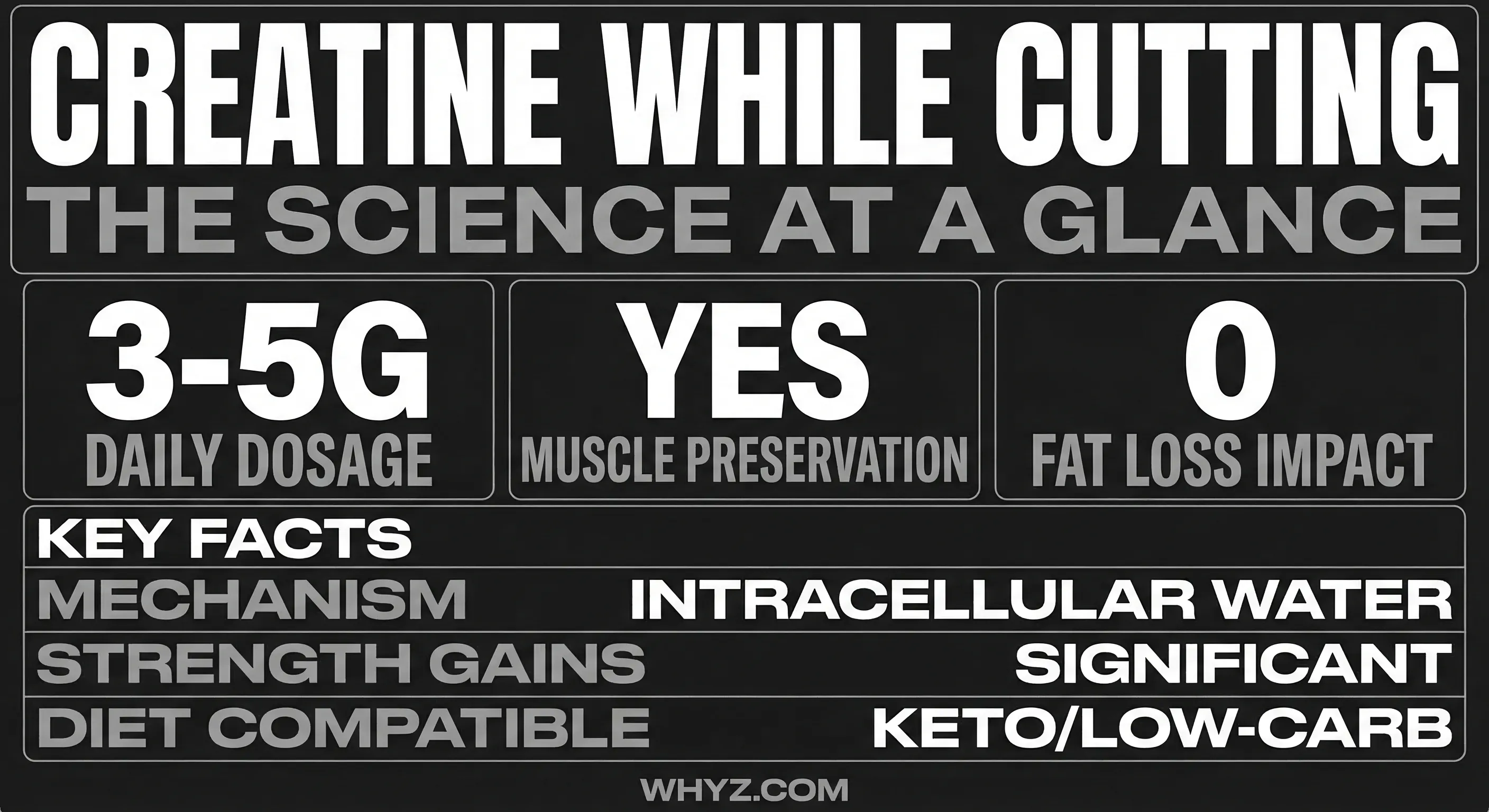
Creatine on a Low-Carb or Keto Cut
Athletes cutting on a low-carbohydrate or ketogenic diet sometimes question whether creatine is effective without carbohydrate-driven insulin spikes to facilitate uptake. The evidence is reassuring.
While insulin does enhance creatine transport into muscle cells, it is not required for uptake. The creatine transporter (CrT) operates via sodium-dependent co-transport and does not require carbohydrates or insulin to function. Studies in participants with limited carbohydrate intake still show creatine saturation with standard 3 to 5 g/day supplementation.
The ISSN position stand confirms that the lack of a carbohydrate co-ingestion strategy does not prevent effective creatine loading (PMID: 28615996). Muscle saturation takes slightly longer without insulin co-support, but steady-state phosphocreatine levels are reached within four to five weeks at maintenance doses.
For athletes on ketogenic cuts, creatine is particularly valuable because the ketogenic diet reduces muscle glycogen stores. Lower glycogen means reduced anaerobic capacity during high-intensity work. Creatine’s phosphocreatine system partially compensates for this glycogen deficit by providing an alternative rapid ATP source. The combination of ketogenic dieting and creatine supplementation is well-tolerated and may preserve more training capacity than either approach alone.
Does Creatine Interfere with Fat Loss?
No evidence suggests creatine directly impairs fat oxidation, lipolysis, or any other mechanism of fat loss. Fat loss during a cut is driven by caloric deficit — energy expenditure exceeding energy intake over time. Creatine does not contribute calories in any physiologically meaningful sense (approximately 4 kcal/g, negligible at 3 to 5 g/day).
The concern that creatine “masks” fat loss by adding water weight to the scale is accurate in a narrow sense: the initial 1 to 2 kg of water weight may temporarily obscure fat loss progress on the scale. However, body composition measurements — DEXA, skinfold calipers, progress photos — clearly show fat loss continues normally. Athletes who track body composition rather than scale weight alone will not be confused by creatine’s water effect.
Dosing Creatine During a Cut
Dosing recommendations do not change during a caloric deficit. The ISSN recommends 3 to 5 grams of creatine monohydrate daily for maintenance, with no loading phase required unless faster saturation is a priority (PMID: 28615996).
First priority: Continue at 3 to 5 g/day throughout the cut without interruption. This is the simplest and most evidence-supported approach.
Second priority: If you started a cut mid-cycle and want to load quickly, 20 g/day (four divided doses of 5 g) for five to seven days will saturate muscles within one week, followed by the standard 3 to 5 g maintenance dose.
Third priority: If you are concerned about scale fluctuation during the first two weeks, begin creatine at 3 g/day rather than 5 g to reduce the initial water weight response. This is a personal preference choice, not a clinical recommendation.
Timing during a cut follows the same logic as at any other phase. Post-workout is a reasonable default. Consistency matters more than precision. See the Creatine Before or After Workout guide for a full timing breakdown.
Should You Stop Creatine Before a Competition or Photo Shoot?
Some physique athletes discontinue creatine two to four weeks before a competition or event to reduce intracellular water and squeeze out the last visible layer of definition. This is a legitimate strategy in extreme competitive contexts where every millimeter of muscular separation matters.
For most people cutting for health, aesthetics, or recreational fitness purposes, stopping creatine before an event is not necessary and carries meaningful downsides: training capacity decreases as phosphocreatine levels fall over one to two weeks, which may compromise the quality of final prep sessions.
If you are not stepping on a bodybuilding stage or doing a professional photoshoot, keep taking creatine through the cut. The muscle fullness from intracellular water produces a better physique outcome than the slight visual dryness from stopping, for most body types and goals.
For the complete creatine evidence base including safety data, forms, and long-term use, see the WHYZ creatine ingredient page.
Frequently Asked Questions
Should I take creatine while cutting? Yes. Creatine preserves muscle mass and training intensity during a caloric deficit. The water weight it adds is intracellular — in the muscle cells — not subcutaneous, so it does not soften your physique or hide muscle definition.
Will creatine make me look bloated while cutting? Creatine draws water into muscle cells, which makes muscles appear fuller and harder. This is different from the subcutaneous water retention that creates a soft, undefined look. Most athletes find creatine improves their physique appearance during a cut rather than worsening it.
Does creatine work without carbs on a keto cut? Yes. Carbohydrates and insulin enhance creatine uptake but are not required. Standard 3 to 5 g/day supplementation saturates muscles within three to five weeks even on a low-carbohydrate diet.
Should I stop creatine before a competition? Only if you are competing in a physique sport and seeking maximum muscular dryness. For most recreational athletes, stopping creatine reduces training capacity without meaningful aesthetic benefit.
Does creatine slow fat loss? No. Creatine does not affect fat oxidation or caloric balance. It adds initial water weight (1 to 2 kg) but this is not fat and does not impair the rate of fat loss during a deficit.
References
- Kreider RB, Kalman DS, Antonio J, et al. (2017). International Society of Sports Nutrition position stand: safety and efficacy of creatine supplementation in exercise, sport, and medicine. J Int Soc Sports Nutr. PMID: 28615996
- Lanhers C, Pereira B, Naughton G, et al. (2017). Creatine supplementation and upper limb strength performance: a systematic review and meta-analysis. Sports Med. PMID: 26828112
- Antonio J, Ciccone V. (2013). The effects of pre versus post workout supplementation of creatine monohydrate on body composition and strength. J Int Soc Sports Nutr. PMID: 23919405
- Forbes SC, Candow DG, Neto JHF, et al. (2022). Changes in fat mass following creatine supplementation and resistance training in adults ≥50 years of age: a meta-analysis. J Funct Morphol Kinesiol. PMID: 35885899