
Home > Learn > Lion’s Mane and Alcohol
It is a question that comes up more often than you might expect: if you take Lion’s Mane for brain health and cognitive support, what happens when you drink alcohol? The answer involves three distinct questions. Is there a dangerous interaction? Does alcohol cancel out Lion’s Mane’s benefits? And can Lion’s Mane offset some of the neural toll that alcohol takes over time?
This guide works through each question using available evidence, with honest acknowledgment of where animal research ends and human clinical data begins.
What Does Lion’s Mane Do in the Brain?
Lion’s Mane (Hericium erinaceus) contains two classes of unique bioactive compounds: hericenones, found in the fruiting body, and erinacines, found in the mycelium. Both have demonstrated the ability to stimulate nerve growth factor (NGF) synthesis in laboratory and animal models. NGF is a protein that supports the growth, maintenance, and survival of neurons, including cholinergic neurons involved in memory and learning.
The most cited human study is a double-blind placebo-controlled trial by Mori et al. (2009) that gave 3,000 mg/day of Lion’s Mane fruiting body powder to 30 adults over age 50 with mild cognitive impairment. After 16 weeks, the Lion’s Mane group showed statistically higher scores on the Revised Hasegawa Dementia Scale compared to placebo. Scores declined after supplementation ceased, suggesting the effect required ongoing intake.
A second human trial by Nagano et al. (2010) found that 2,000 mg/day of Lion’s Mane reduced self-reported depression and anxiety in 30 menopausal women over 4 weeks. The mechanism proposed was reduced inflammation and improved autonomic nervous system function, not direct NGF stimulation, though both may be involved.
Lion’s Mane also shows preliminary evidence for peripheral nerve regeneration. Lai et al. (2013) documented NGF-stimulating activity of hericenones and erinacines in vitro, noting that erinacines cross the blood-brain barrier, which hericenones do not appear to do efficiently. This distinction matters for supplement sourcing: full-spectrum products using both fruiting body and mycelium provide both compound classes.
How Does Alcohol Affect the Nervous System?
Alcohol is a central nervous system depressant that works primarily by enhancing GABA activity (the brain’s main inhibitory neurotransmitter) and suppressing glutamate activity (the main excitatory neurotransmitter). Acutely, this produces sedation, reduced anxiety, and impaired motor coordination. At the neurological level, even moderate alcohol consumption temporarily disrupts memory consolidation, which is why people struggle to recall details from a night of drinking.
Chronic heavy alcohol use causes more lasting changes. Zahr and Bhatt (2018) reviewed alcohol’s neurotoxic effects, documenting reductions in hippocampal volume, frontal lobe gray matter, and white matter integrity in individuals with alcohol use disorder. NGF signaling is disrupted in chronic alcohol exposure. Animal models show that repeated alcohol exposure reduces NGF levels in the brain and peripheral nervous system.
Even moderate, long-term drinking has measurable effects. A large prospective study in the UK Biobank found that drinking above low-risk guidelines was associated with lower gray matter volume and white matter microstructure changes. The pattern is dose-dependent: occasional moderate drinking carries far lower risk than regular heavy intake, but neither is neurologically neutral.
Can You Take Lion’s Mane and Alcohol Together?
No known dangerous pharmacological interaction exists between Lion’s Mane and alcohol. The compounds in Lion’s Mane are primarily metabolized in the gut and liver, not through the same pathways that alcohol uses for breakdown (primarily alcohol dehydrogenase and CYP2E1). There is no documented evidence of the two compounds interfering with each other’s absorption, metabolism, or excretion.
The practical concern is different from a safety concern. Alcohol disrupts the very cognitive processes Lion’s Mane is designed to support. NGF synthesis peaks several hours after consuming Lion’s Mane, and memory consolidation requires undisrupted hippocampal signaling, which alcohol impairs. Taking Lion’s Mane alongside alcohol does not pose a known risk, but it may reduce the functional benefit of the supplement for that day.
If you drink alcohol occasionally and want to maintain Lion’s Mane’s cognitive effects, the simplest approach is temporal separation: take Lion’s Mane in the morning, and drink in the evening if at all. This places Lion’s Mane’s active window well before alcohol consumption begins.
Does Lion’s Mane Help With Alcohol-Related Nerve Damage?
This is where the most interesting (and most preliminary) research lies. Animal studies suggest that Lion’s Mane may offer some protection against alcohol-induced neurological and organ damage. These findings are preclinical, meaning they come from animal models or cell cultures, and cannot be directly applied to humans.
Several relevant animal findings deserve mention. First, a 2015 rodent study found that Hericium erinaceus extract attenuated alcohol-induced elevation of liver enzymes (ALT, AST), suggesting potential hepatoprotective activity. Second, animal studies have documented Lion’s Mane’s potential to protect the gastric mucosa from alcohol-induced damage, a plausible finding given its well-documented anti-ulcer properties. Third, in the context of peripheral nerve damage, the erinacine-stimulated NGF production seen in animal models could theoretically support nerve repair following chronic alcohol exposure, but this has not been tested in humans with alcohol-related neuropathy.
The critical limitation: we do not have human RCTs testing whether Lion’s Mane prevents or reverses alcohol-induced brain or nerve damage. The research does not yet support claims that Lion’s Mane “protects” the nervous system from alcohol in humans. What we can say is that the mechanistic rationale is biologically plausible and the animal data is directionally interesting.
What Does Research Say?
The honest summary of the clinical literature on Lion’s Mane and alcohol is brief: the specific combination has not been tested in humans. The evidence that exists comes from three areas, each with different reliability.
First, general Lion’s Mane cognitive research in humans: Mori et al. (2009) and Nagano et al. (2010) are the most frequently cited human trials, and both use specific doses and populations that may not generalize broadly. Second, animal studies on Lion’s Mane and alcohol: these show promising neuroprotective and hepatoprotective signals, but animal-to-human translation in supplement research has a poor track record. Third, the mechanistic rationale: alcohol suppresses NGF signaling; Lion’s Mane stimulates it. This is a biologically coherent reason to hypothesize benefit, but a hypothesis is not clinical evidence.
Lai et al. (2013) and Phan et al. (2014) provide the most detailed preclinical work on erinacine- and hericenone-mediated neuroprotection. Both find compelling in vitro and animal signals. Neither addressed alcohol specifically.
What you should take away: Lion’s Mane has a real biological mechanism for neuroprotection. The premise that it could benefit those who drink is scientifically coherent. The evidence for this in humans does not yet exist.
Practical Guidance: When to Take Lion’s Mane
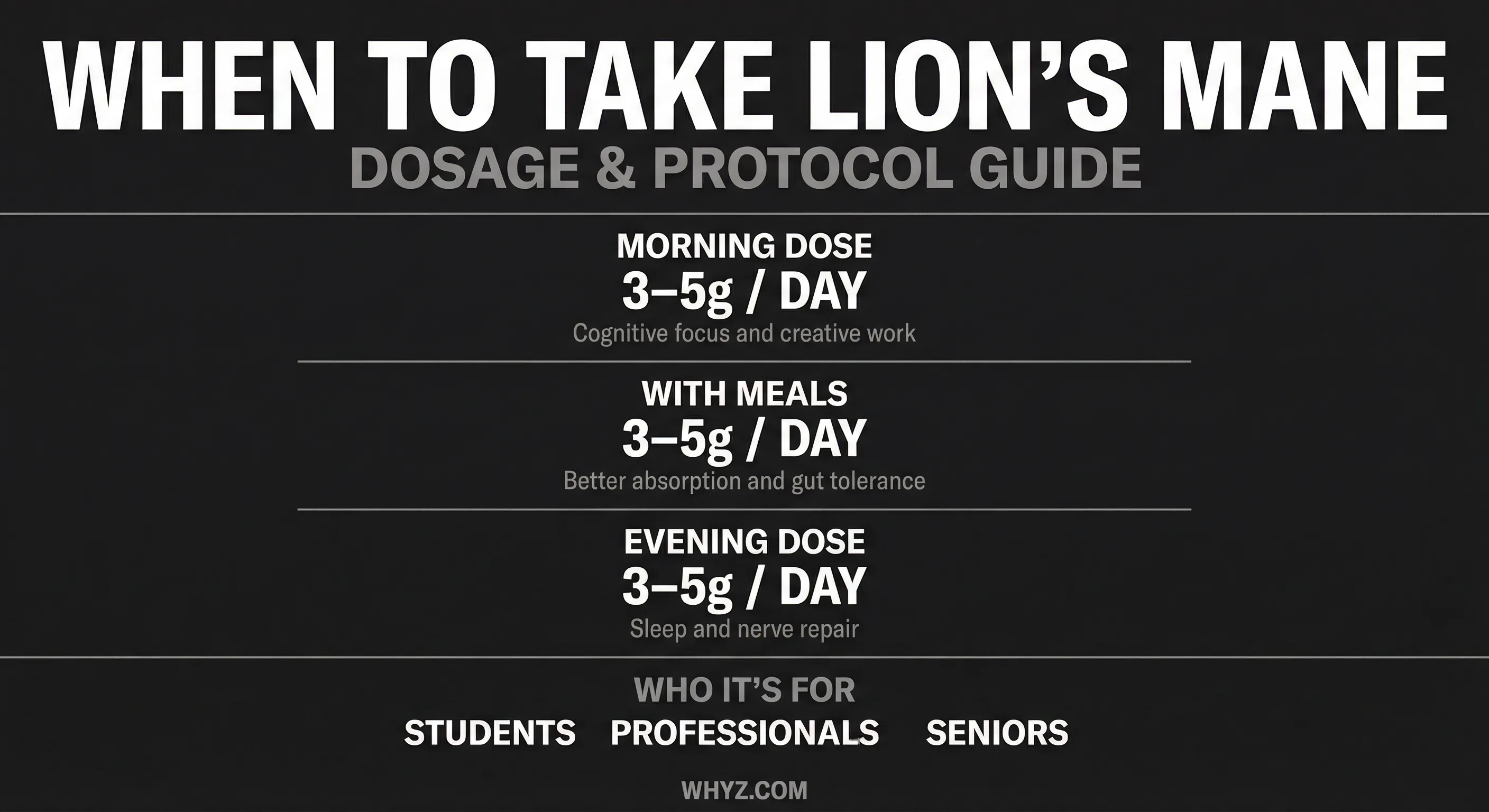
For cognitive benefits, Lion’s Mane is most commonly taken in the morning with breakfast. This allows the NGF-stimulating compounds to be active during the day when focus and mental performance matter most. Consistent daily dosing over weeks to months appears to produce cumulative benefit, as the Mori et al. study showed improvements over 16 weeks that reversed after stopping supplementation.
If you drink alcohol occasionally, morning dosing creates a natural temporal gap from evening consumption. There is no clinical reason to avoid Lion’s Mane on days you drink, provided you are not combining it with anything else that stresses the liver. For people who drink regularly, the practical question shifts: Lion’s Mane is unlikely to meaningfully offset the neurological effects of heavy regular drinking, but it may provide some support to ongoing neuroplasticity and NGF maintenance during periods of moderate use.
Dosing guidance: most human studies have used between 500 mg and 3,000 mg per day of dried fruiting body or extract. Lower doses (500 to 1,000 mg) are a reasonable starting point for general use. See our complete guide at Lion’s Mane Dosage: How Much Should You Take? for a full breakdown by goal.
For more on Lion’s Mane’s mechanisms and evidence profile, see the full ingredient overview at /learn/ingredients/lions-mane/.
Side Effects and Cautions
Lion’s Mane is well-tolerated in the doses studied. The Mori et al. (2009) trial at 3,000 mg/day over 16 weeks reported no adverse events. Reported side effects in lower-quality observational reports include mild gastrointestinal discomfort and, rarely, skin rash. Allergic reactions to Hericium erinaceus have been documented in mushroom-sensitive individuals.
Three specific cautions are worth noting. First, Lion’s Mane may have mild blood-thinning properties based on animal data; if you take anticoagulants, consult your doctor before use. Second, some early research suggests Lion’s Mane may modestly slow blood glucose, which could be relevant for people managing blood sugar. Third, quality varies considerably between products: look for standardized extracts with known erinacine or beta-glucan content.
As for alcohol: the evidence on Lion’s Mane does not change the fundamental guidance on alcohol consumption. Moderate, infrequent drinking carries far lower neurological risk than chronic heavy use. No supplement replaces the benefit of reducing alcohol intake if you are concerned about its cognitive effects.
This article is for informational purposes only and does not constitute medical advice. Consult a qualified healthcare provider before starting any new supplement protocol, particularly if you have a history of liver disease or alcohol use disorder.