
Quick Answer
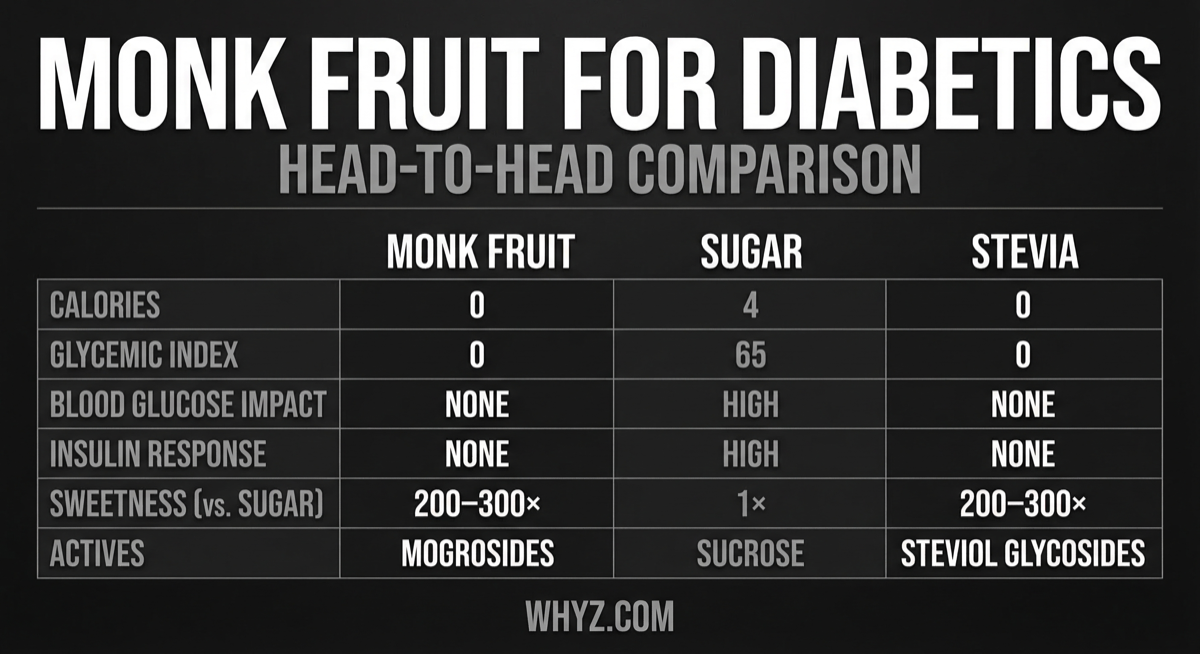
Pure monk fruit extract is generally suitable for people managing diabetes because it contains no sugar, has a glycemic index of 0, and does not raise blood glucose or insulin in clinical studies. The label still matters. Products blended with dextrose, maltodextrin, or other carbohydrates can affect blood sugar and should be counted like any other carb source.
More than 537 million adults worldwide live with diabetes, and for all of them, managing carbohydrate and sugar intake is a daily negotiation. Sweeteners become particularly important in this context: table sugar is off the table in large amounts, but the desire for sweetness does not disappear. Monk fruit extract offers a zero-calorie, zero-glycemic alternative that has attracted research attention specifically because of how its active compounds interact with glucose metabolism. The short answer for people managing blood sugar: monk fruit is one of the most well-tolerated sweetener options available, with no evidence of blood glucose impact at typical use amounts.
What Is Monk Fruit?
Monk fruit (Siraitia grosvenorii) is a small green melon native to southern China and northern Thailand, where it has been used in traditional medicine for centuries. The sweetness comes from a group of compounds called mogrosides, which are triterpene glycosides concentrated in the fruit’s flesh. Mogrosides are 150 to 250 times sweeter than sucrose by weight, which is why a very small amount provides significant sweetness. The FDA classifies monk fruit extract as Generally Recognized as Safe (GRAS). For a full overview of monk fruit’s nutritional profile and sourcing, see the WHYZ monk fruit ingredient page.
Does Monk Fruit Raise Blood Sugar?
No. Pure monk fruit extract has a glycemic index of zero and provides no bioavailable carbohydrates. It does not raise blood glucose. This is the single most important fact for anyone managing diabetes or blood sugar goals.
A 2017 randomized crossover trial published in the European Journal of Clinical Nutrition compared the postprandial glucose and insulin responses to beverages sweetened with aspartame, monk fruit, stevia, and sucrose. Monk fruit, stevia, and aspartame all produced significantly lower glucose and insulin responses than sucrose, and none of the three non-nutritive sweeteners produced a meaningful glucose or insulin spike above baseline (Tey et al., 2017). This is direct clinical evidence that monk fruit sweetener does not disrupt blood sugar in a real-world consumption context.
The mechanism behind this zero glycemic impact is straightforward. Mogrosides are not absorbed through the typical carbohydrate metabolic pathways. They pass through the upper GI tract without being converted to glucose, which means the pancreas receives no signal to release insulin. There is no blood sugar spike, no compensatory insulin surge, and no subsequent glucose crash.
How Do Mogrosides Work?
The mogrosides in monk fruit do more than simply avoid raising blood sugar. Emerging research suggests they may actively support glucose regulation through several mechanisms, though most of this evidence comes from animal models and early in vitro work rather than large human trials.
One mechanism involves AMPK activation. AMPK (AMP-activated protein kinase) is an enzyme that functions as a cellular energy sensor. When activated, it promotes glucose uptake in skeletal muscle and suppresses glucose production in the liver, two effects that support healthier blood sugar levels. A 2018 study found that mogroside-rich extract from Siraitia grosvenorii activated AMPK pathways in both liver and muscle tissue of treated animals, contributing to hypoglycemic and hypolipidemic effects (Liu et al., 2018).
A second mechanism involves gut microbiota modulation. A 2021 study examined whether mogrosides regulate short-chain fatty acid (SCFA) production in the gut of type 2 diabetic rats, finding that mogroside treatment shifted the gut microbiome toward profiles associated with improved glucose metabolism and reduced systemic inflammation (Xu et al., 2021). SCFAs produced by gut bacteria have established roles in insulin sensitivity and appetite regulation. A 2024 study extended this line of evidence, finding that mogroside administration in type 2 diabetic mice improved insulin resistance markers and modulated intestinal microflora composition favorably (Li et al., 2024).
A third mechanism involves direct anti-hyperglycemic activity. Research on a specific fraction of Luohanguo (monk fruit) extract in obese type 2 diabetic rats found significant reductions in fasting blood glucose and improvements in lipid profiles compared to untreated controls (Wang et al., 2019). These effects in animal models are promising, but they should not be interpreted as clinical evidence that monk fruit treats or reverses diabetes in humans.
How Does Monk Fruit Compare to Other Sweeteners for Blood Sugar Control?
For people managing blood sugar, not all zero-calorie sweeteners are equivalent. The relevant factors are glycemic impact, insulin response, gut microbiome effects, and safety profile.
Monk fruit and stevia are the two plant-derived non-nutritive sweeteners with the strongest safety and glycemic evidence. Both have glycemic indices near zero and do not trigger insulin secretion in clinical studies. The 2017 Tey et al. crossover trial found no meaningful difference between monk fruit and stevia on postprandial glucose or insulin metrics (Tey et al., 2017). For people who dislike stevia’s bitter aftertaste, monk fruit is a direct functional equivalent without the aftertaste issue.
Sucralose is a chlorinated sugar derivative with a glycemic index of zero in isolation, but some research suggests sucralose may alter insulin sensitivity and gut microbiota composition with long-term use in certain individuals. The evidence is mixed and not conclusive, but the uncertainty is a consideration. Monk fruit and stevia have cleaner safety profiles in current literature.
Aspartame is widely used and has a near-zero glycemic impact, but it is synthetic and metabolized to phenylalanine, which is a concern for people with phenylketonuria (PKU). For most people with diabetes, aspartame is safe, but some users prefer to avoid synthetic sweeteners entirely.
Erythritol is a sugar alcohol with a glycemic index near zero that is often blended with monk fruit in retail products. At typical use amounts, erythritol does not raise blood glucose. However, a 2023 observational study raised questions about high erythritol levels and cardiovascular risk, which has prompted ongoing investigation. This is still an evolving area.
For practical purposes: monk fruit and stevia are the most straightforward choices for people managing blood sugar who want plant-derived sweeteners with strong safety track records.
Is Monk Fruit Safe for Type 1 Diabetes?
Yes, with the same caveat that applies to all sweeteners for people managing type 1 diabetes: the sweetener itself is not the variable; the total carbohydrate load of the food or beverage is.
Pure monk fruit extract contains zero carbohydrates and does not affect blood glucose or insulin requirements. A person with type 1 diabetes who uses pure monk fruit to sweeten coffee or tea does not need to adjust their insulin dosing for the sweetener.
The risk with “monk fruit products” (blended retail sweeteners) is the filler ingredients. Many products labeled as monk fruit sweetener contain erythritol, dextrose, or maltodextrin as bulking agents. Dextrose is glucose and will require insulin coverage. Maltodextrin has a glycemic index between 80 and 120 and will also raise blood glucose. People with type 1 diabetes need to read the full ingredient list and nutrition facts panel on any monk fruit product, not just the front-of-package marketing. If the nutrition label shows carbohydrates greater than zero, those carbohydrates require the usual management.
How to Use Monk Fruit if You Are Managing Blood Sugar
Practical usage for people monitoring blood sugar follows a few straightforward rules.
First, choose pure monk fruit extract rather than blended products. Pure monk fruit extract lists only monk fruit extract (or Siraitia grosvenorii fruit extract, or mogrosides) as its ingredient. If anything else appears in the ingredient list, evaluate it separately.
Second, check the nutrition facts panel before any new product. Carbohydrates should read 0g. Calories should read 0 per serving. If either shows a positive value, the product contains caloric fillers.
Third, when baking, note that monk fruit does not caramelize or provide the same bulk and moisture as sugar. Pure monk fruit extract is roughly 200 times sweeter than sugar, so conversion ratios matter. A recipe calling for 1 cup of sugar typically requires about half a teaspoon to 1 teaspoon of pure monk fruit extract, depending on the specific product concentration. Most baking applications work better with a monk fruit and erythritol blend, which provides both sweetness and bulk, but people managing blood sugar should verify the erythritol content if that is a concern.
Fourth, use monk fruit in coffee and tea without concern. Adding a few drops of liquid monk fruit extract or a small amount of powdered extract to a hot beverage does not affect blood glucose or insulin and is one of the most practical day-to-day applications for people avoiding sugar.
Bottom Line
Monk fruit extract is one of the most thoroughly evaluated sweetener options for people managing blood sugar. Its glycemic index is zero, it does not raise insulin, and clinical evidence shows no postprandial glucose impact at typical use amounts. The active compounds, mogrosides, may support glucose regulation through AMPK activation and gut microbiota modulation based on preclinical evidence, though this should not be interpreted as a treatment claim. Pure monk fruit extract is appropriate for people managing both type 1 and type 2 diabetes. The key distinction is between pure monk fruit extract (safe) and blended retail products containing dextrose or maltodextrin (which do affect blood sugar). Read the label.
Frequently Asked Questions
Is monk fruit safe for diabetics? Yes. Pure monk fruit extract has a glycemic index of zero and does not raise blood glucose or insulin in clinical studies. It is considered safe for both type 1 and type 2 diabetes. Always check the ingredient list on retail products for fillers like dextrose or maltodextrin, which do affect blood sugar.
Does monk fruit raise insulin levels? No. Mogrosides, the sweet compounds in monk fruit, are not metabolized as carbohydrates and do not trigger insulin secretion. Clinical trials comparing monk fruit to sucrose show no measurable insulin response above baseline.
Can people with type 2 diabetes use monk fruit every day? Yes. There is no established upper limit for monk fruit extract in healthy adults or those with diabetes, and no evidence of harm from regular daily use. It is one of the most practical sugar alternatives for long-term daily use.
Is monk fruit better than stevia for diabetics? Both monk fruit and stevia have essentially identical glycemic profiles: zero impact on blood glucose and insulin. The choice between them is primarily taste preference. Monk fruit has a cleaner, less bitter finish than stevia for most people.
What monk fruit products should diabetics avoid? Avoid any monk fruit product that contains dextrose, maltodextrin, sugar, honey, or other caloric sweeteners in the ingredient list. These fillers will raise blood glucose and require management. Products labeled “monk fruit blend” frequently contain these fillers.
References
- Tey SL, Salleh NB, Henry J, Forde CG. (2017). Effects of aspartame-, monk fruit-, stevia- and sucrose-sweetened beverages on postprandial glucose, insulin and energy intake. Int J Obes. PMID: 27956737
- Liu WH, Wang L, Xu YJ, et al. (2018). AMPK activation is involved in hypoglycemic and hypolipidemic activities of mogroside-rich extract from Siraitia grosvenorii. J Sci Food Agric. PMID: 30516208
- Xu LW, Zhao H, Tian HM, et al. (2021). Regulating the gut microbiota and SCFAs in the faeces of T2DM rats should be one of antidiabetic mechanisms of mogroside. Phytother Res. PMID: 33741440
- Li J, Chen Y, Zhao X, et al. (2024). Mogroside Alleviates Diabetes Mellitus and Modulates Intestinal Microflora in Type 2 Diabetic Mice. Nutrients. PMID: 38811190
- Wang Y, Li S, Yang W, et al. (2019). Anti-hyperglycemic and anti-hyperlipidemic effects of a special fraction of Luohanguo extract on obese T2DM rats. Molecules. PMID: 31586692