
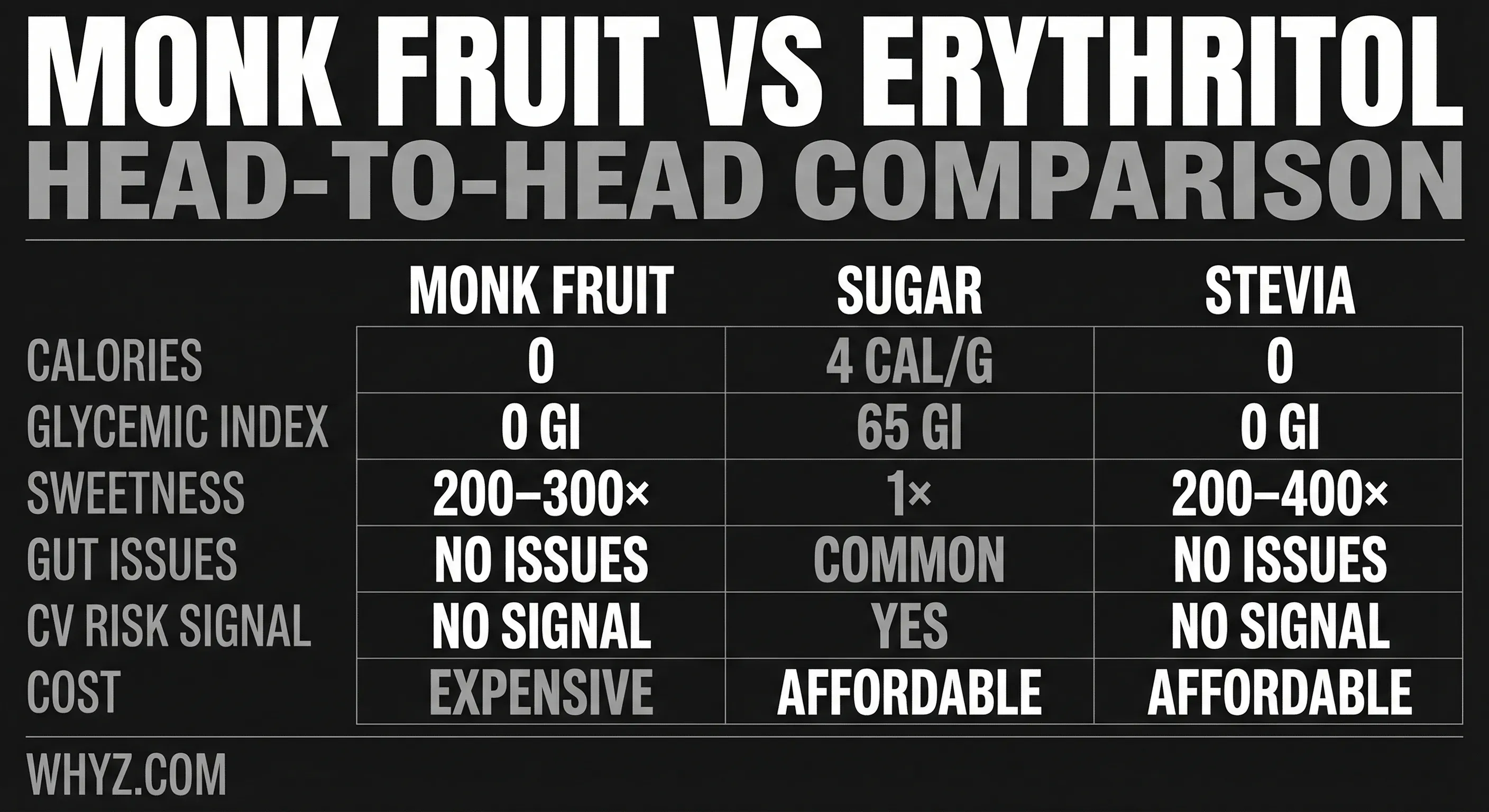
Monk fruit and erythritol are two of the most popular sugar alternatives on the market. Both are marketed as zero-calorie or near-zero-calorie sweeteners with minimal glycemic impact. But they differ substantially in origin, taste, cost, functionality, and emerging safety data. Below is a full evidence-based comparison.
Head-to-Head Comparison
| Category | Monk Fruit Extract | Erythritol |
|---|---|---|
| Source | Siraitia grosvenorii fruit (Southeast Asia) | Fermented glucose (corn or wheat starch) |
| Calories | 0 per serving | 0.2 cal/g (FDA allows “0 calorie” label) |
| Glycemic Index | 0 | 0 |
| Sweetness vs Sugar | 150 to 250x sweeter | 60 to 70% as sweet |
| Taste | Clean sweetness, slight fruity note | Cool, clean, slight cooling sensation |
| Aftertaste | Minimal in high-purity extracts | Minimal |
| Baking | Poor (no bulk, does not caramelize) | Good (provides bulk, browns slightly) |
| Gut tolerance | Excellent (no reported GI issues) | Good (better than other sugar alcohols) |
| Cost | High ($15 to 30/lb pure extract) | Low ($3 to 8/lb) |
| CV risk signal | None identified | 2023 observational study flagged concern |
How Monk Fruit Works
Monk fruit sweetener comes from the Siraitia grosvenorii vine, native to southern China and northern Thailand. The sweet compounds are mogrosides, specifically mogroside V, which is 200 to 300 times sweeter than sucrose by weight. Mogrosides are not absorbed or metabolized for energy. They pass through the digestive tract without raising blood glucose, triggering insulin, or contributing calories.
The main limitation of pure monk fruit extract is practical, not biological. Because it is 200x sweeter than sugar, a tiny amount provides intense sweetness. This makes it difficult to use in recipes that depend on sugar for volume, structure, or browning. Pure monk fruit dissolves well in beverages but cannot replicate sugar’s role in baked goods without a bulking agent.
How Erythritol Works
Erythritol is a four-carbon sugar alcohol produced commercially by fermenting glucose with yeast (typically Moniliella pollinis). Unlike other sugar alcohols such as xylitol or sorbitol, erythritol is absorbed in the small intestine and excreted through urine rather than reaching the large intestine for fermentation. This absorption pattern explains why erythritol causes far fewer gastrointestinal side effects than other polyols.
Erythritol provides about 60 to 70% of sugar’s sweetness with roughly 0.2 calories per gram (compared to sugar’s 4 calories per gram). Because it has bulk and crystalline structure similar to sugar, it works well in baking. It does not caramelize at the same temperature as sugar, but it provides acceptable texture and structure in most applications.
The 2023 Cleveland Clinic Cardiovascular Study
In February 2023, Witkowski et al. published a study in Nature Medicine that changed the conversation about erythritol. The study examined over 4,000 adults undergoing cardiac evaluation and found that elevated plasma erythritol levels were associated with a significantly increased risk of major adverse cardiovascular events, including heart attack and stroke (PMID: 36849732).
Three key findings emerged from this research. First, individuals in the highest quartile of plasma erythritol had roughly double the risk of cardiovascular events compared to the lowest quartile. Second, in vitro experiments showed erythritol enhanced platelet aggregation and clot formation at physiologically relevant concentrations. Third, a small human feeding study confirmed that consuming 30 grams of erythritol raised plasma levels above the threshold associated with increased clotting for over two days.
Important context: This was an observational cohort study, not a randomized controlled trial. The participants were patients already at elevated cardiovascular risk (undergoing cardiac evaluation), which limits generalizability to healthy populations. Erythritol produced endogenously during metabolic stress may be a marker of disease rather than a cause. The dose tested (30 g) exceeds what most people consume in a day from sweetened products.
The study does not prove erythritol causes heart attacks. It identifies a signal that warrants further investigation, particularly in individuals with pre-existing cardiovascular disease.
Gut Health Comparison
Monk fruit extract has no documented negative effects on gut health. Mogrosides pass through the GI tract without fermentation and preliminary animal research suggests they may have prebiotic properties, though human data confirming this is lacking.
Erythritol is better tolerated than other sugar alcohols because it is absorbed before reaching the colon. At typical dietary doses (10 to 20 g/day), most people experience no gastrointestinal symptoms. At higher doses (40 to 50 g), some individuals report nausea or mild digestive discomfort. A 2007 dose-response study found that erythritol doses up to 0.8 g/kg body weight were well tolerated in healthy adults (PMID: 17828671).
Neither sweetener feeds oral bacteria or promotes tooth decay. Both are considered non-cariogenic.
When to Use Each
Choose pure monk fruit when: you want a calorie-free sweetener for coffee, tea, smoothies, or any liquid application. It dissolves cleanly and provides intense sweetness from a small amount. Ideal for people following strict ketogenic, fasting, or zero-calorie protocols.
Choose erythritol when: you need a sugar substitute for baking, cooking, or any recipe that requires bulk and structure. Erythritol’s granular form measures cup-for-cup close to sugar (at 60 to 70% sweetness), making recipe conversion straightforward.
Choose a blend when: you want the best of both. Monk fruit provides the sweetness; erythritol provides the bulk. Most commercial “monk fruit sweeteners” are exactly this combination. The ratio is typically 99% erythritol and 1% monk fruit extract by weight.
Why Most “Monk Fruit Sweeteners” Are Mostly Erythritol
Walk through the sweetener aisle of any grocery store. Products labeled “monk fruit sweetener” almost always list erythritol as the first (and therefore most abundant) ingredient. This is not deceptive by FDA standards, but it is misleading in practice.
The reason is economics and physics. Pure monk fruit extract is expensive ($200 to 500/kg wholesale) and intensely sweet. You cannot measure it with a spoon. By blending a tiny amount of monk fruit extract with erythritol, manufacturers create a product that looks, measures, and behaves like sugar at a reasonable price.
This matters for two reasons. First, if you are choosing monk fruit specifically to avoid erythritol (perhaps due to the cardiovascular data), check the ingredient list. If erythritol is listed, the product is primarily erythritol. Second, the health profile of the product matches the dominant ingredient, not the one on the front of the package.
How to Read Sweetener Labels
Three steps to identify what you are actually buying:
First, read the ingredients list. Ingredients are listed in descending order by weight. If erythritol, dextrose, or maltodextrin appears before monk fruit extract, those ingredients dominate the product.
Second, check for “proprietary blends.” Some products list “monk fruit blend” without specifying ratios. Assume the cheaper ingredient (erythritol) is the majority unless stated otherwise.
Third, look for mogroside content. Higher-quality monk fruit products specify mogroside V percentage (typically 25% to 55% in concentrated extracts). Products listing “monk fruit extract, 50% mogrosides” deliver more active sweetening compound per gram than those listing just “monk fruit extract” without a percentage.
Frequently Asked Questions
Is monk fruit or erythritol better for keto? Both have zero glycemic impact and fit keto macros. Monk fruit is slightly more “pure keto” because it has literally zero calories, while erythritol has trace calories (0.2 cal/g) that are negligible in practice.
Does erythritol cause heart attacks? A 2023 observational study found an association between elevated blood erythritol and cardiovascular events in high-risk patients. This does not prove causation. The study has not been replicated, and the participants had pre-existing cardiovascular risk factors.
Can I use monk fruit and erythritol together? Yes. Blending them is the most common commercial approach. Monk fruit provides sweetness; erythritol provides bulk. This combination works well for baking and general use.
Which sweetener is better for gut health? Both are well-tolerated. Monk fruit has no documented negative gut effects. Erythritol is the best-tolerated sugar alcohol but can cause mild GI distress at very high doses (above 40 g).
Why is pure monk fruit so expensive? Monk fruit grows in a limited geographic region (primarily Guangxi province, China), requires specific climate conditions, and the extraction process to isolate mogrosides is complex. Supply constraints and processing costs keep prices high compared to fermentation-derived sweeteners like erythritol.
References
- Witkowski M, Nemet I, Alamri H, et al. (2023). The artificial sweetener erythritol and cardiovascular event risk. Nat Med. PMID: 36849732
- Bornet FR, Blayo A, Pchard F, Slama G. (1996). Gastrointestinal response and plasma and urine determinations in human subjects given erythritol. Regul Toxicol Pharmacol. PMID: 17828671
- Tey SL, Salleh NB, Henry J, Forde CG. (2017). Effects of aspartame-, monk fruit-, stevia- and sucrose-sweetened beverages on postprandial glucose, insulin and energy intake. Int J Obes. PMID: 27795550
- Xu G, Huang Y, Singh PP, et al. (2015). Mogrosides from Siraitia grosvenorii: a review. J Agric Food Chem. PMID: 26457856
- Liu C, Dai L, Liu Y, et al. (2016). Antiproliferative activity of triterpene glycoside nutrient from monk fruit. Nutrients. PMID: 27355963