
Most shilajit research has been conducted in men, focused on testosterone and fertility. But a growing number of studies are looking at outcomes that matter specifically to women: bone density after menopause, skin aging, fatigue, and mineral absorption.
The evidence base is still early. There are no large-scale RCTs on shilajit for hormonal balance in premenopausal women, and many of the claims circulating online outrun the actual data. This guide covers what the research does and does not support, so you can make an informed decision.
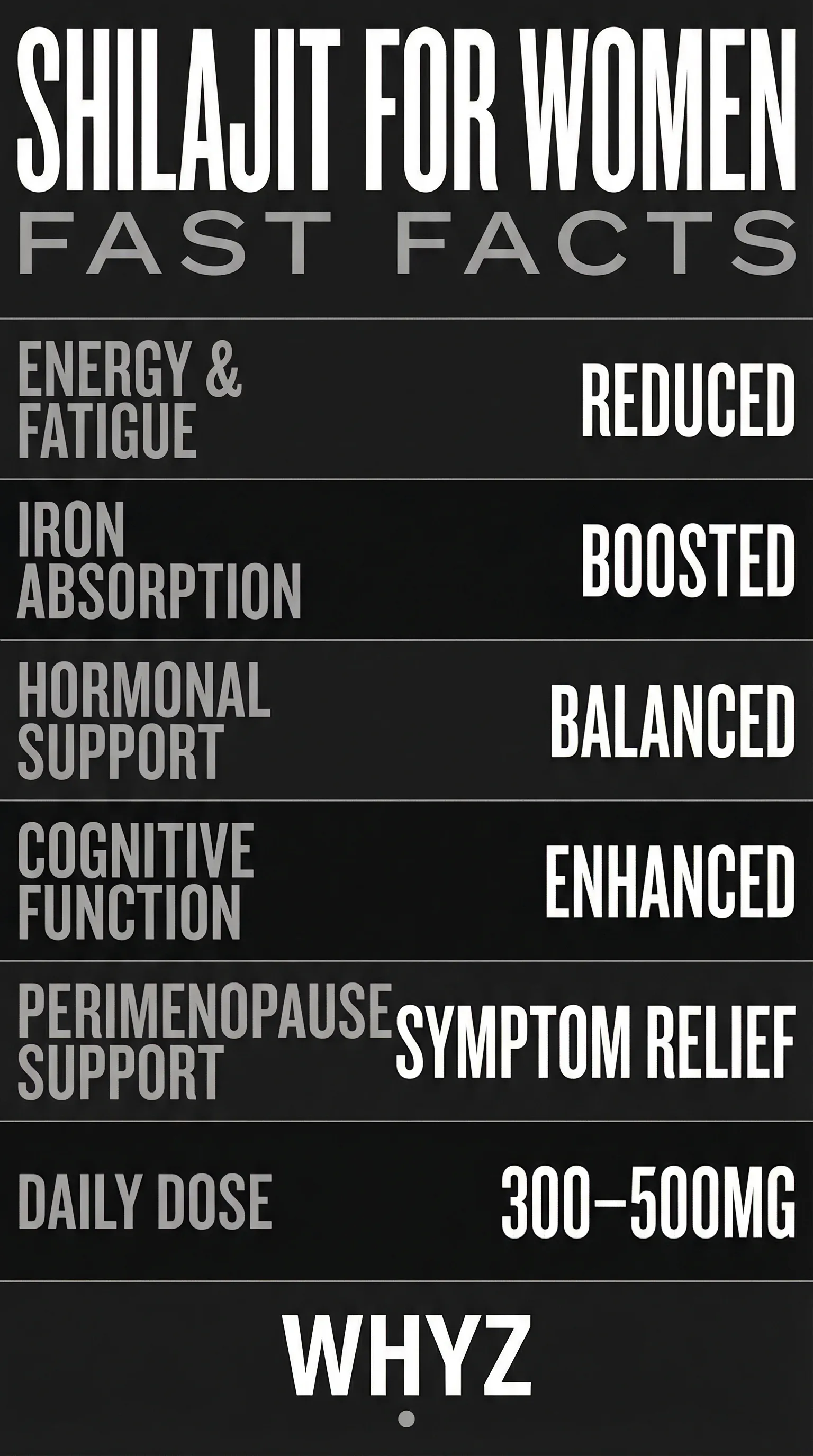
What Is Shilajit?
Shilajit is a tar-like substance formed over centuries from decomposed plant matter compressed between layers of rock in high-altitude mountain ranges, primarily the Himalayas, Altai, and Caucasus. It has been used in Ayurvedic medicine for thousands of years as a general tonic for vitality and rejuvenation.
The primary bioactive component is fulvic acid, which typically makes up 60-80% of purified shilajit. It also contains humic acid, trace minerals (iron, zinc, magnesium, selenium), dibenzo-alpha-pyrones, and small amounts of amino acids. The mineral profile varies depending on geographic origin.
For more on shilajit’s full profile, see the shilajit overview page.
Bone Density in Postmenopausal Women
The strongest clinical evidence for shilajit in women comes from a 2022 randomized, double-blind, placebo-controlled trial. Pingali and Nutalapati studied postmenopausal women with osteopenia (bone mineral density loss that has not yet progressed to osteoporosis). Participants received shilajit extract daily for 48 weeks.
The shilajit group showed reduced markers of oxidative stress and inflammation compared to placebo. Bone mineral density was preserved in a dose-dependent manner, meaning higher doses correlated with better outcomes. The authors attributed the effect partly to shilajit’s antioxidant activity and partly to its mineral content (Pingali & Nutalapati, 2022).
This is a meaningful finding because postmenopausal bone loss is driven by estrogen decline combined with increased oxidative stress. A compound that addresses the oxidative component while delivering trace minerals hits two relevant pathways at once.
Skin Health and Aging
A 2019 study by Das et al. analyzed skin tissue transcriptomics in middle-aged women supplemented with shilajit. The supplementation was associated with upregulation of genes involved in microvascular function and extracellular matrix maintenance, two processes central to skin structure and aging (Das et al., 2019).
This was a gene expression study, not a cosmetic outcome trial. It tells us that shilajit appears to activate cellular pathways relevant to skin health, but it does not confirm visible changes like reduced wrinkles or improved skin elasticity in a controlled setting. Still, the biological signal is real and suggests a mechanistic basis worth further investigation.
Energy and Fatigue
Fatigue is one of the most commonly reported reasons women try shilajit. The proposed mechanism involves fulvic acid’s role in mitochondrial energy production, specifically its ability to facilitate electron transport and improve cellular ATP output.
An animal study by Surapaneni et al. found that shilajit attenuated behavioral symptoms of chronic fatigue in rats by modulating the hypothalamic-pituitary-adrenal (HPA) axis and improving mitochondrial bioenergetics (Surapaneni et al., 2012).
In humans, Keller et al. conducted a study on shilajit supplementation and fatigue-induced decreases in muscular strength. The shilajit group maintained strength better during fatiguing exercise compared to placebo, and serum hydroxyproline levels (a marker of collagen turnover) were also affected (Keller et al., 2019).
These are promising signals, but neither study was designed specifically around women’s fatigue. Fatigue in women often involves hormonal fluctuation, iron status, and thyroid function, which adds complexity that existing shilajit studies have not addressed directly.
Hormonal Balance: What the Evidence Actually Shows
This is where marketing claims and research diverge most sharply.
You will find widespread claims that shilajit “balances estrogen and progesterone” or “regulates menstrual cycles.” No published human clinical trial has demonstrated these effects. The hormone data on shilajit comes primarily from male studies focused on testosterone.
Pandit et al. conducted a clinical evaluation of purified shilajit in healthy male volunteers over 90 days and found significant increases in total testosterone, free testosterone, and dehydroepiandrosterone (DHEA) compared to placebo (Pandit et al., 2016). DHEA is a precursor hormone in both men and women, so the finding has some theoretical relevance to women, but the study population was exclusively male.
An animal study by Kececi et al. examined shilajit’s protective effects against radiation-induced ovarian damage in rats, finding some degree of cellular protection (Kececi et al., 2016). This is a preclinical finding that cannot be directly applied to human hormonal balance.
The honest summary: shilajit may influence hormonal pathways, but the specific claim that it balances female reproductive hormones lacks clinical backing at this time.
Fulvic Acid and Iron Absorption
One of the more practical mechanisms for women involves fulvic acid’s effect on mineral bioavailability. Iron deficiency is the most common nutritional deficiency worldwide, and premenopausal women are disproportionately affected due to menstrual blood loss.
Fulvic acid is a natural chelator. It binds to minerals and may improve their absorption across the intestinal wall. This is supported by its established role in soil chemistry (fulvic acid makes soil minerals more available to plant roots) and by preliminary biological data suggesting similar effects in the gut.
However, this mechanism has not been validated in a human RCT measuring iron status changes with shilajit supplementation. The logic is sound, the mechanism is plausible, and the traditional use aligns with it, but the clinical proof is not there yet. Women taking shilajit for iron support should not treat it as a replacement for proper iron supplementation if they have diagnosed deficiency.
Shilajit Research by Area: Where the Evidence Stands
| Research Area | Study Type | Population | Evidence Level |
|---|---|---|---|
| Bone density preservation | Human RCT | Postmenopausal women | Moderate |
| Skin gene expression | Human transcriptomics | Middle-aged women | Preliminary |
| Anti-fatigue (muscular) | Human RCT | Mixed (not women-specific) | Low-moderate |
| Chronic fatigue (HPA axis) | Animal study | Rats | Preclinical |
| Testosterone/DHEA | Human RCT | Healthy men | Moderate (men only) |
| Ovarian protection | Animal study | Rats | Preclinical |
| Iron/mineral absorption | Mechanistic | N/A | Theoretical |
Dosage Considerations for Women
Most clinical trials used purified shilajit extract at 250-500 mg per day. The 2022 bone density trial used multiple dose levels over 48 weeks. The Keller fatigue study used 250 mg twice daily.
Shilajit comes in resin, capsule, and powder forms. Resin is the traditional format, but standardized extracts offer more consistent dosing. Look for products that specify fulvic acid content (typically 50-60% or higher) and have been tested for heavy metals, as raw shilajit can contain lead, arsenic, and mercury.
Women who are pregnant or breastfeeding should avoid shilajit. There is no safety data for these populations, and the heavy metal contamination risk alone warrants caution.
Safety and Purity
A 91-day repeated administration study in rats found no significant adverse effects from black shilajit at tested doses, supporting general tolerability (Velmurugan et al., 2012). Human clinical trials have reported mild side effects including headache and digestive discomfort at standard doses.
The bigger safety concern with shilajit is purity. Unpurified or poorly sourced shilajit may contain heavy metals at unsafe levels. Third-party testing for lead, arsenic, mercury, and cadmium is non-negotiable. Products should also be tested for microbial contamination.
The Bottom Line
Shilajit research in women is limited but not empty. The bone density trial in postmenopausal women and the skin transcriptome study provide legitimate, peer-reviewed evidence of biological activity in female populations. The fatigue data is promising but not yet women-specific.
Claims about hormonal balance, menstrual regulation, and fertility support in women remain unsupported by human clinical data. This does not mean these effects are impossible, but it means the evidence is not there to confirm them.
If you are considering shilajit, focus on purified, heavy-metal-tested products at 250-500 mg daily. Set realistic expectations based on what the research actually shows, not what marketing materials promise.
Frequently Asked Questions
Is shilajit safe during pregnancy?
No safety data exists for shilajit use during pregnancy or breastfeeding. The risk of heavy metal contamination in unregulated products adds an additional concern. Most practitioners recommend avoiding shilajit entirely during pregnancy and lactation until safety data becomes available.
Does shilajit affect estrogen levels?
No human clinical trial has measured estrogen changes with shilajit supplementation. One male study showed increases in testosterone and DHEA (a precursor hormone that can convert to estrogen or testosterone), but this cannot be directly applied to women’s estrogen levels. The claim that shilajit “balances estrogen” is not supported by published research.
Can shilajit help with PCOS?
There are no clinical studies evaluating shilajit specifically for polycystic ovary syndrome. Some of shilajit’s proposed mechanisms (anti-inflammatory activity, mineral delivery, potential HPA axis modulation) are relevant to PCOS pathophysiology, but this is theoretical. Women with PCOS should work with their healthcare provider on evidence-based interventions.
What is the right dose of shilajit for women?
Clinical trials have used 250-500 mg daily of purified shilajit extract. The bone density trial used multiple dose levels and found dose-dependent effects over 48 weeks. Start at the lower end (250 mg daily) and adjust based on tolerance. Choose products standardized to fulvic acid content with third-party heavy metal testing.
Should I choose resin or capsule form?
Both forms can be effective if properly purified and standardized. Resin is the traditional form and some users prefer it for perceived authenticity, but capsules and powders offer more consistent dosing and easier third-party verification. What matters most is the fulvic acid percentage and heavy metal testing status, not the physical form.
How long does shilajit take to work?
The bone density study ran for 48 weeks. The muscular fatigue study used shorter supplementation periods. Most anecdotal reports of increased energy come within 2-4 weeks, but these are not from controlled trials. Set a minimum trial period of 8-12 weeks before evaluating whether shilajit is working for you.
Is shilajit the same as ashwagandha?
No. Shilajit is a mineral-rich humic substance, while ashwagandha (Withania somnifera) is a plant root. They are both classified as Ayurvedic adaptogens, and some products combine them. But their compositions, mechanisms, and evidence bases are distinct. Ashwagandha has a stronger clinical trial record for stress and anxiety in women. They should not be treated as interchangeable.