
Stevia is 200 to 350 times sweeter than sugar, carries zero calories, and has a spotless safety record. Yet a meaningful share of people who try it put the bottle down and never come back. The reason is almost always the same: a lingering bitter or licorice-like aftertaste that sugar simply does not produce. That bitterness is not a fluke, a bad batch, or a brand problem. It is a predictable consequence of stevia’s chemistry, and once you understand the mechanism, you can choose products and strategies that minimize it.
What Compounds Are Actually in Stevia?
Stevia rebaudiana is a leafy herb from the Asteraceae family, native to Paraguay and Brazil. Its sweetness comes from a family of compounds called steviol glycosides, not from sugars. All steviol glycosides share the same core structure: a steviol backbone (a diterpene) decorated with sugar chains (glucose and rhamnose units) at two attachment points.
The most abundant glycosides in commercial stevia are stevioside and rebaudioside A (Reb A), which together make up 80 to 90 percent of the glycoside content in most leaf extracts. Rebaudioside A is the preferred commercial glycoside because it delivers higher sweetness intensity and a cleaner taste than stevioside. Newer products isolate rebaudioside D (Reb D) or rebaudioside M (Reb M), which are present in the leaf in much smaller concentrations but taste significantly closer to sucrose.
The key structural difference between glycosides is the number and arrangement of glucose units attached to the steviol backbone. More glucose units tend to produce a sweeter, less bitter perception. Reb M carries four glucose units at one attachment point, compared to two for stevioside, and that structural difference is directly linked to its reduced bitterness.
Which Compounds Cause the Bitterness?
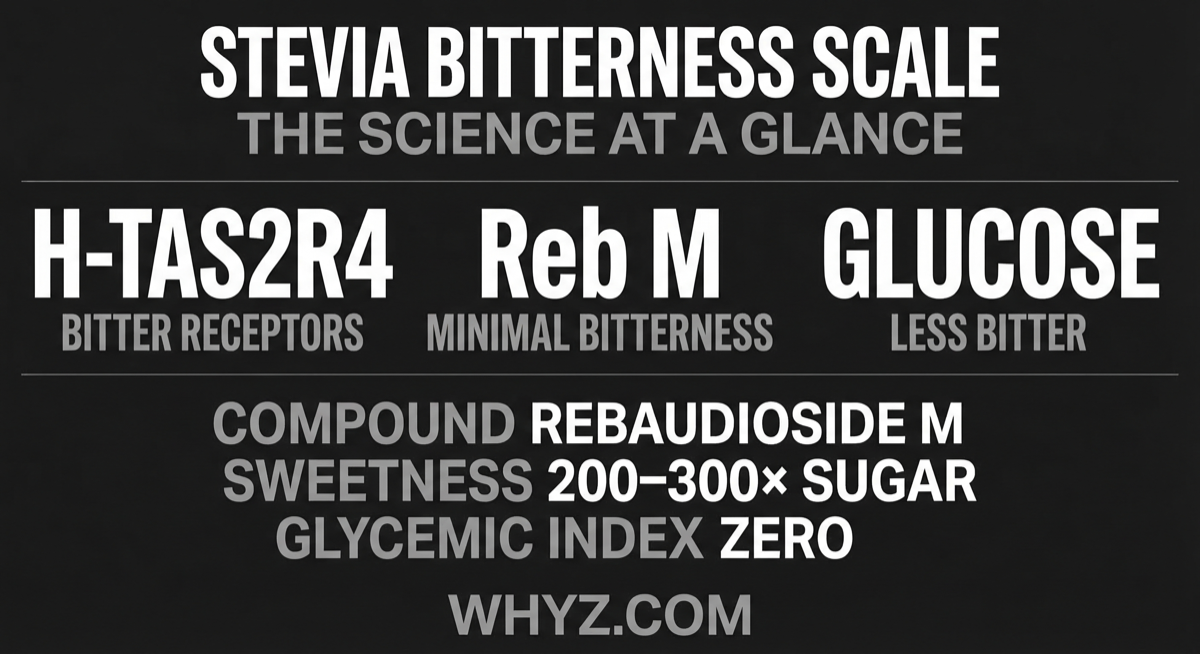
The bitter aftertaste of stevia is not random, and it is not simply a high-concentration effect. Research published in the Journal of Agricultural and Food Chemistry identified that steviol glycosides activate two specific human bitter taste receptors: hTAS2R4 and hTAS2R14 (Hellfritsch et al., 2012). These are G-protein coupled receptors on taste receptor cells in the mouth. When a steviol glycoside binds to them, they send a signal to the brain that registers as bitterness — the same basic mechanism that makes coffee, hops, and dark chocolate taste bitter.
Stevioside is the strongest activator of hTAS2R4 and hTAS2R14. It also has an unusual property: at higher concentrations, its perceived sweetness actually decreases. This suggests that the bitter signal from these receptors partially overrides or competes with the sweet signal from the TAS1R2/TAS1R3 sweet receptor. The practical result is a “sweet at first, then bitter” temporal profile that many people find unpleasant in beverages.
Rebaudioside A activates the same receptors, but with lower potency. Reb D and Reb M activate them at lower levels still, which explains their substantially cleaner taste profile in sensory panels.
Why Do Some People Taste It More Than Others?
If you have served stevia-sweetened lemonade at a gathering, you have probably noticed that reactions vary widely. Some guests notice nothing off. Others grimace. This variability is not imaginary or psychological. It reflects genuine biological differences in bitter taste sensitivity.
First, genetic variation in bitter taste receptor genes is common in humans. Specific single-nucleotide polymorphisms in TAS2R4 and TAS2R14 alter how strongly these receptors respond to their ligands. People who carry high-sensitivity variants of these receptor genes perceive stevia’s bitter notes at lower concentrations and describe them as more intense than people with low-sensitivity variants.
Second, a broader taste phenotype called supertasting affects roughly 25 percent of the population. Supertasters have a higher density of fungiform papillae (the small structures on the tongue that house taste buds) and tend to perceive all bitter, sweet, and pungent stimuli more intensely. Supertasters are overrepresented among people who strongly dislike stevia.
Third, prior exposure and context matter. People who regularly consume bitter foods like dark leafy vegetables, black coffee, or hoppy beer develop some perceptual adaptation to bitter stimuli. They may rate stevia’s bitterness as less disruptive than people with little bitter exposure.
The practical implication: if stevia tastes unacceptable to you at doses where others find it pleasant, your bitter receptor sensitivity is likely high, and no amount of product testing with standard Reb A formulas is going to eliminate the problem entirely. Reb M formulations or alternative sweeteners are a better starting point.
Does Processing Affect How Bitter Stevia Tastes?
Yes, significantly. The bitterness of a stevia product depends on which glycosides it contains and how pure that fraction is.
Crude leaf extracts contain a mixture of all glycosides including stevioside, steviolbioside, and rubusoside, which are the most bitter. These extracts taste sharply herbal and are rarely used in commercial food applications today.
Purified Reb A extracts (95% purity or higher) reduce the contribution of stevioside and other bitter glycosides. Most mainstream stevia products sold in grocery stores are high-purity Reb A. These have a notably cleaner taste than crude extracts, though the characteristic bitter finish of Reb A is still detectable by many people.
Enzymatically glycosylated stevia is a processing step that adds additional glucose units to existing glycosides. This shifts the structural profile toward compounds that more closely resemble Reb D and Reb M. Enzymatically modified stevia has reduced bitterness in sensory evaluations and is used in some food manufacturer formulations.
Reb D and Reb M products represent the current frontier. Reb M is present in the stevia leaf at concentrations of only 0.1 to 1 percent, making direct extraction expensive. Many commercial Reb M products are produced via fermentation using engineered yeast that expresses the relevant biosynthetic enzymes. Multiple sensory studies have found that trained panels do not detect significant bitterness in Reb M solutions at typical use concentrations.
How to Minimize Stevia’s Bitter Aftertaste
Several practical strategies reduce or mask stevia bitterness in everyday use.
First, switch glycoside grades. If standard stevia tastes bitter to you, try a Reb D or Reb M product. The taste difference between a Reb A formula and a Reb M formula is substantial, and many people who gave up on stevia after trying Reb A find Reb M acceptable. The trade-off is cost: Reb M products typically cost 30 to 50 percent more than Reb A.
Second, use acid to suppress bitterness. A small amount of citric acid or lemon juice activates different taste pathways that can partially suppress bitter signals. This is why stevia often tastes better in lemonade or citrus-flavored drinks than in plain water. Adding a squeeze of lemon to stevia-sweetened water or iced tea is a free, immediate fix for many people.
Third, blend stevia with other sweeteners. Combining stevia with erythritol, allulose, or monk fruit reduces the stevia concentration needed to achieve target sweetness, which lowers bitter receptor activation. Many commercial “natural sweetener blends” use this principle. A 50/50 blend of stevia and monk fruit, calibrated by sweetness equivalence, is a combination that many people find cleaner-tasting than stevia alone. You can read more about monk fruit’s own taste profile on the WHYZ monk fruit ingredient page.
Fourth, use stevia in bold-flavored applications. The bitter notes of Reb A are far less noticeable in strong flavors like dark chocolate, coffee, cinnamon, or ginger. If you are making a chocolate protein shake or spiced baked goods, stevia’s aftertaste is effectively masked by competing flavor compounds. It is the neutral applications, plain water, vanilla custard, light lemon desserts, where bitterness is most exposed.
Fifth, reduce total concentration. Stevia’s dose-bitterness relationship is steep. Using slightly less stevia and relying on other flavor enhancement techniques (a pinch of salt, a dash of vanilla) can cut perceived bitterness considerably without noticeably reducing sweetness.
Is the Bitter Taste Harmful?
No. The bitter receptors activated by steviol glycosides are chemosensory receptors, not markers of toxicity. The activation of hTAS2R4 and hTAS2R14 by stevia is not associated with any adverse physiological effect. Bitterness in this context is purely a sensory signal, not a warning about the compound’s safety.
Stevia holds GRAS (Generally Recognized as Safe) status from the U.S. FDA, and high-purity steviol glycosides have been evaluated by the European Food Safety Authority, the World Health Organization, and regulatory bodies in Japan, Australia, and Canada, all of which have confirmed their safety at typical dietary exposures. The bitterness is a palatability issue, not a health concern.
Which Stevia Products Have the Least Aftertaste?
The label tells you more than the marketing claims. Look for these indicators:
- “Reb M” or “Rebaudioside M” in the ingredients: lowest bitterness
- “Reb D” or “Rebaudioside D”: low bitterness, less expensive than Reb M
- “Reb A 97%” or “Rebaudioside A”: moderate bitterness, most widely available
- “Stevia leaf extract” without a glycoside specification: likely a mixed extract with higher stevioside content and stronger bitterness
- Blended products with erythritol or monk fruit: can reduce bitterness substantially even with Reb A as the stevia component
Products marketed as “fermentation-derived” Reb M typically produce a rounder, more neutral sweetness than products using rare-extraction Reb M from the leaf, because the fermentation process yields a purer, more consistent glycoside profile.
For a deeper look at stevia’s history, safety data, and uses beyond sweetening, visit the WHYZ stevia ingredient page.
Summary
Stevia’s bitter aftertaste comes from steviol glycosides, particularly stevioside and rebaudioside A, activating human bitter taste receptors hTAS2R4 and hTAS2R14. The intensity of bitterness you perceive depends on which glycoside is in the product, how concentrated it is, and how sensitive your bitter taste receptors are genetically. Reb M and Reb D products, acid-based applications, and stevia blends are the most effective practical strategies for reducing bitter perception. If standard stevia has always tasted bitter to you, the problem is not your imagination. It is your biology meeting a specific chemistry, and there are product-level and formulation-level solutions that work.