
People managing diabetes or blood sugar spend a lot of time reading ingredient labels. The question “is this sweetener safe?” comes up constantly, and the answers from food packaging, influencers, and even well-meaning healthcare providers vary enough to create real confusion.
Stevia stands out in that landscape. The evidence on stevia’s safety for people with diabetes or prediabetes is more robust than for most sweeteners, and the mechanism is unusually well understood. This guide covers what clinical research actually shows.
What Is Stevia and How Is It Sweetened?
Stevia extract is derived from the leaves of Stevia rebaudiana Bertoni, a plant native to South America. The sweetness comes from compounds called steviol glycosides — primarily Reb A in most commercial products, with newer extracts using Reb M and Reb D for cleaner flavor profiles.
Steviol glycosides pass through the upper gastrointestinal tract essentially intact. They are not absorbed in the small intestine. Gut bacteria in the colon cleave the glycoside bonds to release steviol, which is absorbed, metabolized by the liver, and excreted in urine. At no point in this process does stevia contribute glucose, fructose, or any caloric substrate to circulation (Brandle et al., 1998 review, cited in Chatsudthipong & Muanprasat, 2009).
This is not the same mechanism as, for instance, sugar alcohols like maltitol, which are partially absorbed and do raise blood glucose in proportion to the amount consumed. Stevia is structurally unrelated to carbohydrates and behaves differently at every step.
Does Stevia Raise Blood Sugar?
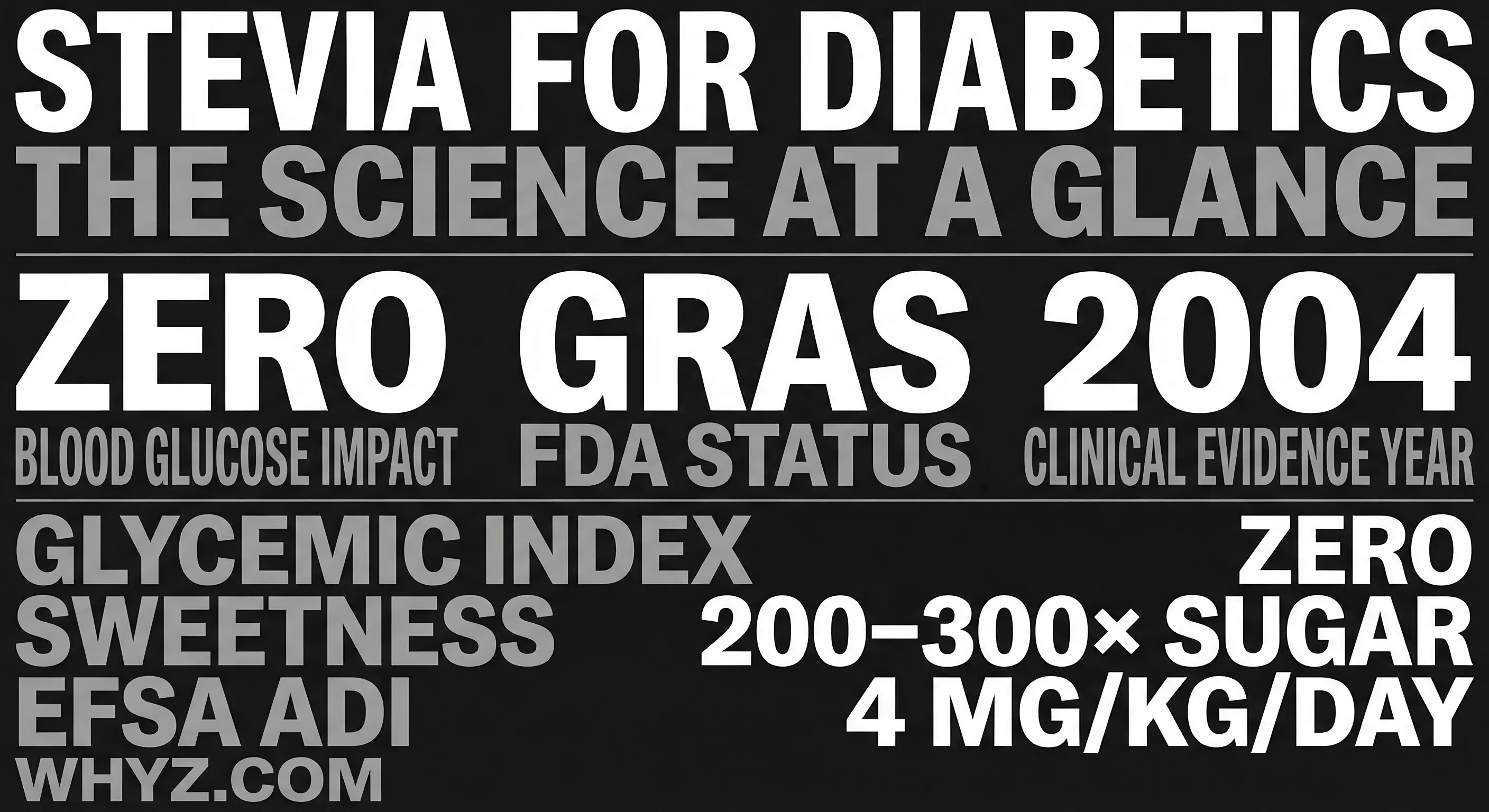
No. Stevia’s glycemic index is zero. This has been confirmed in human studies using both healthy and diabetic participants.
A study by Anton and colleagues examined the effects of stevia, aspartame, and sucrose preloads on postprandial glucose and insulin levels in lean and obese adults. The stevia preload produced significantly lower postprandial glucose and insulin responses compared to the sucrose condition. Stevia also performed comparably to aspartame on glucose and insulin measures — without the caloric contribution of sucrose (Anton et al., 2010).
This is the baseline finding you’d expect from a non-caloric, non-glycemic sweetener. But stevia research goes further.
Does Stevia Have Active Effects on Blood Glucose Control?
This is where stevia becomes more interesting than a simple zero-calorie sweetener. Stevioside — the most studied steviol glycoside — appears to have direct effects on glucose metabolism that go beyond simply not raising blood sugar.
A randomized crossover trial by Gregersen and colleagues studied 12 type 2 diabetic patients who consumed a standard test meal supplemented with either 1 gram of stevioside or 1 gram of maize starch as control. The stevioside meal reduced the incremental area under the glucose response curve by 18% compared to control (p = 0.013). The insulinogenic index — a measure of insulin response per unit of glucose absorbed — increased by roughly 40% in the stevioside condition (Gregersen et al., 2004).
This finding suggests stevioside does not simply add zero glucose to a meal. It may actively improve how that meal’s glucose is handled by the body.
How Does Stevia Affect Insulin?
The insulinogenic index increase in the Gregersen trial was significant and points to a mechanism: stevioside appears to enhance insulin secretion from pancreatic beta cells in a glucose-dependent manner. This is relevant for type 2 diabetics, where beta cell function is often impaired.
Animal research on the mechanistic side has been consistent. A study by Chen and colleagues found that stevioside increased insulin sensitivity in fructose-fed rats — a model of diet-induced insulin resistance. Stevioside reduced plasma glucose, insulin, and triglycerides in these animals, while improving their glucose tolerance (Chen et al., 2005).
The proposed mechanisms include direct stimulation of insulin secretion via calcium channel modulation and reduction of hepatic gluconeogenesis. Human trials have not yet fully characterized these mechanisms at the cellular level, but the downstream effects on glucose response are documented.
Is Stevia Approved and Recognized as Safe?
Yes. The regulatory picture is clear across major authorities:
- FDA: Granted Generally Recognized as Safe (GRAS) status to high-purity steviol glycoside extracts (95%+ purity) in 2008. This applies to commercial stevia extracts used in food and beverages.
- European Food Safety Authority (EFSA): Approved steviol glycosides for use in 2011, setting an acceptable daily intake (ADI) of 4 mg/kg body weight per day.
- WHO/FAO: The Joint Expert Committee on Food Additives (JECFA) established the same 4 mg/kg/day ADI.
- American Diabetes Association: Identifies stevia as an accepted non-nutritive sweetener that, when substituted for sugary alternatives, can help reduce overall caloric and carbohydrate intake.
The safety review conducted for GRAS designation included toxicological studies, reproductive and developmental studies, and genotoxicity assessments. No adverse effects were identified at doses relevant to human consumption (Chatsudthipong and Muanprasat, 2009).
What About Long-Term Use in Diabetics?
Long-term human safety data for stevia in diabetics is more limited than short-term data, which is worth acknowledging. Most clinical trials are acute or run for weeks to months. However:
The long history of stevia use in Paraguay, Brazil, and Japan (where it has been widely consumed since the 1970s) provides epidemiological context. No population-level signals of harm have emerged from these populations despite decades of regular use.
The mechanistic safety rationale is also strong. Because steviol glycosides are not absorbed in the small intestine and are excreted after liver metabolism, they do not accumulate in tissue. There is no plausible long-term toxicity pathway at normal dietary doses.
For type 2 diabetics taking medications that stimulate insulin release (sulfonylureas, GLP-1 agonists), the insulin-sensitizing effects of stevioside are theoretically relevant — though the clinical significance at typical dietary doses is small. If you are managing medications closely, discussing stevia use with your provider is reasonable, though there is no evidence of dangerous interactions in the literature.
Does Stevia Affect Insulin Resistance?
The animal evidence suggests possible benefit. The Chen et al. study on insulin-resistant rats found improvement in insulin sensitivity markers. Human evidence is more limited, but the Gregersen trial’s insulinogenic index finding points in the same direction — better insulin efficiency per unit of glucose.
What stevia clearly does not do is worsen insulin resistance, which is the concern with sweeteners that trigger cephalic phase insulin responses or disrupt gut microbiome composition. Stevia’s safety profile on these axes is considerably cleaner than some other sweeteners, including certain artificial options.
Does Stevia Affect HbA1c?
The evidence here is mixed but generally neutral. The meta-analyses available on stevia and glycemic markers have not found significant effects on HbA1c in most studies. This is expected — HbA1c reflects average blood glucose over two to three months, and most stevia trials are either too short or use doses too variable to show consistent HbA1c changes.
The absence of an HbA1c benefit is not a strike against stevia for diabetics. The expected benefit is not HbA1c reduction; it is the ability to sweeten foods and beverages without contributing carbohydrate load — and when used as a substitution for sugar, that substitution reduces the carbohydrate exposure that would otherwise accumulate over months and affect HbA1c.
How Does Stevia Compare to Other Sweeteners for Diabetics?
For people with diabetes, the most relevant comparison is against sugar, because that is the primary substitution in practice. On every glycemic metric, stevia is clearly preferable to sugar — no calories, no blood glucose elevation, no insulin spike from carbohydrate digestion.
Compared to other non-caloric sweeteners:
Monk fruit extract has a similar glycemic profile — zero caloric impact, zero glycemic index. Monk fruit mogrosides are structurally different from steviol glycosides but produce no measurable blood glucose or insulin response. For diabetics who find stevia’s flavor profile challenging (the slight bitterness or aftertaste), monk fruit is a viable alternative with similar safety credentials.
Erythritol has a glycemic index of zero and is generally well-tolerated. A 2023 paper raised concerns about elevated plasma erythritol and platelet aggregation in cardiovascular risk groups, which is worth awareness for diabetics with comorbid cardiovascular disease.
Aspartame has a glycemic index of zero. The Anton et al. trial found comparable postprandial glucose and insulin responses between stevia and aspartame — both lower than sucrose. Aspartame’s long-term safety is well-established, though some individuals report sensitivity to it.
Sucralose does not raise blood glucose directly, but some research suggests it may affect glycemic response when consumed alongside carbohydrates or in people who do not regularly use non-nutritive sweeteners. The evidence is mixed.
For straightforward blood sugar management, stevia and monk fruit are among the best-supported options in the research record.
How Much Stevia Is Safe for Diabetics?
The EFSA ADI of 4 mg steviol equivalents per kg of body weight per day translates to roughly 200 to 340 mg of steviol glycosides for a 60-80 kg adult — far more than typical dietary use. A standard serving of stevia-sweetened beverage or a packet of stevia powder contains a small fraction of this amount.
In the Gregersen clinical trial, participants used 1 gram of stevioside per meal, which is a substantial dose for research purposes. Even at this level, no adverse effects were observed in the 12-week trial period.
For practical purposes, the ADI is not a realistic ceiling that most consumers approach. Diabetics using stevia as a sugar substitute can do so without concern about approaching unsafe intake levels.
What Should Diabetics Look For on a Stevia Product Label?
Check for fillers. Many commercial stevia products use erythritol or dextrose as a bulking agent. Dextrose is glucose — it will raise blood sugar and must be counted as a carbohydrate. Products listing dextrose as the first or second ingredient should be treated as partially glycemic.
Look for high-purity extracts. Products labeled “stevia extract” or listing Reb A, Reb M, or steviol glycosides are the actual zero-glycemic option. “Stevia blend” products may be cut with other sweeteners.
Pure powder vs. liquid. Liquid stevia drops are typically just stevia extract in water or glycerin — the cleanest form for diabetics. Pure stevia powder (not the granulated blends) is also reliable.
The Bottom Line
Stevia is safe for diabetics. The evidence supports this clearly. Its glycemic index is zero, it does not raise blood sugar or insulin, and clinical research suggests stevioside may actively support better postprandial glucose handling in type 2 diabetics.
The regulatory bodies that have reviewed stevia’s safety record — FDA, EFSA, JECFA — have all reached the same conclusion. Decades of real-world use in South America and Japan provide additional context.
For people managing diabetes who want to sweeten food and beverages without glycemic consequences, stevia is one of the best-supported options available.
References
- Chatsudthipong V, Muanprasat C. Stevioside and related compounds: therapeutic benefits beyond sweetness. Pharmacol Ther. 2009;121(1):41-54. PMID: 19961353
- Anton SD, et al. Effects of stevia, aspartame, and sucrose on food intake, satiety, and postprandial glucose and insulin levels. Appetite. 2010;55(1):37-43. PMID: 20303371
- Gregersen S, et al. Antihyperglycemic effects of stevioside in type 2 diabetic subjects. Metabolism. 2004;53(1):73-6. PMID: 14681845
- Chen TH, et al. Increase of insulin sensitivity by stevioside in fructose-rich chow-fed rats. Horm Metab Res. 2005;37(10):610-6. PMID: 16278783