
The most common question people have after deciding to try Tongkat Ali is how much to actually take. And the answer is simpler than most supplement forums suggest. Check what the clinical trials actually used and the answer becomes clear.
Human studies on Eurycoma longifolia have used doses ranging from 200 to 400 mg per day of standardized extract. That is a narrow, well-tested range. Most of the debate online about cycling, higher doses, and timing is speculative rather than evidence-based.
This guide covers what the studies actually used, why standardization matters more than raw milligram count, and what to realistically expect at clinical doses.
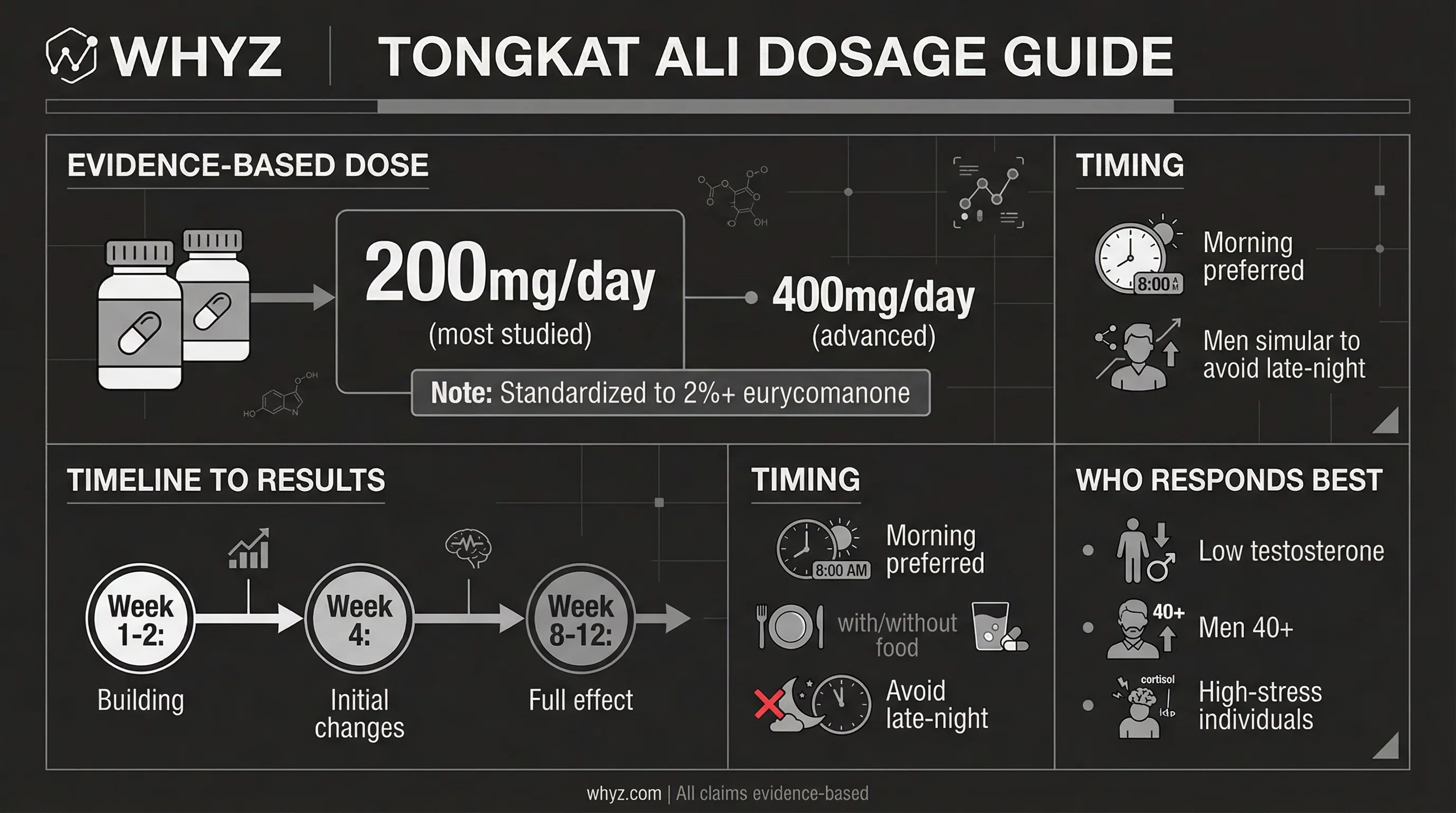
Summary Table
| Parameter | Evidence-Based Range |
|---|---|
| Standard dose | 200-400 mg/day of standardized extract |
| Most studied dose | 200-300 mg/day |
| Trial duration for results | 4-12 weeks |
| Standardization to look for | Eurycomanone content (1-2%) |
| Timing | Morning with or without food |
| Cycling | Not required by evidence (some users prefer 5 days on / 2 days off) |
| Who benefits most | Men with below-normal testosterone or elevated cortisol from stress |
| Maximum dose studied in humans | 400 mg/day (Physta extract, 6 weeks) |
What the Clinical Trials Used
The majority of Tongkat Ali research uses Physta, a freeze-dried water extract standardized to specific eurycomanone and glycosaponin content, developed by Biotropics Malaysia. Because different Physta studies used the same extract, dosing comparisons across them are meaningful. This is not true for the broader supplement market, where different products, extraction methods, and concentrations make mg-to-mg comparisons unreliable.
200 mg/day: The 2013 RCT by Talbott et al. used 200 mg/day of standardized Tongkat Ali in 63 moderately stressed adults for four weeks. Results showed a 16% reduction in cortisol and a 37% increase in testosterone compared to placebo. Mood scores also improved. This is the study most frequently cited for Tongkat Ali’s cortisol-modulating effects (Talbott et al., 2013).
300 mg/day: A 2012 double-blind RCT by Ismail et al. studied 109 men aged 30 to 55 who received 300 mg/day of Physta for 12 weeks. Participants showed significant improvements in sexual well-being scores and quality of life compared to the placebo group (Ismail et al., 2012).
400 mg/day: A 2014 crossover study by Chen et al. gave 400 mg/day of Physta to male recreational athletes for six weeks. Testosterone levels supported the prior efficacy data, and notably, no adverse effects on liver enzymes or kidney function markers were observed. This was specifically designed as a safety study to confirm that the extract does not create hepatotoxic or nephrotoxic risk at this dose (Chen et al., 2014).
The 2022 systematic review and meta-analysis by Leisegang et al. pooled data from multiple RCTs and confirmed that Eurycoma longifolia supplementation significantly improved serum total testosterone across male populations, with the most consistent effects seen in men with hypogonadal baseline levels (Leisegang et al., 2022).
A 2021 six-month RCT by Leitao et al. studied Tongkat Ali in men with androgen deficiency of aging males (ADAM), and found significant improvements in erectile function and testosterone when combined with concurrent exercise training (Leitao et al., 2021).
Why Standardization Matters More Than Milligrams
A product labeled “500 mg Tongkat Ali root” tells you almost nothing about how much active compound you are actually getting.
Raw Tongkat Ali root varies enormously in eurycomanone content depending on the age of the plant, growing conditions, and part of the root used. A product with 500 mg of poorly-sourced, non-standardized root powder may deliver less active compound than a 200 mg standardized extract specifying eurycomanone content.
The clinical evidence is built on standardized extracts, primarily Physta at specific eurycomanone and glycosaponin percentages. When buying a product, look for:
- Stated eurycomanone percentage (1% to 2% is typical for Physta-like extracts)
- “Standardized water extract” or the Physta trademark
- Third-party testing that verifies active compound content
A 200 mg standardized extract with known eurycomanone content is a more reliable dose than 1,000 mg of unknown root powder, regardless of the number on the label.
Does Dose Matter for Different Goals?
The clinical trials do not provide a strong dose-response comparison because most studies used a single dose per treatment arm. What the data does suggest:
Testosterone normalization: The 200-400 mg range consistently showed effects on serum testosterone in men with below-normal levels. There is no evidence that exceeding 400 mg/day produces proportionally greater testosterone increases.
Cortisol reduction and stress: The 200 mg dose in the Talbott et al. RCT showed meaningful cortisol reduction in stressed subjects, suggesting this lower end of the range is sufficient for the cortisol-modulating effect.
Sexual well-being and libido: Both 200 mg and 300 mg doses showed improvements in sexual function and well-being scores across different RCTs.
There is no clinical evidence supporting doses above 400 mg/day. The 2021 Chan et al. study specifically examined whether Eurycoma longifolia affects hormonal regulation in healthy young men with normal testosterone. The results showed attenuated or absent effects in this population, reinforcing that dose is less important than baseline status. Men with normal testosterone show much smaller responses than those with low baseline levels (Chan et al., 2021).
Timing: When to Take It
No head-to-head timing study compares morning versus evening dosing specifically for Tongkat Ali. The practical guidance comes from the compound’s properties:
Morning dosing is generally recommended because the cortisol-reducing effect interacts with the body’s natural diurnal cortisol curve. Cortisol is highest in the morning (cortisol awakening response) and drops throughout the day. Taking Tongkat Ali in the morning targets this peak period. Additionally, the mild energizing effect some users report makes morning dosing preferable to avoid sleep disruption.
With or without food: Clinical trials have not consistently specified fasting status. The extract is water-soluble (Physta is a water-based extract), and food is unlikely to significantly affect absorption. Take it at whatever time is most consistent for you.
Avoid late evening dosing for users who notice increased energy or altered sleep patterns at their given dose.
Should You Cycle Tongkat Ali?
Cycling is widely discussed in supplement forums but has no direct clinical support one way or the other. The clinical trials that showed results ran continuous daily dosing for four to twelve weeks without reported tachyphylaxis (tolerance development).
The cycling recommendations (typically 5 days on / 2 days off, or 8 weeks on / 2 weeks off) appear to originate from precautionary extrapolation rather than trial data. No published study has compared continuous dosing to cycled dosing for efficacy or safety outcomes in humans.
From a practical standpoint: if you are taking a quality standardized extract at 200-400 mg/day for the purpose of supporting testosterone and cortisol balance during a stress-intensive period of life, continuous use for the duration of that period is consistent with how the trials were conducted. If you want to cycle for personal preference or cost management, there is no evidence it harms efficacy to take periodic breaks.
Population-Specific Dosing Notes
Men with low testosterone or androgen deficiency: The clinical trials show the strongest effects here. The 200-400 mg range is appropriate. Start at 200 mg and assess after four to six weeks before increasing.
Healthy young men with normal testosterone: The evidence for significant testosterone increases is weaker. A 2021 study by Chan et al. found minimal HPG axis effects in healthy young males. At this population baseline, Tongkat Ali’s primary benefit may be more about cortisol management and subjective mood than measurable testosterone change.
Men over 40 with age-related testosterone decline: The systematic review and meta-analysis by Leisegang et al. suggests this group benefits meaningfully. The 200-400 mg range is well-studied for this demographic.
Women: Limited human trials exist specifically for women. An ongoing RCT described in a 2023 BMJ Open paper by Muniandy et al. is studying Physta in perimenopausal and postmenopausal women. Until that data is available, dosing guidance for women is not supported by clinical evidence (Muniandy et al., 2023).
What to Expect at Clinical Doses
Managing expectations matters. The research supports these realistic outcomes at 200-400 mg/day of standardized extract:
What the evidence supports:
- Modest normalization of testosterone in men with below-normal baseline levels (not a large absolute increase in men with normal testosterone)
- Meaningful cortisol reduction in moderately stressed individuals
- Improvements in sexual well-being and libido scores on validated questionnaires
- Possible improvements in mood state (reduced tension, anger scores)
What the evidence does not support:
- Dramatic testosterone increases in healthy men with normal baseline levels
- Significant muscle mass gains as a primary outcome
- Dose-dependent benefits above 400 mg/day
- Results appearing faster than four weeks of consistent use
A 2024 systematic review by Morgado et al. that broadly evaluated testosterone-booster supplements found that Tongkat Ali showed better evidence than most other compounds in this category, while noting that the supplement industry broadly overstates effect sizes (Morgado et al., 2024).
Interactions and Contraindications
A 2010 pharmacokinetic study by Salman et al. found that Eurycoma longifolia water extract altered propranolol bioavailability in rats, suggesting potential CYP enzyme interactions (Salman et al., 2010). While this was an animal study, anyone taking cardiovascular medications, beta-blockers, or hormone-related prescriptions should speak with a physician before starting Tongkat Ali.
Individual case reports (not controlled evidence of causality) describe rare liver injury and cardiac arrhythmia in Tongkat Ali users. These do not establish causality but warrant caution for people with pre-existing cardiac conditions or liver concerns.
Men with hormone-sensitive conditions (prostate concerns, for example) should consult a physician before using any testosterone-supporting supplement.
The Bottom Line on Dosage
200 to 400 mg per day of a standardized Tongkat Ali extract is the range supported by human clinical trials. Start at 200 mg, use a product with stated eurycomanone standardization, and give it four to twelve weeks before evaluating results.
Higher doses are not clinically supported. Non-standardized root powders in the 500-1,000 mg range are not backed by the same evidence as the standardized extracts used in trials. The mg number on a non-standardized label is largely meaningless without knowing the active compound content.
For the most consistent results, pair Tongkat Ali with the population context where it works best: men with below-normal testosterone, elevated cortisol from chronic stress, or age-related androgen decline. For healthy young men with normal hormone profiles, the benefit is modest at best.
Frequently Asked Questions
What dose of Tongkat Ali is most studied in humans?
The most commonly studied doses in human RCTs are 200 mg/day (Talbott et al., 2013) and 300 mg/day (Ismail et al., 2012). A 400 mg/day dose was used in a safety-focused study by Chen et al. (2014). These three doses represent the bulk of the standardized clinical evidence.
Can I take more than 400 mg per day?
No clinical evidence supports higher doses producing better results. The trials showing efficacy all fall within the 200-400 mg range using Physta-type extracts. Self-experimenting above this range means going outside the studied safety and efficacy window.
How long until Tongkat Ali starts working?
Most clinical trials ran four to twelve weeks and showed meaningful changes within that window. Do not expect results in under four weeks of consistent daily use at clinical doses.
Does it matter if I take Tongkat Ali with food or on an empty stomach?
Clinical trials have not identified a significant difference. Physta is a water-based extract and is unlikely to be dramatically affected by food intake. Take it at whatever time fits your routine best.
Is 200 mg enough or should I take 400 mg?
The 2013 Talbott et al. RCT showed meaningful cortisol reduction and testosterone support at 200 mg/day. Starting at 200 mg is reasonable. If you have not noticed any effect after six to eight weeks at 200 mg, increasing to 300-400 mg per day is within the studied range.
Why does standardization matter more than the total milligrams?
Because eurycomanone (the primary active compound) content varies dramatically between products. A 500 mg capsule of raw root powder may contain far less eurycomanone than a 200 mg standardized extract. The clinical trials used extracts with known active compound content. Raw powder milligrams are not a reliable proxy for active compound delivery.
Should I take Tongkat Ali if my testosterone is normal?
The clinical evidence suggests smaller benefits in this population. The strongest research is in men with below-normal testosterone or elevated cortisol. If your primary goal is cortisol management or stress resilience, the data supports potential benefits even at normal testosterone baseline. If your goal is a dramatic testosterone increase from an already-normal level, the evidence does not strongly support that outcome.