
Tongkat Ali and Fadogia agrestis are both marketed for the same goal: supporting testosterone levels and male performance. You see them stacked together in formulas, compared in YouTube videos, and debated in fitness forums constantly. But the research behind these two compounds is not even close.
One has decades of human clinical trials. The other has mostly rodent data and one study that also raised safety flags. That gap matters a lot more than most supplement labels acknowledge.
This guide covers what the science actually shows, where each compound stands on safety, and how to think about which one belongs in your regimen.
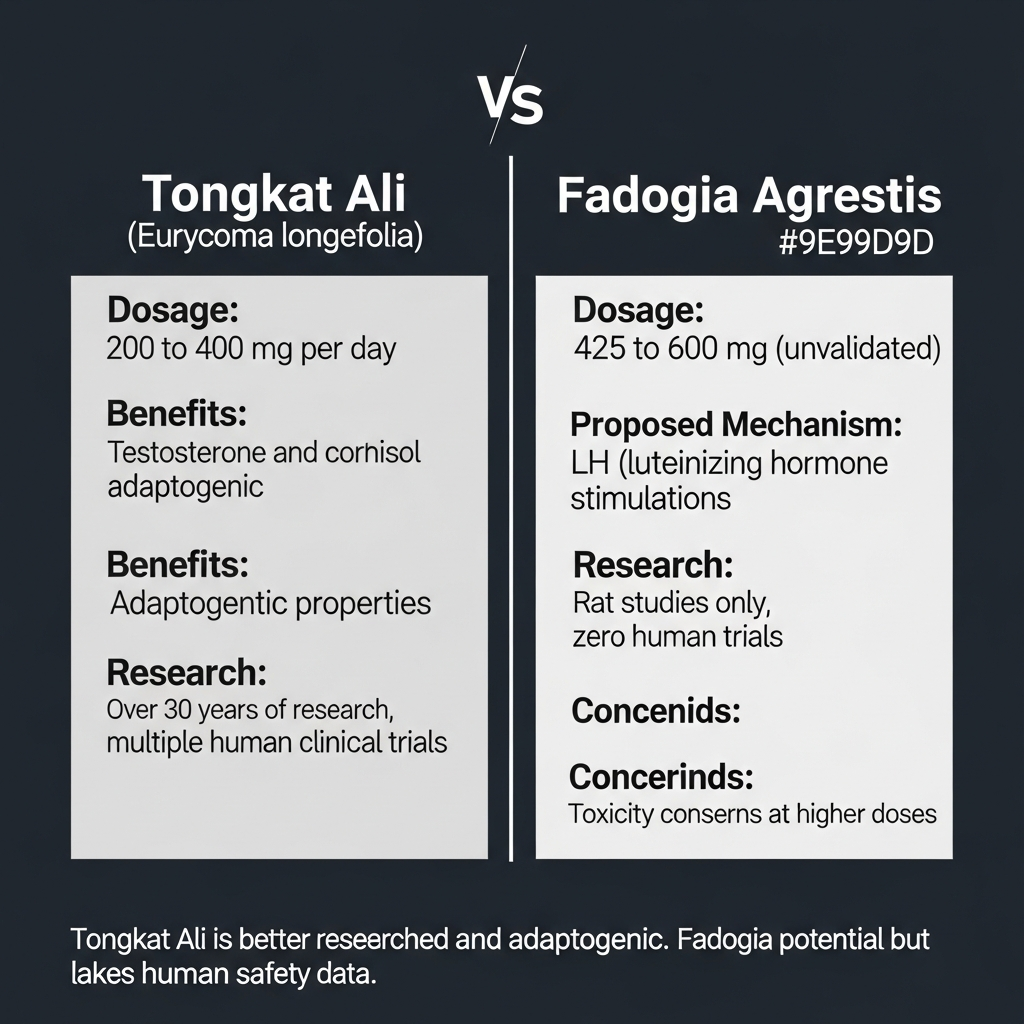
Quick Comparison
| Feature | Tongkat Ali | Fadogia Agrestis |
|---|---|---|
| Scientific name | Eurycoma longifolia | Fadogia agrestis |
| Origin | Southeast Asia (Malaysia, Indonesia) | West Africa (Nigeria) |
| Human clinical trials | Multiple RCTs | None confirmed |
| Proposed mechanism | Cortisol reduction, free testosterone support, possible aromatase inhibition | LH stimulation (in rodents) |
| Evidence for testosterone | Low-moderate (human data exists) | Very low (preclinical only) |
| Safety data | Well-documented, mild side effects | Limited (testicular toxicity in rodents at high doses) |
| Typical dose | 200-400 mg/day (standardized extract) | 425-600 mg/day (common supplement dose) |
| Standardization available | Yes (eurycomanone content) | No |
| Traditional use history | Centuries in Southeast Asia | Limited regional use |
What Is Tongkat Ali?
Tongkat Ali comes from the roots of Eurycoma longifolia, a tree native to Malaysia, Indonesia, and Thailand. It has been used in traditional Southeast Asian medicine for centuries, documented mainly as a general tonic, anti-fatigue remedy, and treatment for reduced libido.
The active compounds include quassinoids (primarily eurycomanone), alkaloids, and peptides. Standardized commercial extracts specify eurycomanone content as a quality marker. The most studied form is a freeze-dried water extract called Physta, developed by Biotropics Malaysia and used in the majority of published clinical trials.
The proposed mechanism is not a direct testosterone-boosting effect in the way most marketing implies. Rather, research suggests Eurycoma longifolia works primarily by reducing cortisol, which in turn reduces the stress-induced suppression of testosterone production. High cortisol levels suppress the hypothalamic-pituitary-gonadal (HPG) axis. By lowering cortisol, the HPG axis can operate closer to its baseline capacity, allowing free testosterone levels to normalize.
What Is Fadogia Agrestis?
Fadogia agrestis is a shrub from West Africa. It has a shorter documented history of traditional use compared to Tongkat Ali, primarily limited to certain regions in Nigeria where the plant was used as a folk aphrodisiac.
The active compounds are believed to include alkaloids and saponins. The proposed mechanism is that Fadogia stimulates luteinizing hormone (LH) release from the pituitary, which then signals the testes to produce more testosterone. This mechanism, however, has only been demonstrated in rodent studies. No controlled human trials have evaluated whether this pathway operates the same way in men.
The Evidence Gap: Human Trials vs. Animal Studies
This is the most important distinction between these two compounds.
Tongkat Ali’s human evidence:
A 2022 systematic review and meta-analysis by Leisegang et al. analyzed randomized clinical trials of Eurycoma longifolia in men. The review found that E. longifolia supplementation significantly improved serum total testosterone in male subjects. The effect was more pronounced in men with below-normal baseline testosterone levels (hypogonadal populations) than in healthy men with normal testosterone (Leisegang et al., 2022).
A 2013 randomized controlled trial by Talbott et al. studied 63 moderately stressed adults (32 men, 31 women) who received 200 mg/day of a standardized Tongkat Ali extract for four weeks. The Tongkat Ali group showed a 16% decrease in cortisol and an 37% increase in testosterone compared to placebo. The researchers also measured significant improvements in tension, anger, and confusion on validated mood assessments (Talbott et al., 2013).
A 2012 double-blind, placebo-controlled RCT by Ismail et al. in 109 men aged 30 to 55 tested 300 mg/day of Physta extract for 12 weeks. The Tongkat Ali group showed significant improvements in sexual well-being scores and quality of life measures compared to placebo (Ismail et al., 2012).
A 2021 six-month RCT by Leitao et al. studied men with androgen deficiency of aging males (ADAM). Tongkat Ali combined with concurrent training significantly improved erectile function scores and testosterone levels compared to training alone (Leitao et al., 2021).
A 2024 systematic review by Morgado et al. assessed testosterone-booster supplements broadly. Among the compounds reviewed, Tongkat Ali showed some of the better evidence for modest testosterone improvement. The authors noted that effect sizes across all testosterone-booster supplements tend to be modest and population-dependent (Morgado et al., 2024).
A 2014 crossover study by Chen et al. confirmed that 400 mg/day of Physta extract for six weeks was safe and did not affect liver or kidney function markers in recreational athletes (Chen et al., 2014).
Fadogia agrestis’s evidence:
The primary Fadogia agrestis study is a 2005 paper by Yakubu et al. in male albino rats. Male rats given aqueous extract of Fadogia agrestis stem at 18 mg/kg, 50 mg/kg, and 100 mg/kg showed dose-dependent increases in serum testosterone and improved sexual behavior parameters (Yakubu et al., 2005).
A 2008 follow-up study by Yakubu et al. examined the testicular effects of the same extract over 28 days in rats. At higher doses (50 mg/kg and 100 mg/kg), the extract caused measurable changes in testicular function indices. Some effects were reversible after a 10-day washout period, but the finding raised concern about potential dose-dependent testicular toxicity (Yakubu et al., 2008).
That is essentially the complete published body of evidence for Fadogia agrestis’s effects on testosterone and sexual function. There are no human clinical trials. There are no dose-response studies in humans. The LH-stimulation mechanism that is widely cited in supplement marketing has not been demonstrated in human subjects.
Safety Profiles
Tongkat Ali has a well-characterized safety profile from multiple human trials spanning four to twelve weeks. Commonly reported side effects at standard doses (200-400 mg/day) include mild increases in energy that can occasionally disrupt sleep if taken late in the day, and possible irritability in sensitive individuals. The 2014 Chen et al. study specifically confirmed that six weeks of Physta at 400 mg/day did not adversely affect liver enzymes or kidney function markers in athletes.
Some case reports exist. A 2025 report described a probable case of cardiac arrhythmia associated with Tongkat Ali use, and a 2024 case report documented a rare liver injury. Both are individual cases, not controlled evidence of causality, but they are worth noting, especially for people with cardiovascular conditions or existing liver concerns.
Fadogia agrestis has a limited human safety dataset. The primary concern comes from the 2008 Yakubu rodent study showing testicular function changes at doses that roughly translate to common supplement serving sizes (depending on the species scaling factor used). The absence of human pharmacokinetic data means there is no confirmed safe dose range for humans. Products on the market typically dose Fadogia at 425 to 600 mg per serving without clinical support for those specific amounts.
This does not mean Fadogia is definitively dangerous at typical supplement doses. It means the data to say it is safe simply does not exist yet.
Why Fadogia Became Popular
Fadogia agrestis’s rise in popularity is almost entirely attributable to podcast and social media exposure starting around 2021-2022, particularly from discussions around its use alongside apigenin. The mechanism (LH stimulation leading to more testosterone production) is compelling and biologically plausible. That plausibility, combined with aggressive marketing and the stacking narrative, drove massive consumer adoption before any human trials were conducted.
This is a well-documented pattern in the supplement industry. A mechanism sounds good in animal models, social media amplifies it, and consumer demand creates a market years before the evidence base catches up.
Who Should Take Tongkat Ali
Tongkat Ali shows the most consistent benefit in men with below-normal testosterone levels, moderately elevated cortisol from chronic stress, or those over 40 experiencing age-related testosterone decline. For healthy young men with normal testosterone levels, the effect size is smaller.
Research also suggests potential benefits for women navigating perimenopause or postmenopause, where hormonal fluctuations affect energy and mood, though this evidence is still early. A 2023 BMJ Open protocol paper by Muniandy et al. describes an ongoing RCT specifically studying Physta in perimenopausal and postmenopausal women (Muniandy et al., 2023).
There is no clear clinical evidence supporting Fadogia agrestis use for any specific population because human trials have not been conducted.
Stacking Both Together
Many commercial testosterone-support supplements stack Tongkat Ali and Fadogia agrestis together. The rationale is that the two mechanisms are additive: Tongkat Ali reduces cortisol suppression of the HPG axis while Fadogia stimulates LH to drive testicular testosterone production.
That logic is mechanistically interesting but clinically untested. No study has examined the combination in humans. The presence of Tongkat Ali in a formula provides the evidential anchor. Fadogia’s contribution in that context remains speculative.
If you choose a product containing both, the Tongkat Ali is doing the work supported by evidence. Fadogia is an unverified add-on whose human effect and human safety margin remain genuinely unknown.
The Bottom Line
Tongkat Ali is the stronger evidence-based choice between these two compounds. Multiple human clinical trials, including a systematic review and meta-analysis, support its effects on testosterone normalization, cortisol reduction, and sexual well-being, particularly in men with below-normal baseline testosterone. It has a documented safety profile from human studies.
Fadogia agrestis has a compelling mechanism story but no human clinical trials to support its effectiveness, and the primary animal research raises enough safety questions that waiting for human data before heavy use is reasonable.
If you want a hormone-support supplement backed by clinical evidence, Tongkat Ali is the defensible choice. Fadogia agrestis may prove effective in future human trials, but that data does not exist yet.
Frequently Asked Questions
Is Fadogia agrestis safe to take daily?
No human safety data exists to confirm what constitutes a safe daily dose of Fadogia agrestis. The only controlled studies were in rats, and higher doses in that research raised concerns about testicular function. This does not mean the compound is definitively unsafe in humans at typical supplement doses, but the absence of human safety data is a real gap, not a marketing oversight.
Does Tongkat Ali actually raise testosterone?
In men with below-normal testosterone levels, controlled trials show meaningful improvements. In healthy young men with normal testosterone, the effect is smaller and less consistent. The primary mechanism appears to be reducing cortisol’s suppressive effect on the HPG axis, allowing testosterone to normalize rather than directly stimulating new production.
How long does Tongkat Ali take to work?
Human trials showing testosterone and cortisol changes typically ran four to twelve weeks. Most clinical trials that showed significant results used the Physta standardized extract at 200-400 mg/day for at least four weeks. Expecting noticeable changes in one to two weeks is not well-supported by the research timeline.
Can women take Tongkat Ali?
The existing clinical trials focused primarily on men. Limited evidence suggests potential benefits for women, particularly around perimenopause, but a definitive evidence base for women’s hormonal benefits does not yet exist. The 2023 BMJ Open RCT protocol by Muniandy et al. suggests this research is actively underway.
What is eurycomanone and why does it matter?
Eurycomanone is the primary bioactive quassinoid compound in Eurycoma longifolia root. Commercial extract standardization to a specific eurycomanone percentage (often 1% to 2%) provides a quality benchmark, since raw Tongkat Ali root varies widely in potency. If a product lists no standardization, the actual active compound content is unknown.
Should I take Tongkat Ali and Fadogia agrestis together?
Many formulas combine them. The Tongkat Ali contribution is evidentially supported. Fadogia’s human contribution is unknown. If you want the stack, you are essentially taking Tongkat Ali with an untested addition. There is no clinical data on interactions between them or combined dosing safety in humans.
Does Tongkat Ali interact with medications?
A 2010 pharmacokinetic study by Salman et al. found that Eurycoma longifolia water extract modified the bioavailability of propranolol, a beta-blocker, in a rat model. While this was an animal study, it raises the possibility of CYP enzyme interactions with certain medications. Anyone taking cardiovascular medications or hormone-related prescriptions should consult a physician before adding Tongkat Ali (Salman et al., 2010). ).