
Home > Learn > Vitamin C Dosage: How Much Should You Take Daily?
Vitamin C is the most widely consumed supplement in the world, with an estimated 50% of U.S. adults taking it in some form. Yet the gap between the official recommended daily allowance and the doses most supplements contain is staggering. The RDA sits at 75 to 90 mg for adults, while a typical supplement capsule delivers 500 to 1,000 mg. That 5-to-10x difference raises a simple question: how much do you actually need?
The answer depends on what you are trying to achieve. Pharmacokinetic research from the National Institutes of Health shows that plasma saturation occurs at roughly 200 mg per day in healthy adults Levine et al. (1996, PMID 8623000). Beyond that threshold, absorption efficiency drops and excess is excreted in urine. But certain populations and goals may warrant higher intakes. Here is what the clinical evidence actually supports.
What Is Vitamin C and Why Does Dosage Matter?
Vitamin C, also called ascorbic acid, is a water-soluble vitamin that the human body cannot produce on its own. It serves as a cofactor in at least eight enzymatic reactions, including the hydroxylation steps required for collagen synthesis. It also functions as a direct antioxidant, scavenging reactive oxygen species in blood and tissues.
Because it is water-soluble, the body does not store large reserves. Excess intake is filtered by the kidneys and excreted within hours. This means consistent daily intake matters more than occasional large doses. Unlike fat-soluble vitamins such as A or D, you cannot “bank” vitamin C for later use. Daily replenishment is the only reliable strategy, and the amount you need depends on your baseline status, lifestyle, and health goals.
How Much Vitamin C Do You Need Per Day?
Three numbers from the National Academies define vitamin C intake targets for healthy adults. The Estimated Average Requirement (EAR) is 60 mg for women and 75 mg for men. The Recommended Dietary Allowance (RDA) is 75 mg for women and 90 mg for men. The Tolerable Upper Intake Level (UL) is 2,000 mg per day for all adults.
Smokers need an additional 35 mg per day above the RDA due to accelerated oxidative depletion of ascorbic acid. Pregnancy raises the RDA to 85 mg, and breastfeeding pushes it to 120 mg. Children and adolescents follow age-adjusted schedules ranging from 15 mg (toddlers) to 75 mg (teens). These figures are designed to prevent deficiency in 97.5% of the population, not to optimize any particular health outcome.
Standard vs. High-Dose Vitamin C: What the Research Shows
NIH pharmacokinetic data show that oral doses of 200 mg per day produce near-complete saturation of plasma and white blood cells Levine et al. (1996, PMID 8623000). At 500 mg, plasma levels plateau and bioavailability drops to roughly 73%. At 1,000 mg, bioavailability falls further to about 50%, with the excess exiting through urine.
This does not mean higher doses are useless. It means the body has a ceiling for circulating ascorbic acid from a single oral dose. Splitting 1,000 mg into two 500 mg doses taken six hours apart maintains higher plasma levels throughout the day than a single 1,000 mg dose. For people with increased oxidative stress, compromised absorption, or higher baseline requirements, doses above the RDA may still confer benefits that the RDA alone would not.
Vitamin C for Immune Support: Does More Help?
A Cochrane meta-analysis of 29 trials involving over 11,000 participants found that regular vitamin C supplementation at doses of 200 mg or more per day did not reduce the incidence of colds in the general population. However, it did reduce cold duration by 8% in adults and 14% in children Hemila and Chalker (2013, PMID 23440782).
The effect was more pronounced in people under heavy physical stress. Five trials involving marathon runners, skiers, and soldiers in subarctic conditions found a 52% reduction in cold incidence with vitamin C supplementation. A 2017 review confirmed that vitamin C contributes to immune defense by supporting both innate and adaptive immunity, including the function of neutrophils and lymphocytes Carr and Maggini (2017, PMID 29099763). The practical takeaway: 200 to 1,000 mg daily may shorten colds and support immune cell function, with the strongest evidence in physically active populations.
Vitamin C for Skin and Collagen
Vitamin C is required for the enzymatic hydroxylation of proline and lysine in collagen synthesis. Without adequate ascorbic acid, collagen production falters, which is why scurvy (severe vitamin C deficiency) causes skin breakdown, bleeding gums, and poor wound healing. Even mild depletion may impair collagen turnover in skin and connective tissue.
A 2017 review found that both dietary and supplemental vitamin C are associated with improved skin appearance, reduced wrinkling, and enhanced protection against UV-induced photodamage Pullar et al. (2017, PMID 28805671). Topical vitamin C operates through different pathways and is better studied for direct skin application, but oral intake ensures systemic availability for collagen synthesis throughout the body. Doses in skin-focused studies typically range from 100 to 1,000 mg per day.
Vitamin C for Athletes and Active Adults
Exercise increases oxidative stress and vitamin C turnover. A 2014 trial found that men with marginal vitamin C status who supplemented with 1,000 mg daily for eight weeks showed measurable improvements in physical activity levels and reported fewer cold symptoms compared to placebo Johnston et al. (2014, PMID 25010554).
Athletes training at high volumes may benefit from 500 to 1,000 mg per day to offset exercise-induced depletion. However, some researchers have raised the concern that very high antioxidant intake could blunt the adaptive signaling pathways triggered by exercise. This remains debated. Current consensus from the ISSN and other sports nutrition authorities is that moderate supplementation (200 to 1,000 mg) supports recovery without meaningfully interfering with training adaptations.
Upper Limit and Safety
The Tolerable Upper Intake Level for vitamin C is 2,000 mg per day for adults. This is not a threshold where toxicity begins, but rather the level above which the risk of adverse effects increases. The most common side effects above the UL are gastrointestinal: diarrhea, nausea, and abdominal cramping. These result from unabsorbed ascorbic acid drawing water into the intestinal lumen through osmotic effects.
High-dose vitamin C also increases urinary oxalate excretion, which may raise the risk of kidney stones in predisposed individuals. People with a history of calcium oxalate stones should exercise caution with doses above 1,000 mg. Those with hereditary hemochromatosis (iron overload) should also be careful, as vitamin C enhances non-heme iron absorption. For the general healthy population, doses up to 2,000 mg are considered safe when taken with adequate hydration.
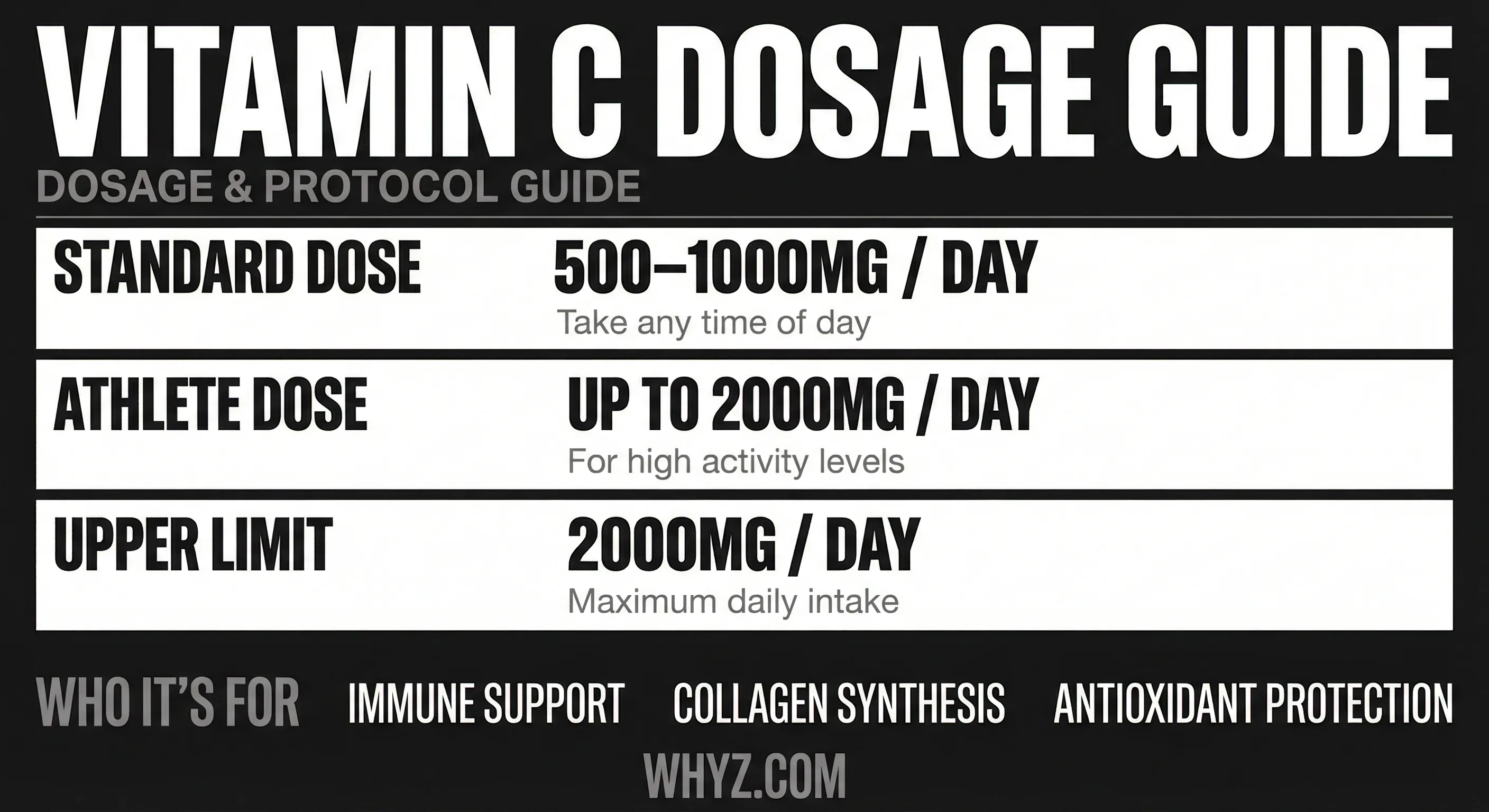
Best Forms of Vitamin C
Ascorbic acid is the most studied and least expensive form. It is effective and well-absorbed at doses up to 200 mg. At higher doses, buffered forms like sodium ascorbate or calcium ascorbate may cause less gastric irritation because they are less acidic.
Liposomal vitamin C encapsulates ascorbic acid in phospholipid spheres, which some studies suggest may improve bioavailability at higher doses by bypassing the normal intestinal absorption limit. However, the evidence base is small, and the price premium is substantial. Ester-C (calcium ascorbate with threonate) has been marketed for superior absorption, but head-to-head comparisons with standard ascorbic acid show minimal practical differences. For most people, plain ascorbic acid or a buffered form works well at a fraction of the cost.
How to Take Vitamin C: Timing and Split Dosing
Vitamin C absorbs best when taken with food, which slows gastric emptying and improves bioavailability. An empty stomach does not block absorption, but taking it with a meal reduces the risk of nausea, especially at higher doses.
Split dosing is the single most effective strategy for maximizing plasma levels. Taking 500 mg twice daily produces more sustained blood levels than 1,000 mg once daily, because the intestinal transporters that absorb ascorbic acid become saturated above roughly 200 to 500 mg per dose. If your goal is immune support or collagen synthesis, spacing two to three smaller doses throughout the day is more effective than one large morning dose. Pair vitamin C with iron-rich meals if you want to boost non-heme iron absorption from plant foods.
Frequently Asked Questions
How much vitamin C should I take daily? The RDA is 75 mg for women and 90 mg for men. Research suggests 200 mg per day achieves near-complete plasma saturation. For immune support or collagen-related goals, 500 to 1,000 mg per day in split doses is a common evidence-informed range.
Can you take too much vitamin C? The Tolerable Upper Limit is 2,000 mg per day. Exceeding this regularly increases the risk of diarrhea, nausea, and abdominal cramping. People prone to kidney stones should stay below 1,000 mg unless advised otherwise by a healthcare provider.
Is 1,000 mg of vitamin C too much? For most healthy adults, 1,000 mg per day is safe and well within the UL of 2,000 mg. Bioavailability drops at single doses above 500 mg, so splitting into two 500 mg servings is more efficient than taking 1,000 mg at once.
Does vitamin C help with colds? Regular supplementation at 200 mg or more per day may reduce cold duration by about 8% in adults. It does not reliably prevent colds in the general population, but physically active individuals appear to benefit more.
What is the best form of vitamin C to take? Ascorbic acid is the most studied, most affordable, and most effective for general use. Buffered forms (sodium or calcium ascorbate) may be gentler on sensitive stomachs. Liposomal vitamin C may improve absorption at very high doses, but costs significantly more.
References
- Levine M, Conry-Cantilena C, Wang Y, et al. (1996). Vitamin C pharmacokinetics in healthy volunteers: evidence for a recommended dietary allowance. Proc Natl Acad Sci USA. PMID: 8623000
- Hemila H, Chalker E. (2013). Vitamin C for preventing and treating the common cold. Cochrane Database Syst Rev. PMID: 23440782
- Carr AC, Maggini S. (2017). Vitamin C and Immune Function. Nutrients. PMID: 29099763
- Pullar JM, Carr AC, Vissers MCM. (2017). The Roles of Vitamin C in Skin Health. Nutrients. PMID: 28805671
- Johnston CS, Barkyoumb GM, Schumacher SS. (2014). Vitamin C supplementation slightly improves physical activity levels and reduces cold incidence in men with marginal vitamin C status. Nutrients. PMID: 25010554