
Branched-chain amino acids are one of the most widely debated supplements in sports nutrition, and timing is the question that comes up most. Should you take them before training to reduce muscle breakdown? During to sustain performance? After to accelerate recovery?
The research on this is more nuanced than most supplement labels suggest. BCAAs: leucine, isoleucine, and valine: have clear mechanistic roles in muscle protein synthesis and exercise metabolism. But the clinical evidence for one timing window being definitively superior over another is weaker than the marketing implies.
Here is what the science actually says and where timing decisions make a genuine difference.
What BCAAs Do During Exercise
To understand when timing matters, you need to understand what BCAAs are doing physiologically during a training session.
Leucine and muscle protein synthesis signaling: Leucine is the primary trigger for muscle protein synthesis (MPS) through the mTORC1 pathway. When blood leucine rises above a certain threshold, mTOR activates and initiates the cellular machinery for muscle repair and growth. This is well-established in the mechanistic literature (Wolfe, 2017).
Isoleucine and glucose uptake: Isoleucine drives glucose transport into muscle cells, supporting energy availability during exercise. It increases GLUT4 translocation to the cell membrane, effectively improving how efficiently your muscles access carbohydrate fuel.
Valine and energy metabolism: Valine contributes to nitrogen balance and participates in energy metabolism, though its specific contribution is less studied than leucine or isoleucine.
The critical limitation: BCAAs can trigger the initiation signal for MPS, but completing the full MPS response requires all nine essential amino acids. If your body cannot source the remaining six from blood or muscle stores, the process stalls. This is why EAAs or whole protein sources provide a more complete MPS stimulus than BCAAs alone: and why the context of your total dietary protein intake matters enormously for evaluating BCAA benefit (Wolfe, 2017).
Anti-inflammatory role: BCAAs also play a role in managing exercise-induced inflammation. A 2025 review found that BCAA supplementation attenuates inflammatory markers including IL-6 and TNF-alpha following endurance exercise, supporting faster recovery between sessions (Pasiakos et al., 2025).
Pre-Workout BCAAs: The Case For
Taking BCAAs 30-60 minutes before training creates elevated plasma amino acid concentrations that peak during your session. This matters for two specific scenarios.
Fasted training: When you train after an overnight fast or in a calorie-restricted state, muscle protein breakdown rates increase to supply amino acids for energy and to maintain blood glucose. A BCAA dose before fasted training provides a direct amino acid source, reducing the degree to which muscle tissue is broken down for fuel. This is the scenario where pre-workout BCAAs have the clearest rationale: they provide substrate without meaningfully disrupting the hormonal state of a fast (since BCAAs are calorie-sparse and do not spike insulin significantly at typical doses).
Delayed meal timing: If you are training more than 3-4 hours after your last protein-containing meal, your blood amino acid levels will be low. A pre-workout BCAA serving helps ensure amino acids are available when the muscle-damaging stimulus of training hits.
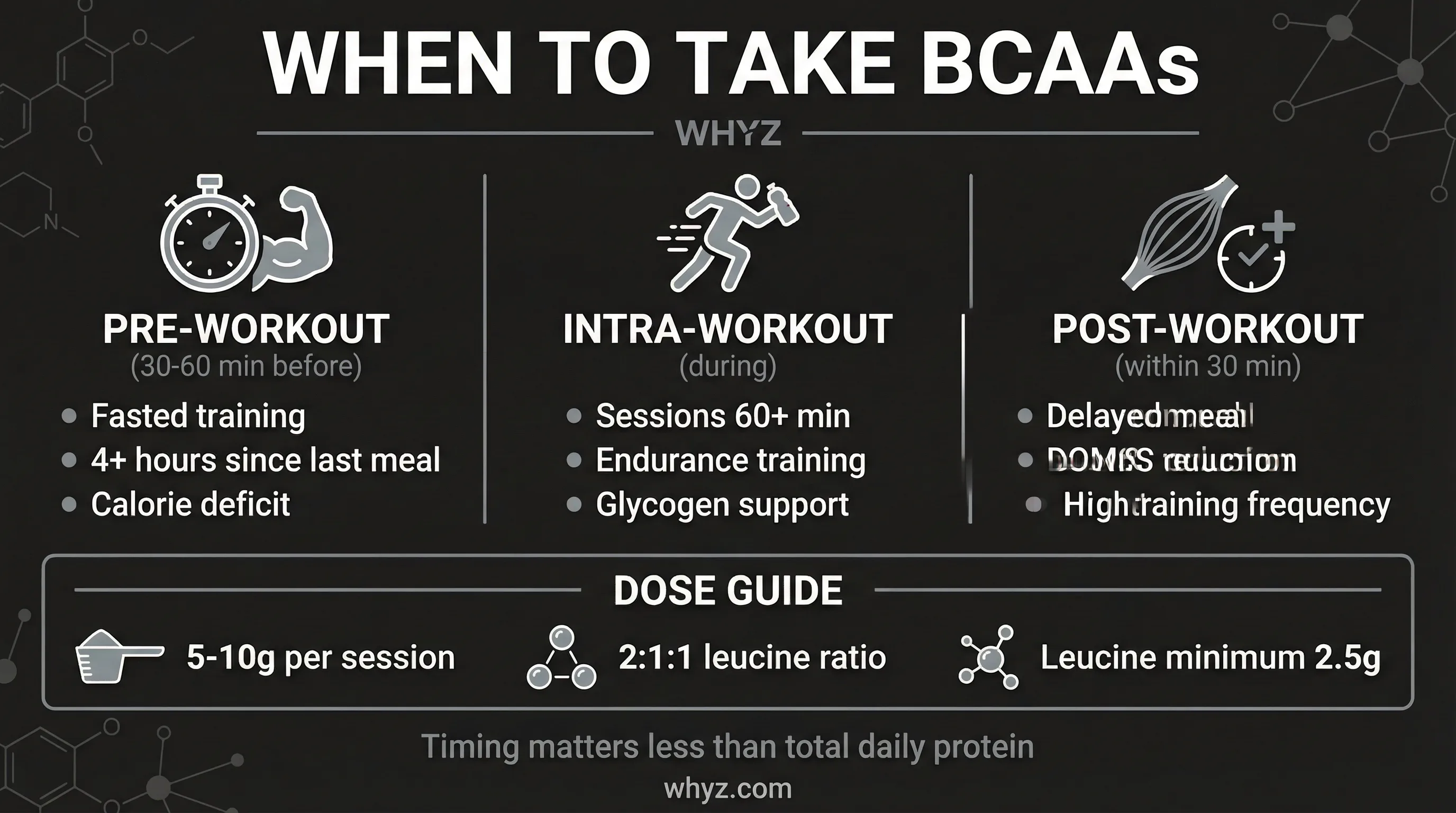
Practical dose before training: 5-10 g, taken 30-60 minutes pre-workout. Leucine-dominant products (2:1:1 or higher leucine ratio) are preferred for the MPS signaling effect.
Intra-Workout BCAAs: When They Help Most
Intra-workout BCAAs make the most sense for extended training sessions: typically those lasting more than 60-75 minutes.
Glycogen conservation: During prolonged exercise, your body increasingly relies on amino acid oxidation for fuel as glycogen stores deplete. BCAAs can serve as an additional energy substrate, sparing glycogen and potentially extending endurance. Isoleucine’s role in glucose transport becomes particularly relevant in this extended window.
Fatigue reduction: Tryptophan competes with BCAAs for the same transport protein to cross the blood-brain barrier. During extended exercise, BCAA concentrations in blood drop while free tryptophan rises, increasing serotonin production in the brain: a proposed mechanism of central fatigue. Maintaining BCAA availability during long sessions may slow this process, though human evidence for the central fatigue hypothesis is mixed.
Who benefits most: Endurance athletes, those doing 90-minute or longer sessions, and anyone training in a fasted or calorie-restricted state. For standard 45-60 minute resistance training sessions with adequate pre-workout nutrition, intra-workout BCAAs provide minimal additional benefit.
Intra-workout dose: 5-10 g in water throughout the session. This works well in an unflavored or lightly flavored form to avoid GI issues during training.
Post-Workout BCAAs: Recovery Support
Post-workout is the most common time people take BCAAs, driven by the logic that muscles are most receptive to amino acids immediately after training. The anabolic window concept is real but shorter and less dramatic than supplement marketing historically claimed.
Where post-workout BCAAs help: If you cannot consume a full protein-rich meal within 1-2 hours of training, a post-workout BCAA supplement provides immediate amino acid availability to begin muscle repair. The leucine spike re-activates the MPS signal that your workout triggered.
The protein adequacy caveat: Post-workout BCAAs provide the most benefit when total daily protein intake is insufficient or delayed. If you regularly eat adequate protein (around 1.6-2.2 g/kg/day) and consume a protein-containing meal within 1-2 hours of training, the incremental benefit of an additional BCAA supplement is smaller.
Muscle soreness reduction: The evidence for BCAAs reducing delayed onset muscle soreness (DOMS) is consistent across several studies. Post-workout BCAAs may reduce soreness magnitude and accelerate functional recovery, which matters if you train multiple times per week in the same muscle groups.
Post-workout dose: 5-10 g immediately after training, ideally with a small carbohydrate source to support glycogen replenishment.
Timing Comparison: What Actually Matters
| Timing | Best For | Benefit Strength |
|---|---|---|
| Pre-workout (30-60 min before) | Fasted training, sessions 4+ hours after last meal, calorie deficit | Moderate to high in relevant contexts |
| Intra-workout (during session) | Sessions 60+ minutes, endurance training, prolonged effort | Moderate for extended sessions |
| Post-workout (within 30 min) | Delayed post-workout meal, high training frequency, DOMS reduction | Moderate, conditional on protein intake |
| Morning (with breakfast) | Daily dose with first meal regardless of training | Low incremental benefit vs. whole protein |
The honest answer is that all three windows are viable, and none is dramatically superior to the others for most people. The bigger variables are:
- Your total daily protein intake
- Whether you are training fasted or fed
- Session duration and intensity
- Whether you can access whole protein foods around training
How Much to Take
The dose range studied in clinical research is 5-20 g per session, with most trials using 10-15 g for performance and recovery outcomes.
For most people, 5-10 g per session is sufficient. This provides a meaningful leucine dose (2.5-5 g at a 2:1:1 ratio) to trigger MPS signaling without excessive cost or calories.
The 2:1:1 ratio (leucine:isoleucine:valine) is the most common and reflects the natural ratio in food protein. Higher leucine ratios (4:1:1 or above) are used by some practitioners to maximize the MPS signal, particularly for older adults where leucine thresholds for MPS appear higher.
Older adults: Research suggests the leucine threshold for triggering MPS increases with age. Adults over 50 may need higher leucine doses per serving: in the 3-4 g range: to achieve the same MPS activation that 2.5 g achieves in younger adults.
The Protein Adequacy Question
This is the most important consideration when evaluating BCAA supplements, and it is rarely discussed on product labels.
If your total daily protein intake is adequate (1.6-2.2 g/kg/day from whole foods and/or protein supplements), the incremental benefit of isolated BCAA supplements is smaller. Whole protein sources: chicken, eggs, whey, Greek yogurt: contain BCAAs as well as all six other essential amino acids. They provide the complete stimulus for MPS that isolated BCAAs cannot.
BCAAs are most valuable when:
- Total daily protein intake is below target
- Training is done fasted or in a calorie deficit
- Whole protein consumption around training is limited
- You are trying to reduce muscle breakdown during weight loss phases
- Training frequency is high and soreness/recovery is a bottleneck
BCAAs add less value when:
- You already eat 1.6+ g/kg/day of quality protein
- You consume a protein-rich meal within 1-2 hours of training
- Your training sessions are shorter than 60 minutes and at moderate intensity
Who Benefits Most from BCAA Timing
Physique athletes in a cut: Calorie deficits reduce total protein from food. BCAAs provide a low-calorie amino acid source that can protect muscle mass during cutting phases. Pre-workout and intra-workout timing is particularly relevant here.
Endurance athletes: Long training sessions with glycogen depletion and high muscle-protein turnover make intra-workout BCAAs more relevant than for strength-only training.
Older adults (50+): Age-related anabolic resistance means muscle tissue is less responsive to the MPS signal. Higher leucine doses per serving and more frequent protein meals: including BCAA supplementation between meals: may help older adults maintain muscle mass.
Vegetarians and vegans: Plant-based diets tend to be lower in leucine specifically. BCAA supplementation may help close the leucine gap for athletes following plant-based eating patterns.
High-frequency trainers: Training the same muscle group 3-4 times per week leaves less time for recovery. Post-workout BCAAs that reduce DOMS can directly support training adherence in high-frequency programs.
Common Timing Mistakes
Taking BCAAs on top of an already adequate protein shake: If you are consuming 25-40 g of whey protein post-workout, that shake already contains 5-7 g of BCAAs. Adding a separate BCAA supplement on top adds cost with minimal added benefit.
Relying on BCAAs as a protein replacement: BCAAs trigger MPS initiation but cannot sustain it without the full complement of essential amino acids. Using them as a substitute for whole protein or protein supplements will leave MPS incomplete.
Ignoring the dose: 2-3 g BCAA servings marketed in some pre-workout blends are below the threshold for meaningful leucine signaling (which requires roughly 2.5-3 g of leucine alone). Check the leucine content specifically, not just total BCAAs.
Expecting results from timing without sufficient total dose: Taking BCAAs at the perfect time in a 3 g serving is less effective than taking a 10 g serving at a less-than-perfect time.
Frequently Asked Questions
Do BCAAs break a fast? BCAAs contain 4 calories per gram, so they are technically not a zero-calorie supplement. However, they do not spike insulin significantly and do not suppress autophagy in the way carbohydrates or fat would. For most fasting goals (hormonal, performance), a 5-10 g BCAA serving before fasted training is a reasonable compromise.
Should I take BCAAs before or after a workout? For most people, one well-timed serving accomplishes more than splitting the dose. If you train fasted, pre-workout timing takes priority. If you train fed but have a delayed post-workout meal, post-workout timing matters more. Both windows work.
How long before a workout should I take BCAAs? 30-60 minutes is sufficient for absorption and peak plasma levels during training. Taking them immediately before works as well for most people: the absorption window is not as precise as it is sometimes marketed.
Do BCAAs cause weight gain? At 4 calories per gram and typical doses of 5-10 g, a BCAA serving contributes 20-40 calories. This is unlikely to cause weight gain in isolation. Some people experience water retention during initial use, which resolves.
Are BCAAs worth taking if I already use whey protein? If your whey is getting you to your daily protein targets and you consume it around training, isolated BCAA supplements provide minimal additional benefit. The exception is fasted training, where BCAAs before and whey after is a reasonable strategy.
Can I take BCAAs every day? Yes. BCAAs are essential amino acids, and daily intake: from food or supplements: is normal. There is no established need to cycle them.
Summary
Timing does matter for BCAAs, but not as much as total dose and total daily protein intake. The clearest timing advantages are:
- Pre-workout when training fasted or 4+ hours after the last protein meal
- Intra-workout for sessions exceeding 60-75 minutes
- Post-workout when a protein-rich meal is more than 1-2 hours away
For most people exercising with adequate nutrition, a single 10 g serving of BCAAs at whichever window is most convenient will cover the bases. The goal is consistent daily amino acid availability around training, not perfect timing optimization.
For more context on how BCAAs compare to full essential amino acid supplements, see the BCAA vs EAA guide. For dosage specifics, see the BCAA dosage page.
References
-
Wolfe RR. Branched-chain amino acids and muscle protein synthesis in humans: myth or reality? J Int Soc Sports Nutr. 2017;14:30. PMID 28175999
-
Pasiakos SM, McLellan TM, Lieberman HR. Branched-Chain Amino Acids and Inflammation Management in Endurance Sports: Molecular Mechanisms and Practical Implications. Nutrients. 2025;17(8):1323. PMID 40284200
-
Stokes T, Hector AJ, Morton RW, McGlory C, Phillips SM. Recent Perspectives Regarding the Role of Dietary Protein for the Promotion of Muscle Hypertrophy with Resistance Exercise Training. Nutrients. 2018;10(2):180. PMID 30340425
-
Phillips SM, Van Loon LJC. Dietary proteins for athletes: From requirements to optimum adaptation. J Sports Sci. 2011;29 Suppl 1:S29-38. PMID 22301837
-
Drummond MJ, Rasmussen BB. Leucine-enriched nutrients and the regulation of mammalian target of rapamycin signalling and human skeletal muscle protein synthesis. Curr Opin Clin Nutr Metab Care. 2008;11(3):222-226. PMID 24751198
-
Zanini AS, de Oliveira Alves E, de Figueiredo LJA, et al. Effects of Amino Acid Supplementation on Muscle protein metabolism and adaptation: a narrative review. Nutrients. 2025;17(17). PMID 41093311