
Quick Facts
| Property | Details |
|---|---|
| What it is | Cytidine 5’-diphosphocholine, a naturally occurring nucleotide that provides both choline and uridine (via cytidine conversion) |
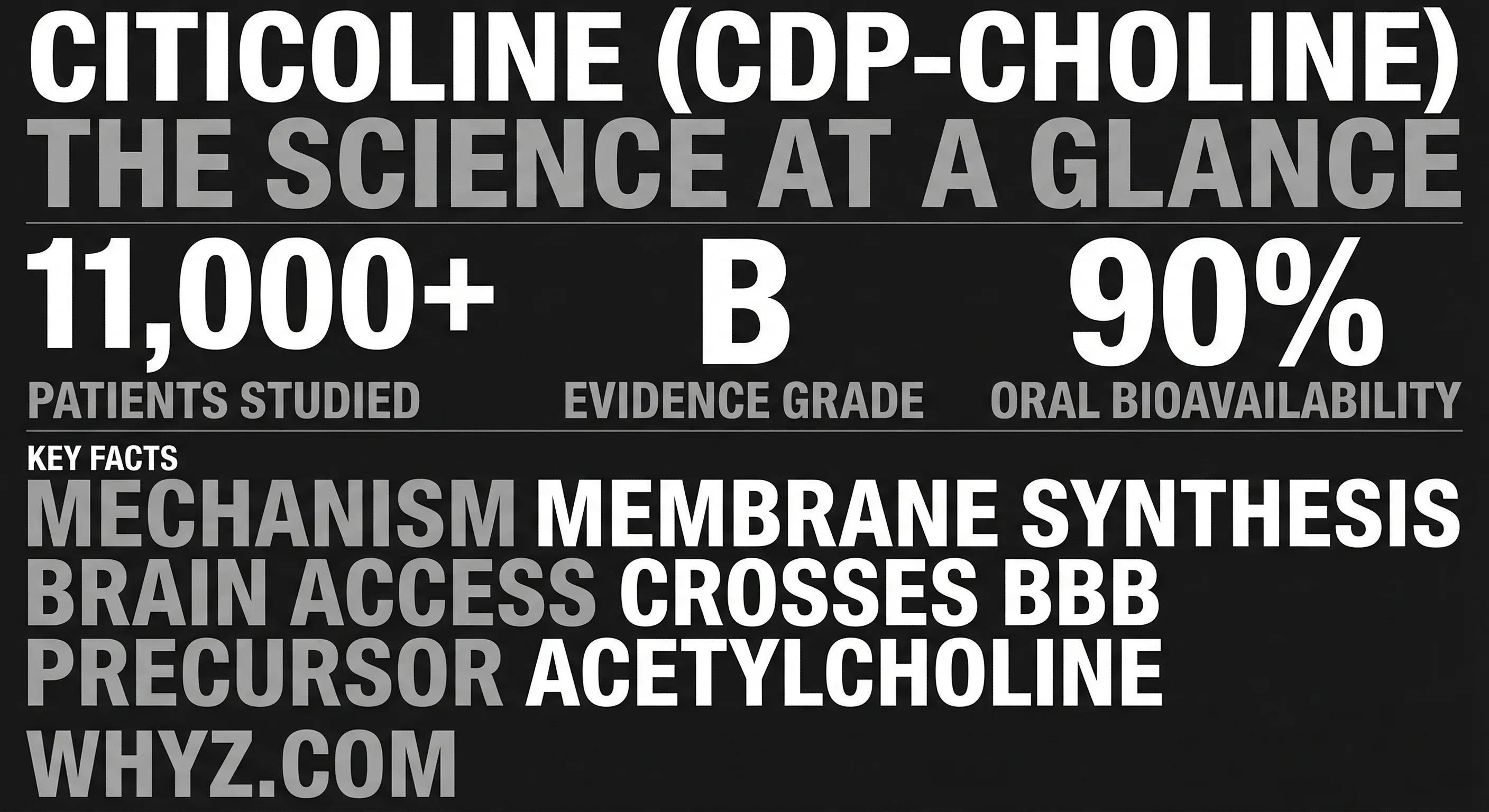
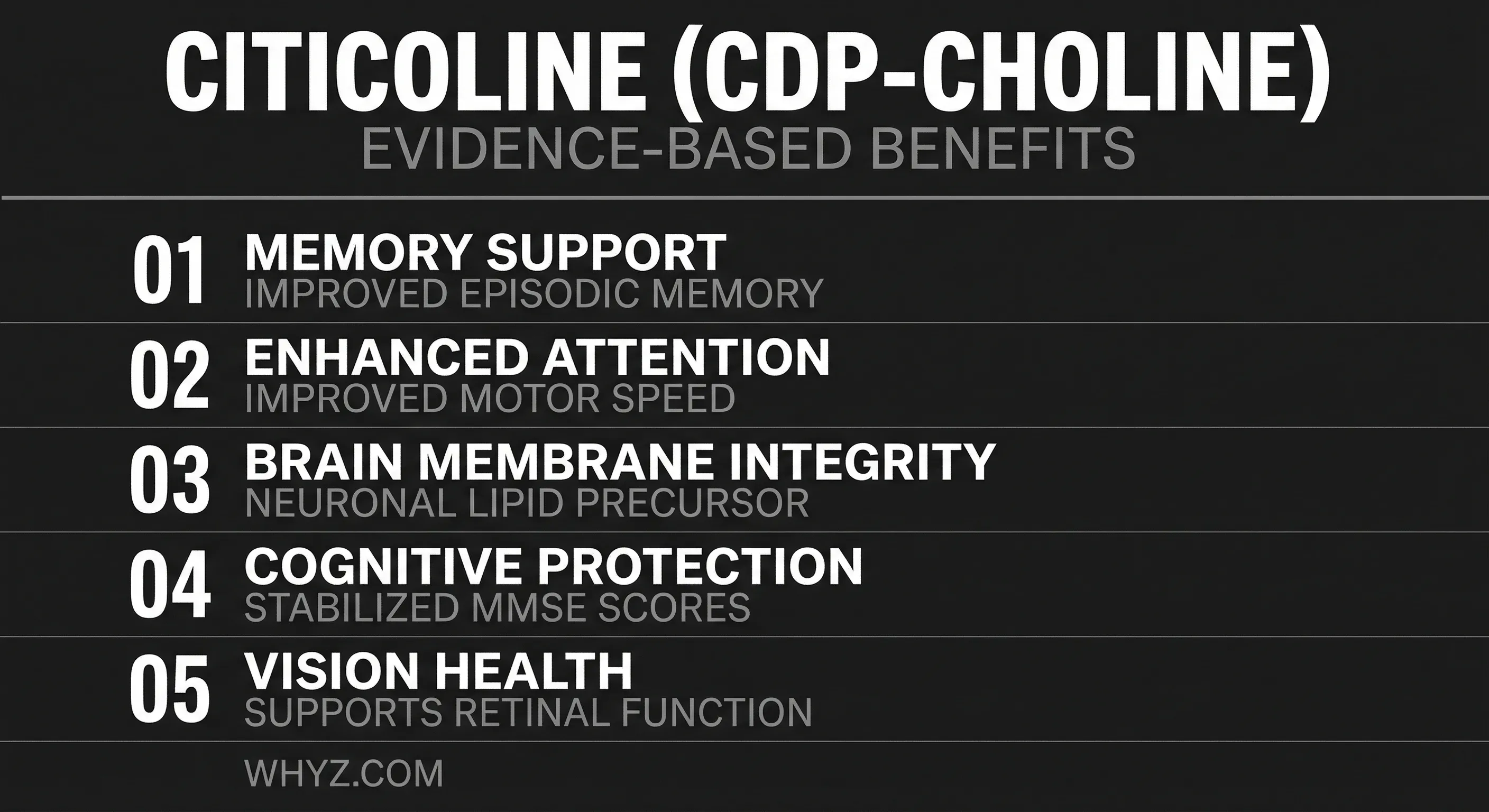
| Primary Benefits | Memory support, attention, neuronal membrane integrity, choline status |
| Standard Dosage | 250-500 mg daily |
| Best Time to Take | Morning, with or without food |
| Evidence Grade | B (multiple RCTs with modest effect sizes, mostly small sample sizes) |
| Bioavailability | >90% oral absorption, comparable to intravenous administration |
What Is Citicoline?
Citicoline is a compound that the body produces naturally as part of building brain cell membranes. The chemical name is cytidine 5’-diphosphocholine, often abbreviated as CDP-choline. Every cell in the nervous system relies on citicoline as an intermediate step in manufacturing phosphatidylcholine, the most abundant phospholipid in neuronal membranes.
The compound was first isolated in 1955 by Eugene Kennedy, who identified its role in the CDP-choline pathway for phospholipid biosynthesis. As a supplement, citicoline has been studied in over 11,000 patients across clinical trials spanning cognitive function, stroke recovery, and vision health (Secades, 2022). Japan and several European countries have approved citicoline as a prescription drug for neurological conditions, while the United States and most other markets classify it as a dietary supplement.
Citicoline stands apart from other choline supplements (choline bitartrate, alpha-GPC) because oral citicoline delivers two bioactive molecules at once. The compound splits in the gut into choline and cytidine. Cytidine then converts to uridine, a nucleotide that independently supports brain membrane synthesis (Weiss, 1995). This dual-delivery mechanism is why researchers sometimes call citicoline a “prodrug” for both choline and uridine.
How Does Citicoline Work?
Citicoline’s mechanism centers on the CDP-choline pathway, the primary biosynthetic route for phosphatidylcholine in all mammalian cells. Phosphatidylcholine constitutes roughly 40-50% of the total phospholipid mass in neuronal cell membranes. The pathway requires three substrates: choline, cytidine triphosphate (CTP), and diacylglycerol (Adibhatla & Hatcher, 2002).
Dual absorption pathway. After oral ingestion, citicoline is hydrolyzed in the gut wall and liver into free choline and cytidine. Absorption is nearly complete, with less than 1% of an administered dose appearing in feces. Plasma levels peak at approximately 1 hour after ingestion, with a second, larger peak at 24 hours as the compounds redistribute (Secades & Lorenzo, 2006). Oral bioavailability exceeds 90%, making the oral route essentially equivalent to intravenous delivery.
Cytidine-to-uridine conversion. Cytidine undergoes deamination to uridine in the liver and other tissues. Uridine enters the brain via nucleoside transporters, where it is phosphorylated to uridine triphosphate (UTP) and then to CTP. CTP is the rate-limiting substrate for phosphatidylcholine synthesis. Cansev (2008) demonstrated that oral CDP-choline administration increased plasma uridine concentrations and promoted the formation of new brain synapses in rodent models (Cansev, 2008).
Choline and acetylcholine. The free choline component crosses the blood-brain barrier via choline transporters and enters the acetylcholine synthesis pathway. Acetylcholine is the primary neurotransmitter for memory encoding, attention, and neuromuscular function. Citicoline provides choline without depleting membrane phosphatidylcholine stores, a problem that occurs when the brain scavenges its own membranes for acetylcholine precursors under conditions of high cholinergic demand (Grieb, 2014).
Additional proposed mechanisms. Preclinical research suggests citicoline may preserve cardiolipin and sphingomyelin content in brain membranes, stimulate glutathione synthesis (an antioxidant), and reduce glutamate-mediated excitotoxicity during oxygen deprivation (Rao et al., 2000). These findings come primarily from ischemia models and should not be directly extrapolated to healthy-population supplementation.
What Are Citicoline’s Benefits?
The clinical evidence for citicoline spans cognitive function in healthy adults, post-stroke recovery, and vision health. The strongest supplementation-relevant data comes from trials in healthy older adults and individuals with mild age-related cognitive changes.
Memory in healthy older adults. Nakazaki et al. (2021) conducted a randomized, double-blind, placebo-controlled trial in 100 healthy older adults (50-85 years) with age-associated memory impairment. Participants received 500 mg/day of citicoline (as Cognizin) for 12 weeks. The citicoline group showed improved episodic memory composite scores compared to placebo, with the largest effects in delayed recall tasks (Nakazaki et al., 2021).
Attention in adolescents. McGlade et al. (2019) studied citicoline in healthy adolescent males (13-18 years) using doses of 250 mg/day and 500 mg/day for 28 days. Both dose groups showed improved motor speed and attention compared to placebo, with the 500 mg dose producing a 25% improvement in attention accuracy on the CPT-II continuous performance test (McGlade et al., 2019).
Mild cognitive impairment. Cotroneo et al. (2013) evaluated 265 elderly patients with mild vascular cognitive impairment treated with 500 mg/day citicoline for 9 months. MMSE scores remained stable in the citicoline group while declining in the untreated group, suggesting a protective effect against cognitive deterioration in that population (Cotroneo et al., 2013).
Post-stroke cognitive recovery. Alvarez-Sabin et al. (2013) followed first-ever ischemic stroke patients treated with 1,000 mg/day citicoline for 12 months. Citicoline-treated patients showed less cognitive decline in attention-executive function and temporal orientation domains compared to those not receiving citicoline (Alvarez-Sabin et al., 2013).
Vision and glaucoma research. Citicoline has been studied for its effects on retinal ganglion cell function and visual pathway integrity. Oddone et al. (2021) reviewed the evidence and found that citicoline may support visual function in patients with glaucoma and other optic neuropathies, potentially through its membrane-stabilizing and neuroprotective properties (Oddone et al., 2021).
For detailed coverage of each benefit with full study citations, see the benefits subpage.
How Much Citicoline Should You Take?
Most clinical trials in healthy or mildly impaired populations use doses between 250 and 500 mg per day. The European Food Safety Authority (EFSA) has set a maximum recommended intake of 500 mg/day for dietary supplements and 1,000 mg/day for medical foods.
The Nakazaki et al. (2021) memory trial used 500 mg/day, and the McGlade et al. (2019) attention study found benefits at both 250 mg and 500 mg per day. For general cognitive support in healthy adults, 250-500 mg/day taken in the morning aligns with the available evidence.
Higher doses (1,000-2,000 mg/day) appear in stroke and neurological research but are not necessary or recommended for general supplementation. Some evidence suggests that 250 mg/day may be sufficient for healthy individuals, with higher doses reserved for clinical applications (Gareri et al., 2015).
Citicoline can be taken with or without food. The compound is water-soluble, and food does not appear to meaningfully affect absorption given the already high (>90%) oral bioavailability.
For detailed dosing protocols, see the dosage subpage.
Is Citicoline Safe?
Citicoline has an established safety profile across multiple clinical trials and post-marketing surveillance studies spanning decades. A 2022 comprehensive review by Secades analyzed safety data from trials involving over 11,000 patients and found adverse event rates comparable to placebo at standard doses (Secades, 2022).
Common side effects. The most frequently reported adverse effects are mild and gastrointestinal: stomach discomfort, nausea, and diarrhea. These occur at low rates and are typically indistinguishable from placebo in controlled trials. Headache, restlessness, and insomnia have been reported occasionally (Lozano Fernandez, 1983).
Drug interactions. Citicoline may enhance the effects of levodopa, a Parkinson’s disease medication. Individuals taking levodopa should consult their healthcare provider before supplementing with citicoline. A potential interaction with antipsychotic medications has been noted, as citicoline’s dopaminergic effects could theoretically interfere with dopamine-blocking drugs.
Populations to exercise caution. Pregnant and breastfeeding women should avoid citicoline due to insufficient safety data in these populations. Individuals with psychotic conditions should use citicoline only under medical supervision, as some case reports have raised concerns about exacerbation of symptoms.
Citicoline is not intended to diagnose, treat, cure, or prevent any disease.
For the complete safety profile including contraindications, see the side effects subpage.
Forms of Citicoline
Citicoline supplements are available in several forms:
Free-form powder offers flexible dosing and fast dissolution in water. Pure citicoline powder has a mildly bitter taste. Powder form allows precise dose adjustment between 250 and 500 mg.
Capsules provide pre-measured doses, typically 250 mg or 500 mg per capsule. Capsules are convenient but offer less dosing flexibility than powder.
Cognizin is a patented, branded form of citicoline produced through a fermentation process. Several clinical trials, including the Nakazaki et al. (2021) memory study, used Cognizin specifically. This form has been granted GRAS (Generally Recognized as Safe) status by the FDA for use in foods and beverages.
Combination products pair citicoline with other nootropic ingredients such as phosphatidylserine, bacopa, or omega-3 fatty acids. These can be convenient but make it harder to attribute effects to citicoline specifically and limit dose adjustment.
When evaluating supplements, look for products that specify the citicoline content per serving (not just a proprietary blend weight) and have third-party testing for purity.
How Does Citicoline Compare to Other Choline Sources?
Three choline supplements dominate the market: citicoline (CDP-choline), alpha-GPC, and choline bitartrate. Each delivers choline through a different mechanism with different secondary benefits.
Citicoline vs. alpha-GPC. Alpha-GPC (alpha-glycerylphosphorylcholine) contains approximately 40% choline by weight, compared to roughly 18% for citicoline. Alpha-GPC delivers more raw choline per gram but does not provide the cytidine/uridine component that citicoline offers. Alpha-GPC has stronger evidence for acute power output in athletes, while citicoline’s evidence base is stronger for sustained cognitive applications.
Citicoline vs. choline bitartrate. Choline bitartrate is the most affordable choline source, delivering approximately 41% choline by weight. It effectively raises plasma choline levels and supports liver function. Brain-specific evidence for choline bitartrate is limited compared to citicoline. Choline bitartrate does not provide uridine or cross the blood-brain barrier as efficiently as citicoline-derived choline.
When citicoline makes sense. Citicoline is the preferred form when the goal is cognitive support or brain membrane health. The dual choline-plus-uridine delivery gives citicoline a mechanistic advantage that other choline sources lack. For simple choline status correction (meeting daily adequate intake), choline bitartrate is a more cost-effective option.
Frequently Asked Questions
Does citicoline cross the blood-brain barrier?
Citicoline itself is hydrolyzed before reaching the brain. The resulting choline and cytidine (converted to uridine) cross the blood-brain barrier independently via specific transporters. Once in the brain, these components are resynthesized into CDP-choline by CTP:phosphocholine cytidylyltransferase, the rate-limiting enzyme in phosphatidylcholine synthesis (Weiss, 1995).
Can you take citicoline every day?
Clinical trials have used daily dosing for periods up to 12 months without reports of serious adverse effects (Alvarez-Sabin et al., 2013). The Secades (2022) review encompassing over 11,000 patients found no safety signals associated with chronic use at recommended doses.
How long does citicoline take to work?
Plasma levels of choline and cytidine peak within 1 hour of oral ingestion. Cognitive benefits in clinical trials typically emerge after 4-12 weeks of consistent daily supplementation. The Nakazaki et al. (2021) memory trial measured improvements at 12 weeks. Acute single-dose cognitive effects have not been consistently demonstrated in healthy populations.
Is citicoline the same as CDP-choline?
Yes. Citicoline and CDP-choline (cytidine 5’-diphosphocholine) are two names for the same compound. “Citicoline” is the more common term in supplement and pharmaceutical contexts, while “CDP-choline” is preferred in biochemistry.
Can you take citicoline with coffee?
No adverse interaction between citicoline and caffeine has been reported. Both compounds support alertness through different mechanisms (citicoline via cholinergic support, caffeine via adenosine receptor blockade). Some users report complementary effects when combining the two.
Who should avoid citicoline?
Pregnant and breastfeeding women should avoid citicoline due to insufficient safety data. Individuals taking levodopa or antipsychotic medications should consult their healthcare provider before use. People with a history of psychotic episodes should use citicoline only under medical supervision.
Source in Bulk
Looking to source bulk citicoline (CDP-choline) powder for manufacturing or formulation? WHYZ supplies wholesale quantities with COA documentation and free evaluation samples. Request a quote →
References
-
Secades JJ. Citicoline: pharmacological and clinical review, 2022 update. Rev Neurol. 2022;75(Suppl 5):S1-S89. PMID: 36544369
-
Jasielski P, Piędel F, Piwek M, et al. Application of Citicoline in Neurological Disorders: A Systematic Review. Nutrients. 2020;12(10):3113. PMID: 33053828
-
Nakazaki E, Mah E, Saber FR, et al. Citicoline and Memory Function in Healthy Older Adults: A Randomized, Double-Blind, Placebo-Controlled Clinical Trial. J Nutr. 2021;151(8):2153-2160. PMID: 33978188
-
McGlade E, Locatelli A, Hardy J, et al. Improved Attentional Performance Following Citicoline Administration in Healthy Adult Women. Food Nutr Sci. 2012;3(6):769-773.
-
McGlade E, Agoston AM, DiMuzio J, et al. The Effect of Citicoline Supplementation on Motor Speed and Attention in Adolescent Males. J Atten Disord. 2019;23(2):121-134. PMID: 26179181
-
Weiss GB. Metabolism and actions of CDP-choline as an endogenous compound and administered exogenously as citicoline. Life Sci. 1995;56(9):637-660. PMID: 7869846
-
Secades JJ, Lorenzo JL. Citicoline: pharmacological and clinical review, 2006 update. Methods Find Exp Clin Pharmacol. 2006;28(Suppl B):1-56. PMID: 17171187
-
Adibhatla RM, Hatcher JF. Citicoline mechanisms and clinical efficacy in cerebral ischemia. J Neurosci Res. 2002;70(2):133-139. PMID: 12271462
-
Cansev M. Uridine and cytidine in the brain: their transport and utilization. Brain Res Rev. 2006;52(2):389-397.
-
Cansev M, Wurtman RJ, et al. Oral administration of circulating precursors for membrane phosphatides can promote the synthesis of new brain synapses. Alzheimers Dement. 2008;4(1 Suppl 1):S153-S168. PMID: 18631994
-
Grieb P. Neuroprotective properties of citicoline: facts, doubts and unresolved issues. CNS Drugs. 2014;28(3):185-193. PMID: 24504829
-
Rao AM, Hatcher JF, Dempsey RJ. Lipid alterations in transient forebrain ischemia: possible new mechanisms of CDP-choline neuroprotection. J Neurochem. 2000;75(6):2528-2535. PMID: 11080206
-
Cotroneo AM, Castagna A, Putignano S, et al. Effectiveness and safety of citicoline in mild vascular cognitive impairment: the IDEALE study. Clin Interv Aging. 2013;8:131-137. PMID: 23403474
-
Alvarez-Sabin J, Ortega G, Jacas C, et al. Long-term treatment with citicoline may improve poststroke vascular cognitive impairment. Cerebrovasc Dis. 2013;35(2):146-154. PMID: 23406981
-
Gareri P, Castagna A, Cotroneo AM, et al. The role of citicoline in cognitive impairment: pharmacological characteristics, possible advantages, and doubts for an old drug with new perspectives. Clin Interv Aging. 2015;10:1421-1429. PMID: 26366063
-
Oddone F, Rossetti L, Parravano M, et al. Citicoline in Ophthalmological Neurodegenerative Disease: A Comprehensive Review. Pharmaceuticals. 2021;14(3):281. PMID: 33804675
-
Lozano Fernandez R. Efficacy and safety of oral CDP-choline: drug surveillance study in 2817 cases. Arzneimittelforschung. 1983;33(7A):1073-1080. PMID: 6684470