
Quick Facts
| Property | Details |
|---|---|
| What it is | Creatine chemically chelated (bonded) to magnesium, combining two ATP metabolism cofactors in one compound |
| Scientific name | Creatine magnesium chelate |
| Also called | MagnaPower, Mg-creatine chelate, MgCr-C |
| Primary Claims | Enhanced creatine uptake, superior intracellular hydration, reduced extracellular water retention versus monohydrate |
| Standard Dosage | 2.5-5g creatine equivalent per day |
| Best Time to Take | Pre-workout or any consistent daily time |
| Form | Powder, capsule |
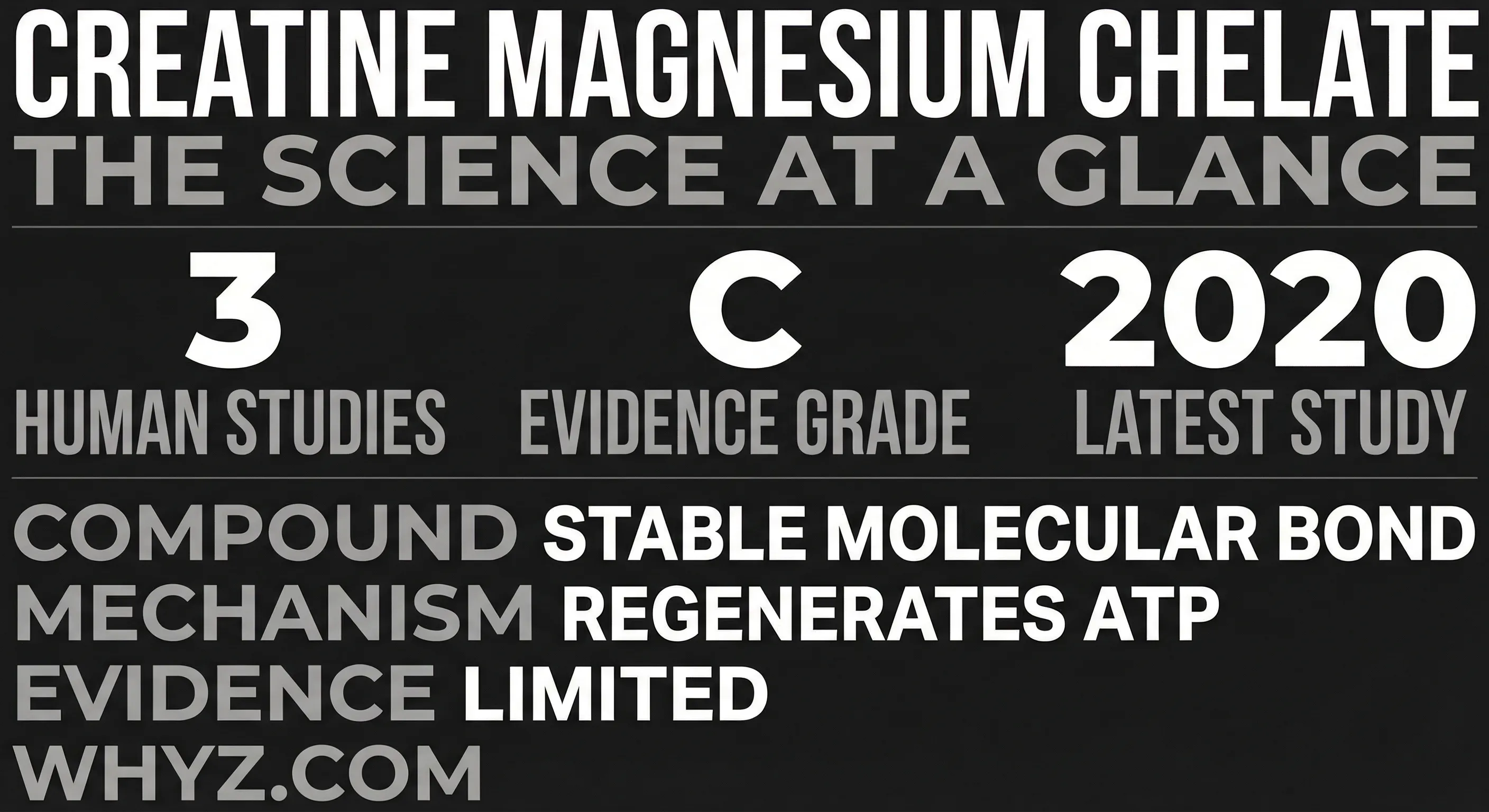
| Evidence Grade | C, Limited (only 3 human studies directly test this compound, and results are mixed) |
| Key Studies | Brilla et al. 2003, body water and torque (PMID: 14506619). Selsby et al. 2004, low-dose performance (PMID: 15142029). Zajac et al. 2020, elite soccer sprint ability (PMID: 32998206) |
| Status | Marketed as an advanced creatine form. Limited clinical evidence, no demonstrated superiority over monohydrate |
Creatine magnesium chelate bonds creatine to magnesium at the molecular level, creating a compound that delivers both nutrients in a single chelated structure. The rationale is straightforward: creatine regenerates ATP, and magnesium is a required cofactor for the creatine kinase enzyme that drives that regeneration. Combining them in a chelate could theoretically improve creatine stability and cellular uptake. The 2003 Brilla et al. study in Metabolism provided initial support, showing that the chelated form shifted body water from extracellular to intracellular compartments and increased quadriceps peak torque, while creatine + magnesium oxide co-supplementation did not reach significance for torque (PMID: 14506619). A follow-up by Selsby et al. (2004) in the Journal of Strength and Conditioning Research found no performance advantage for the chelate over plain creatine at 2.5g/day (PMID: 15142029).
Three human studies exist on this compound. That is the complete clinical evidence base. Creatine monohydrate has over 500 published studies and remains the reference standard by a wide margin. This guide covers what the limited research shows, where the chelated form may differ from monohydrate, and whether those differences justify the higher price.
What Is Creatine Magnesium Chelate and How Does It Work?
Creatine magnesium chelate is a chelated compound where creatine and magnesium are bound together in a stable molecular complex, distinct from simply taking creatine and magnesium as separate supplements. The compound is sold under the trademarked brand name MagnaPower. First, creatine functions as an energy substrate in skeletal muscle by converting to phosphocreatine (PCr), which donates a phosphate group to ADP during high-intensity effort to rapidly regenerate ATP. Second, magnesium serves as a required cofactor for creatine kinase, the enzyme that catalyzes the interconversion of creatine and phosphocreatine. Magnesium also stabilizes ATP molecules structurally, as ATP exists in the cell primarily as an Mg-ATP complex. Third, chelation binds these two molecules in a single structure that proponents argue is absorbed through different pathways than creatine monohydrate alone, with greater stability in the acidic stomach environment.
The distinction from co-supplementation matters. Brilla et al. (2003) directly compared magnesium-creatine chelate against creatine + magnesium oxide taken as separate compounds, and found that only the chelated form produced significant intracellular water increases and significant peak torque gains (PMID: 14506619). The co-supplementation group gained body weight but did not match the chelate’s effects on water distribution or strength. This suggests the chelated bond confers something beyond simply consuming both nutrients simultaneously, though the specific absorption mechanism has not been confirmed in pharmacokinetic studies.
What Does the Clinical Evidence Show for Creatine Magnesium Chelate?
Three published human studies have directly tested creatine magnesium chelate. Each used a different dose, duration, and population.
Brilla et al. (2003) enrolled 35 subjects in a randomized, blinded study comparing three groups: placebo (maltodextran), magnesium oxide + creatine co-supplementation (800 mg Mg + 5g Cr), and magnesium-creatine chelate (800 mg Mg + 5g Cr) for 2 weeks. The chelate group showed a significant increase in intracellular water (26.29 to 28.01 L, p<0.05) with a corresponding decrease in extracellular water (15.75 to 14.88 L, p<0.05). Peak quadriceps torque at 180 degrees/second increased significantly only in the chelate group (124.5 to 135.8 Nm, p<0.05). The co-supplementation group approached significance for torque (p=0.06) but did not cross the threshold. Both treatment groups increased power (PMID: 14506619).
Selsby et al. (2004) tested a lower dose in 31 weight-trained men. Three groups received placebo (multidextran), creatine (2.5g/day), or Mg2+-creatine chelate (2.5g Cr/day) for 10 days. Both creatine groups showed significantly greater increases in bench press work at 70% 1RM compared to placebo. No significant difference existed between the creatine and chelate groups for either 1RM or total work. The study concluded that low-dose creatine was effective, but the chelated form offered no advantage at this dose (PMID: 15142029).
Zajac et al. (2020) examined 20 elite soccer players (16 completed the study) over 16 weeks. The supplemented group received 5,500 mg magnesium creatine chelate daily (0.07 g/kg/day). After 16 weeks, the supplemented group showed significantly better total time, average power, and max power on the Repeated Sprint Ability Test compared to placebo. Both first and sixth 35m sprint times improved significantly. Creatinine levels increased but stayed within reference ranges (PMID: 32998206).
Fazio et al. (2022) published a systematic review in the Journal of Strength and Conditioning Research covering alternative creatine forms. The review noted that magnesium-creatine chelate was among the few alternative forms with any published human data, but concluded that no alternative form demonstrated consistent superiority over creatine monohydrate (PMID: 36000773).

Does Creatine Magnesium Chelate Have Better Bioavailability Than Monohydrate?
The bioavailability question is central to every alternative creatine form, and the answer for magnesium-creatine chelate is mixed. Creatine monohydrate already achieves approximately 99% oral bioavailability in solid form according to established pharmacokinetic data. That leaves an extremely narrow window for any alternative form to improve upon.
The chelate’s proposed advantage involves a different mechanism than simply better absorption. Brilla et al. (2003) found that the chelated form shifted water from extracellular to intracellular compartments, while the co-supplementation group (same doses of creatine and magnesium, just not chelated together) gained body weight without this intracellular shift (PMID: 14506619). This suggests the chelate may enhance cellular uptake of creatine rather than total absorption from the gut. The intracellular water increase is consistent with greater creatine accumulation inside muscle cells, since creatine is osmotically active and draws water with it. If more creatine reaches the intracellular compartment, more water follows.
No pharmacokinetic study has measured blood creatine levels after ingestion of the chelated form versus monohydrate to directly quantify absorption differences. Selsby et al. (2004) tested the practical endpoint: does more creatine getting into cells translate to more work output? At 2.5g/day for 10 days, the answer was no, both forms performed equally (PMID: 15142029). The Andres et al. (2017) review of creatine forms in Molecular Nutrition and Food Research noted that limited data exist on the chelate’s pharmacokinetics and raised some safety considerations related to total magnesium intake from the chelated form (PMID: 28019093).
How Does Creatine Magnesium Chelate Affect Water Retention?
Water retention is the most common consumer complaint about creatine monohydrate, and the Brilla 2003 data offers the chelate’s most distinctive finding. In that trial, the chelate group increased intracellular water by 1.72 L while decreasing extracellular water by 0.87 L over just 2 weeks (PMID: 14506619). The co-supplementation group gained 0.75 kg of body weight (p<0.05) without this favorable water redistribution.
What this means practically: creatine monohydrate loading often produces visible puffiness or bloating because some water is retained in extracellular spaces, outside the muscle cells. If the chelated form preferentially drives water into cells rather than between them, the cosmetic and comfort effects could differ meaningfully. Intracellular hydration also has physiological implications. Cellular swelling activates anabolic signaling pathways, increases protein synthesis, and supports muscle function.
This is a single study with 35 subjects over 2 weeks. The water distribution finding has not been replicated. Supplement marketing has amplified the Brilla data considerably beyond what a single short-term trial with moderate sample size can support.
What Is the Correct Dosage for Creatine Magnesium Chelate?
No dose-optimization trials exist for creatine magnesium chelate. The three published studies used different dosing protocols, making direct comparison difficult.
Dosing from the literature:
| Study | Daily Dose | Duration | Outcome |
|---|---|---|---|
| Brilla 2003 | 5g Cr + 800mg Mg (chelated) | 2 weeks | Significant torque and ICW increase |
| Selsby 2004 | 2.5g Cr equivalent (chelated) | 10 days | Equal to plain Cr, both beat placebo |
| Zajac 2020 | 5,500mg MgCr-C (0.07g/kg/day) | 16 weeks | Improved sprint ability |
The ISSN position stand on creatine supplementation establishes that 3-5g/day of creatine is sufficient to maintain peak muscle creatine stores after saturation, and that loading phases (20g/day for 5-7 days) are optional since 3-5g/day reaches the same muscle saturation level within 3-4 weeks (PMID: 28615996). These guidelines were developed for creatine monohydrate but provide reasonable starting parameters for the chelated form.
A practical approach: 3-5g of creatine equivalent daily from the chelated form, taken consistently at any time of day. The magnesium content of a typical 5g serving provides approximately 200-400mg of elemental magnesium. The Institute of Medicine sets the tolerable upper intake level for supplemental magnesium at 350mg/day for adults, primarily based on the laxative threshold. Individuals already taking magnesium supplements should account for the chelate’s magnesium contribution to avoid exceeding this level.
Is Creatine Magnesium Chelate Safe?
Creatine’s long-term safety is well-established. The ISSN position stand confirmed that creatine supplementation up to 30g/day for 5 years is safe and well-tolerated in healthy individuals across a range of populations from infants to elderly (PMID: 28615996). The chelated form shares the core creatine molecule and would be expected to carry a similar safety profile, with the addition of magnesium-related considerations.
Zajac et al. (2020) monitored creatinine levels across 16 weeks of supplementation and found increases but within normal reference ranges (PMID: 32998206). Higher serum creatinine during creatine supplementation reflects increased creatine turnover, not kidney damage. This pharmacological artifact is well-documented across all creatine forms.
Andres et al. (2017) reviewed creatine forms in Molecular Nutrition and Food Research and noted specific safety considerations for magnesium creatine chelate related to magnesium intake levels. At doses providing 5g of creatine, the chelated form delivers substantial supplemental magnesium. Exceeding 350mg/day of supplemental magnesium can cause diarrhea, nausea, and abdominal cramping in sensitive individuals (PMID: 28019093). This is a dose-dependent GI effect, not a toxicity concern.
Populations that should consult a physician before use: individuals with kidney disease, those on medications that affect magnesium balance (diuretics, proton pump inhibitors), pregnant or breastfeeding women, and anyone with diagnosed magnesium sensitivity.
How Does Creatine Magnesium Chelate Compare to Creatine Monohydrate?
| Factor | Creatine Magnesium Chelate | Creatine Monohydrate |
|---|---|---|
| Published human studies | 3 | 500+ |
| Oral bioavailability | Not directly measured | ~99% |
| Muscle creatine loading | Shown effective (Zajac 2020) | Extensively proven |
| Intracellular hydration | Favorable shift (Brilla 2003) | General water retention |
| Performance benefits | Demonstrated (equal to CrM in direct comparisons) | Extensively demonstrated |
| Magnesium content | Built-in (200-400mg per serving) | None |
| Loading phase needed | Not tested, likely optional as with CrM | Optional (ISSN position) |
| Cost per gram | Higher | Lower |
| Safety data | Limited but no concerns in 3 studies | Extensive, up to 5 years |
The practical summary: creatine magnesium chelate delivers creatine effectively and may have a favorable effect on water distribution. No study has shown it produces greater strength, power, or muscle gains than creatine monohydrate. The Brilla 2003 intracellular water finding is notable but unreplicated. Creatine monohydrate remains the evidence-backed default choice for creatine supplementation.
References
-
Brilla LR, Giroux MS, Taylor A, Knutzen KM. Magnesium-creatine supplementation effects on body water. Metabolism. 2003, 52(9):1136-1140. PMID: 14506619
-
Selsby JT, DiSilvestro RA, Devor ST. Mg2+-creatine chelate and a low-dose creatine supplementation regimen improve exercise performance. J Strength Cond Res. 2004, 18(2):311-315. PMID: 15142029
-
Zajac A, Golas A, Chycki J, Halz M, Michalczyk MM. The effects of long-term magnesium creatine chelate supplementation on repeated sprint ability (RAST) in elite soccer players. Nutrients. 2020, 12(10):2961. PMID: 32998206
-
Fazio C, Elder CL, Harris MM. Efficacy of alternative forms of creatine supplementation on improving performance and body composition in healthy subjects: a systematic review. J Strength Cond Res. 2022, 36(9):2663-2670. PMID: 36000773
-
Andres S, Ziegenhagen R, Trefflich I, et al. Creatine and creatine forms intended for sports nutrition. Mol Nutr Food Res. 2017, 61(6). PMID: 28019093
-
Kreider RB, Kalman DS, Antonio J, et al. International Society of Sports Nutrition position stand: safety and efficacy of creatine supplementation in exercise, sport, and medicine. J Int Soc Sports Nutr. 2017, 14:18. PMID: 28615996