
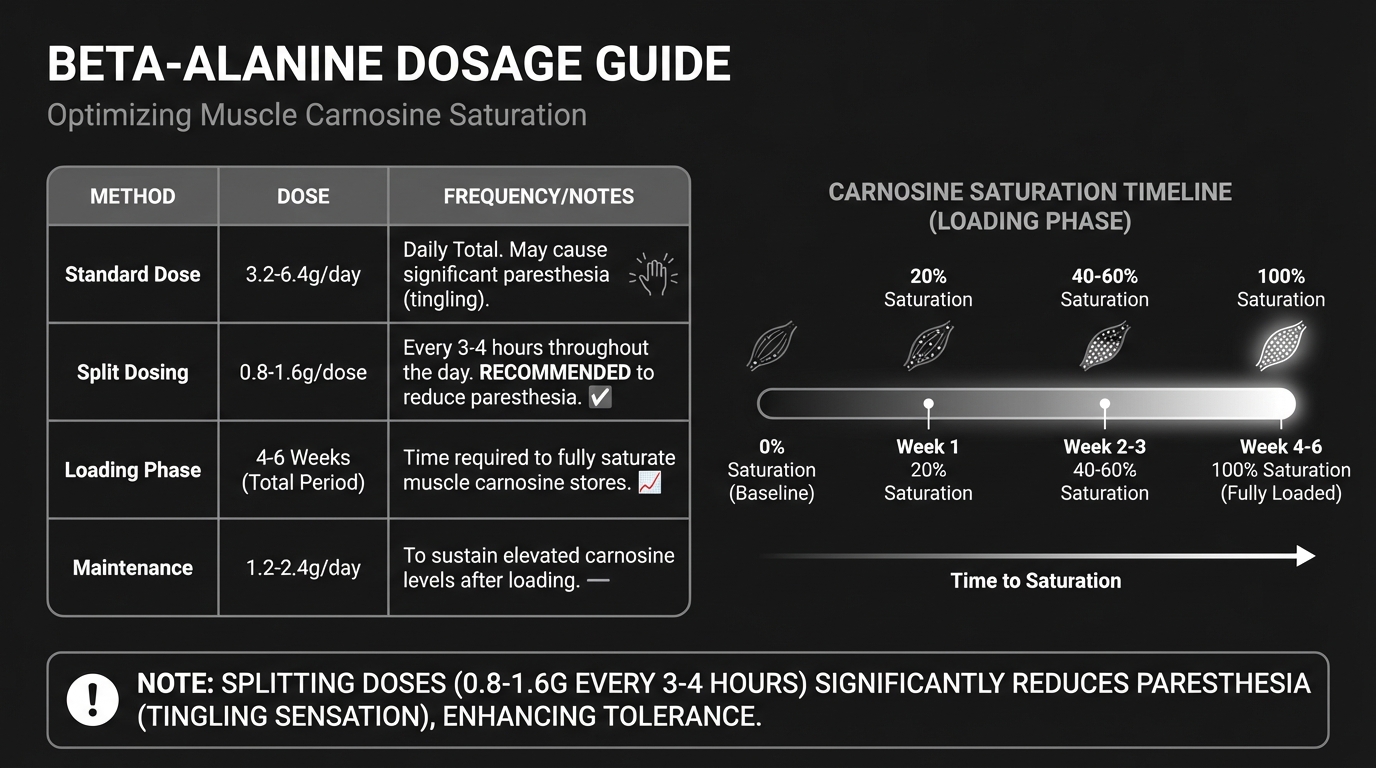
The research-supported beta-alanine dose is 3.2 to 6.4 grams per day, split into smaller servings of 0.8 to 1.6 grams taken every 3-4 hours. This split-dosing approach reduces the tingling sensation (paresthesia) that most users experience with larger single doses. You need to maintain this daily intake for at least 4 weeks to meaningfully increase muscle carnosine levels, with 10-12 weeks producing even greater saturation.
That is the short version. Here is the full breakdown of why these numbers matter and how to structure your dosing for maximum benefit.
Why Dosage Matters More Than Most Supplements
Beta-alanine works differently than supplements that produce acute effects. Caffeine hits within 30 minutes. Creatine can start loading on day one. Beta-alanine does neither.
Beta-alanine is a precursor to carnosine, a dipeptide stored in skeletal muscle that buffers hydrogen ions during high-intensity exercise. The performance benefit comes from elevated muscle carnosine, not from beta-alanine itself. Building up that carnosine takes weeks of consistent daily dosing.
Think of it like filling a reservoir. Each daily dose adds a small amount of carnosine to the pool. Skip days and the pool stops filling. Take too little per day and saturation takes much longer. Take too much in a single sitting and the paresthesia can become uncomfortable enough to make you stop altogether.
The International Society of Sports Nutrition (ISSN) position stand on beta-alanine (Trexler et al., 2015) established that 4-6 weeks of supplementation at 4-6 g/day significantly augments muscle carnosine concentrations and acts as an intracellular pH buffer during high-intensity exercise. This remains the most comprehensive evidence-based guideline available.
The Standard Dosing Protocol
Based on the existing research, here is the dosing framework that balances effectiveness with tolerability:
Loading Phase (Weeks 1-4)
Daily total: 3.2 to 6.4 grams per day
Split this into 4 smaller doses of 0.8 to 1.6 grams, taken every 3-4 hours throughout the day. For most people, 4 doses of 1.6 g (totaling 6.4 g/day) represents the upper end of the evidence-based range, while 4 doses of 0.8 g (totaling 3.2 g/day) is the lower threshold.
Hill et al., 2007 demonstrated that 4 weeks of beta-alanine supplementation significantly increased muscle carnosine concentrations, with further gains at 10 weeks. Subjects who supplemented for 10 weeks showed a 80% increase in muscle carnosine content, establishing the dose-duration relationship that guides current protocols.
A practical loading schedule looks like this:
- Dose 1: 1.6 g with breakfast (7-8 AM)
- Dose 2: 1.6 g with lunch (12-1 PM)
- Dose 3: 1.6 g in the afternoon (4-5 PM)
- Dose 4: 1.6 g with dinner (7-8 PM)
Total: 6.4 g/day
If the paresthesia from 1.6 g per dose is uncomfortable, drop to 0.8 g per dose and add more doses throughout the day to maintain the daily total.
Maintenance Phase (After Week 4+)
Once muscle carnosine levels are elevated, you can reduce to a maintenance dose of 1.2 to 3.2 g per day. Carnosine levels decline slowly when supplementation stops (roughly 2-4% per week), so maintaining some daily intake prevents the reservoir from draining.
Research by Church et al., 2017 compared different dosing protocols and found that the total daily dose, rather than the size of individual servings, was the primary driver of carnosine accumulation. This means you have flexibility in how you structure maintenance dosing. Two doses of 1.6 g or three doses of 1.0 g both work.
Why Split Dosing Reduces Tingling
The tingling sensation from beta-alanine (paresthesia) is one of the most commonly reported side effects of any sports supplement. It typically affects the face, hands, and arms. It is harmless, but it bothers a lot of people enough to make them quit.
Paresthesia occurs because beta-alanine activates sensory neurons called MrgprD receptors in the skin. The intensity of the tingling correlates directly with the peak plasma concentration of beta-alanine. Larger doses produce higher peak concentrations, which produce more intense tingling.
Varanoske et al., 2019 compared sustained-release and rapid-release beta-alanine formulations and found that the sustained-release version significantly reduced paresthesia symptoms while producing equivalent muscle carnosine increases. The mechanism is simple: slower absorption means lower peak blood levels, which means less receptor activation in the skin.
You can achieve the same effect with standard beta-alanine powder by splitting your daily dose into smaller servings. Instead of taking 3.2 g at once, take 0.8 g four times per day. The total daily intake stays the same, but the peak blood level at any given point is much lower. For more on managing beta-alanine tingling and what causes it, see our dedicated guide.
If you still experience tingling with split doses, taking each dose with a meal further slows absorption and reduces peak blood concentrations.
How Long Until It Works?
This is the question everyone asks, and the honest answer is that beta-alanine requires patience.
Week 2: Muscle carnosine levels begin measurably increasing, but you likely will not notice performance changes yet.
Week 4: Carnosine levels are elevated enough for initial performance benefits. The Hobson et al., 2012 meta-analysis found that beta-alanine supplementation improved exercise performance, with the largest effects observed in tasks lasting 60-240 seconds. By week 4, you have enough accumulated carnosine to start seeing those benefits.
Weeks 8-12: Carnosine continues accumulating. Hill et al., 2007 showed an 80% increase in muscle carnosine at 10 weeks versus a 58% increase at 4 weeks with continued supplementation. Longer loading periods produce greater saturation and potentially larger performance gains.
After stopping: Muscle carnosine does not crash overnight. It declines gradually at roughly 2-4% per week after supplementation ceases. If you take a short break of 1-2 weeks, you will retain most of your accumulated carnosine.
Who Benefits Most From Beta-Alanine?
Beta-alanine is not a universal performance enhancer. Its benefits are specific to certain types of exercise and certain athlete profiles.
Strong evidence of benefit:
- High-intensity efforts lasting 60-240 seconds: Sprints, 400-800m running, rowing intervals, cycling time trials, high-rep resistance training sets. This is the sweet spot where intracellular acidosis (hydrogen ion accumulation) is a primary limiting factor, and carnosine buffering makes the biggest difference (Hobson et al., 2012).
- Combat sports and team sports: Repeated high-intensity bouts with short rest intervals. The buffering effect accumulates across multiple efforts.
- CrossFit-style training: Mixed-modal workouts that combine anaerobic and glycolytic efforts.
Moderate evidence of benefit:
- Resistance training for hypertrophy: More reps before failure on moderate-to-high rep sets (8-15 reps). The extra reps may contribute to greater training volume over time.
- Endurance athletes during threshold work: The benefit comes during high-intensity portions of endurance training, not during steady-state aerobic work.
Limited evidence of benefit:
- Pure strength training (1-5 rep max): These short maximal efforts are limited by neural and contractile factors, not pH buffering. Carnosine does not meaningfully help with a 1RM attempt.
- Steady-state endurance (zone 2 cardio): Low-intensity exercise does not produce significant hydrogen ion accumulation, so carnosine’s buffering role is minimal.
Combining Beta-Alanine With Other Supplements
Beta-alanine pairs well with several other evidence-based supplements:
Creatine monohydrate: The two work through completely different mechanisms. Creatine supports the phosphocreatine energy system (efforts under 10 seconds), while beta-alanine supports pH buffering (efforts lasting 1-4 minutes). Combining them covers a broader range of exercise intensities. Lancha Junior et al., 2015 reviewed nutritional buffering strategies and noted that combining intracellular (beta-alanine) and extracellular (sodium bicarbonate) buffering agents may produce additive effects.
Caffeine: Pre-workout caffeine combined with chronic beta-alanine supplementation is one of the most common sport supplement stacks. There is no known negative interaction between the two. Caffeine provides acute alertness and power output enhancement, while beta-alanine provides chronic buffering support (Antonio et al., 2024).
Sodium bicarbonate: Bicarbonate buffers extracellular pH while carnosine (from beta-alanine) buffers intracellular pH. Stacking both addresses hydrogen ion accumulation on both sides of the cell membrane. Bicarbonate dosing requires careful attention to GI tolerance (common side effect: stomach distress at higher doses).
Common Dosing Mistakes
Taking it all at once. A 3.2 g or 6.4 g dose in one sitting produces peak paresthesia and does not improve carnosine loading speed compared to the same total dose split across the day.
Stopping after 2 weeks. Muscle carnosine takes at least 4 weeks to reach meaningful levels. Two weeks of supplementation is essentially wasted money. Commit to the full loading phase or skip it entirely.
Only taking it on training days. Carnosine accumulation depends on daily, consistent intake. Skipping rest days slows the loading process. Take it every day, including rest days.
Expecting immediate effects. Beta-alanine produces no acute performance boost on day one. The tingling sensation is not an indicator of it “working.” It is a transient sensory side effect unrelated to the carnosine-building mechanism.
Using pre-workouts as the sole source. Many pre-workout formulas contain 1.6-2.4 g of beta-alanine. That is a reasonable single dose, but if you only take it once per day before training, you are likely under-dosing for optimal carnosine loading.
Frequently Asked Questions
What is the best beta-alanine dose per day?
The evidence supports 3.2 to 6.4 grams per day, split into 4 doses of 0.8 to 1.6 grams each. The ISSN recommends at least 4 weeks at this dose to significantly increase muscle carnosine levels (Trexler et al., 2015).
Can I take 6g of beta-alanine at once?
You can, but you will experience intense paresthesia (skin tingling) for 60-90 minutes. Splitting the dose into smaller servings produces the same carnosine-loading result without the uncomfortable side effects. Church et al., 2017 showed that total daily dose, not single-serving size, drives carnosine accumulation.
How long does beta-alanine take to work?
Expect measurable muscle carnosine increases within 2 weeks and noticeable performance improvements around week 4. Full saturation takes 10-12 weeks of consistent daily supplementation. The Hobson et al., 2012 meta-analysis found that supplementation periods shorter than 4 weeks showed smaller performance effects.
Does beta-alanine need to be cycled?
No. There is no evidence that cycling beta-alanine is necessary or beneficial. Muscle carnosine does not appear to reach a ceiling that triggers diminishing returns with continued use. If you stop supplementing, carnosine levels will gradually decline over several weeks.
Can I take beta-alanine on an empty stomach?
Yes, but it may increase the intensity of paresthesia. Taking beta-alanine with food slows absorption, reduces peak plasma concentrations, and reduces tingling. If paresthesia bothers you, pair each dose with a meal or snack.
Is sustained-release beta-alanine worth the extra cost?
Sustained-release formulations do reduce paresthesia compared to standard powder (Varanoske et al., 2019). If you find the tingling from split doses of standard powder tolerable, there is no performance advantage to the sustained-release version. Both produce equivalent carnosine loading. The sustained-release option is a convenience and comfort choice, not a performance one.
What is the tingling from beta-alanine?
The tingling (paresthesia) is caused by beta-alanine binding to MrgprD sensory receptors in the skin. It is harmless and temporary, typically lasting 60-90 minutes. The intensity is directly related to the dose size and how quickly it is absorbed. Smaller, more frequent doses reduce it. Read our full guide on beta-alanine tingling for more detail.
The Bottom Line
Beta-alanine works, but only if you dose it correctly and give it time. Take 3.2 to 6.4 grams per day, split into smaller servings to manage paresthesia. Maintain daily intake for at least 4 weeks before expecting performance benefits, and consider a 10-12 week loading phase for full carnosine saturation. After that, a maintenance dose of 1.2 to 3.2 g/day preserves your gains.
The evidence base is strong for high-intensity exercise lasting 1-4 minutes. If your training involves repeated sprints, interval work, high-rep resistance training, or combat sports, beta-alanine is one of the few supplements with consistent research backing its performance claims (Trexler et al., 2015, Hobson et al., 2012).