
Home → Guides → Bovine vs Marine Collagen: Which Should You Choose?
Collagen supplements come from two main sources: cattle and fish. Both deliver the amino acids your body uses to build and repair connective tissue, but the marketing around each one tells a different story. Bovine collagen is pitched as the all-rounder for joints, skin, and gut. Marine collagen gets positioned as the premium, better-absorbed option for skin and beauty.
Which one does the research actually support? This guide breaks down the differences in collagen type, absorption, clinical data, cost, and dietary fit so you can make a decision based on evidence rather than branding.
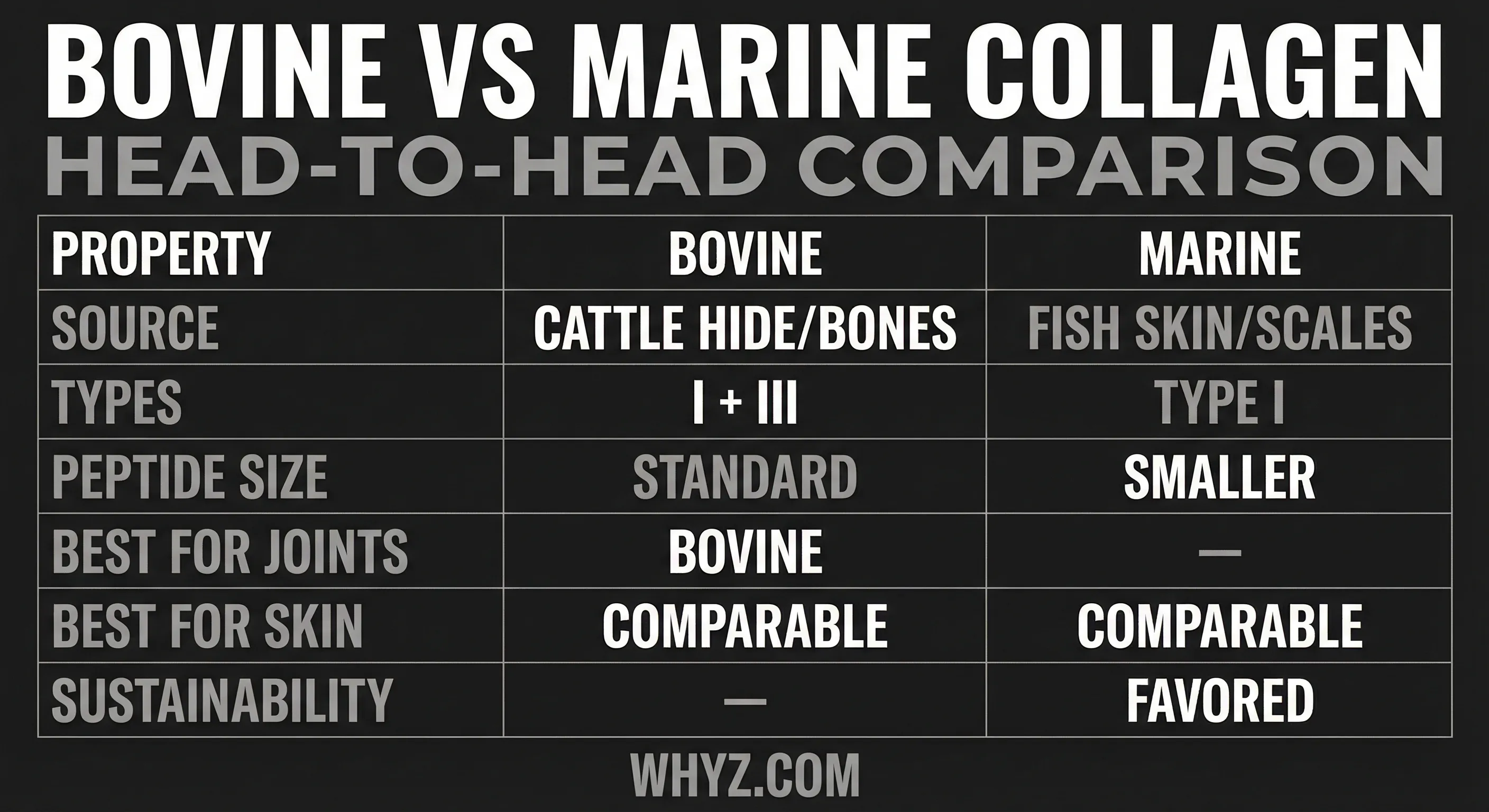
Quick Comparison
| Property | Bovine Collagen | Marine Collagen |
|---|---|---|
| Source | Cattle hide and bones | Fish skin and scales |
| Collagen types | Type I + Type III (some Type II) | Primarily Type I |
| Peptide size | Standard (~3,000-5,000 Da) | Smaller (~1,000-3,000 Da) |
| Bioavailability | Good when hydrolyzed | Good when hydrolyzed |
| Best for joints | Yes, broader type coverage | Limited |
| Best for skin | Strong evidence | Strong evidence |
| Sustainability | Lower (cattle farming) | Higher (fish byproduct) |
| Taste/smell | Neutral when hydrolyzed | Can have mild fish taste |
| Cost per serving | Lower ($0.50-1.00) | Higher ($1.00-2.00) |
| Dietary restrictions | Not for pescatarians | Not for shellfish-allergic |
What Is Bovine Collagen?
Bovine collagen comes from the hides, bones, and connective tissue of cattle. It is the most widely used collagen source in the supplement industry, primarily because of cost and availability.
The raw material undergoes hydrolysis, a process that breaks large collagen molecules into smaller peptides (typically called “collagen peptides” or “hydrolyzed collagen”). These peptides dissolve in liquid and are small enough to absorb through the intestinal wall.
Bovine collagen contains three collagen types relevant to supplementation:
- Type I makes up roughly 90% of your body’s collagen. It is the primary structural protein in skin, tendons, ligaments, and bone.
- Type III is found alongside Type I in skin, blood vessels, and organs. It contributes to skin elasticity and vascular structure.
- Type II is the main collagen in cartilage. Bovine sources can provide this type, particularly from cartilage-derived products like undenatured Type II collagen (UC-II).
The amino acid profile of bovine collagen is rich in glycine (roughly 33% of total amino acids), proline (12-14%), and hydroxyproline (10-12%). These three amino acids are the building blocks your body needs to synthesize its own collagen.
What Is Marine Collagen?
Marine collagen is extracted from the skin, scales, and bones of fish, most commonly cod, snapper, or tilapia. The fish processing industry generates large volumes of these byproducts, making marine collagen a way to capture value from material that would otherwise go to waste.
Marine collagen is predominantly Type I. It does not contain meaningful amounts of Type II or Type III collagen. For skin-focused applications, this is not a limitation since Type I is the primary collagen in human skin. For joint applications, the absence of Type II is a notable gap.
One of the most frequently repeated claims about marine collagen is that its peptides are smaller than bovine peptides, leading to better absorption. The peptide size after hydrolysis does tend to be lower in marine sources (often cited around 1,000-3,000 Daltons versus 3,000-5,000 for bovine). Whether this translates into a clinically meaningful difference in outcomes is a separate question.
The amino acid profile is similar to bovine collagen, with glycine, proline, and hydroxyproline as the dominant amino acids. Some research notes slightly higher levels of alanine in marine collagen, though the functional significance of this difference at supplement doses is unclear.
Bioavailability: Does It Actually Matter?
This is where marketing and science diverge. You will find claims that marine collagen is “1.5x more bioavailable” than bovine collagen. That number circulates widely across supplement websites, but tracing it to a specific clinical trial is difficult. It appears to originate from in vitro absorption studies comparing peptide size, not from head-to-head human trials measuring blood levels or tissue outcomes.
Here is what we actually know:
Peptide size influences absorption rate. Smaller peptides cross the intestinal barrier more easily. Marine collagen peptides are generally smaller after hydrolysis, which gives them a theoretical absorption advantage.
Hydrolysis quality matters more than source. A well-hydrolyzed bovine collagen product with small peptide sizes can match or exceed a poorly hydrolyzed marine product. The processing method, not the animal source, is the primary determinant of peptide size in the final product.
Clinical outcomes are what count. Both bovine and marine collagen peptides have shown measurable benefits in human trials for skin and joint endpoints. No published RCT has demonstrated that marine collagen produces superior clinical outcomes to bovine collagen at equivalent doses.
Shaw et al. (2017) demonstrated that vitamin C-enriched gelatin (a bovine-derived collagen source) significantly increased collagen synthesis markers when taken before exercise (Shaw et al., 2017). The study used 15 grams of gelatin with vitamin C, and the effect was measured through increases in amino-terminal propeptide of collagen I (PINP) in blood. This suggests bovine-sourced collagen is well-absorbed and biologically active.
The bottom line on bioavailability: both sources work. Choose based on other factors.
Clinical Evidence for Bovine Collagen
Bovine collagen peptides have the larger evidence base overall, partly because bovine collagen has been used in research longer and is cheaper to source for trials.
Skin. Proksch et al. (2014) conducted a double-blind, placebo-controlled trial showing that oral intake of specific bioactive collagen peptides (2.5 g/day for 8 weeks) reduced skin wrinkles and increased dermal matrix synthesis, measured through procollagen I, elastin, and fibrillin levels (Proksch et al., 2014). The collagen used was bovine-derived.
Body composition. Zdzieblik et al. (2015) showed that collagen peptide supplementation combined with resistance training improved body composition and increased muscle strength in elderly sarcopenic men, compared to resistance training with placebo (Zdzieblik et al., 2015). The study used 15 g/day of bovine collagen peptides over 12 weeks.
Joints (UC-II). Lugo et al. (2016) tested undenatured Type II collagen (UC-II) from bovine/avian sources in a multicenter RCT for knee osteoarthritis. UC-II at 40 mg/day for 180 days improved knee joint symptoms compared to both placebo and glucosamine-chondroitin (Lugo et al., 2016). UC-II works through a different mechanism than hydrolyzed peptides. It modulates the immune response in the gut to reduce the inflammatory attack on joint cartilage, a process called oral tolerance.
Clinical Evidence for Marine Collagen
The marine collagen evidence base is growing but remains smaller than bovine.
Skin. Inoue et al. (2016) conducted a randomized, double-blind, placebo-controlled study using marine collagen hydrolysates. Participants who consumed the collagen showed improvements in facial skin moisture, elasticity, and wrinkle depth compared to placebo (Inoue et al., 2016). The results were comparable to what bovine collagen studies have shown for similar endpoints.
Bioavailability studies. Several small studies have measured blood levels of hydroxyproline-containing peptides after marine collagen ingestion, confirming that the peptides are absorbed and reach the bloodstream. These pharmacokinetic studies support the claim that marine collagen is bioavailable, but they do not prove it is more bioavailable than bovine collagen in terms of clinical outcomes.
The gap in the marine collagen literature is the lack of large-scale RCTs for joint health. Most marine collagen studies focus on skin endpoints. If your primary goal is joint support, bovine collagen has a stronger evidence trail.
Which Is Better for Joints?
Bovine collagen has the advantage here, for two reasons.
First, bovine sources can provide Type II collagen, the predominant collagen in cartilage. Undenatured Type II collagen (UC-II) from bovine or avian cartilage has specific clinical data showing improvement in knee osteoarthritis symptoms at doses as low as 40 mg/day (Lugo et al., 2016). Marine collagen does not contain Type II.
Second, even standard hydrolyzed bovine collagen peptides provide Type I and Type III, both of which contribute to tendons, ligaments, and the structural framework of joints. Marine collagen provides Type I only.
If joint health is your primary goal, bovine collagen, whether as hydrolyzed peptides or UC-II, is the better-supported choice.
Which Is Better for Skin?
This is closer to a tie. Both bovine and marine collagen provide abundant Type I collagen, the dominant collagen type in human skin. Both have clinical trial data showing improvements in skin hydration, elasticity, and wrinkle reduction.
Proksch et al. (2014) demonstrated skin benefits with bovine collagen peptides at just 2.5 g/day (Proksch et al., 2014). Inoue et al. (2016) showed similar skin improvements with marine collagen hydrolysates (Inoue et al., 2016). No head-to-head trial has compared them directly on skin outcomes.
The marine collagen marketing argument, that smaller peptides reach the dermis more efficiently, is plausible but unproven in comparative human studies. Until a direct comparison trial exists, both sources appear effective for skin.
If you already take bovine collagen for joint or body composition goals, you are likely getting skin benefits as well. There is no strong reason to switch to marine collagen for skin alone.
Dosage: How Much to Take
Most clinical trials use doses in the 2.5 to 15 gram range for hydrolyzed collagen peptides, regardless of source.
| Goal | Suggested Dose | Timing |
|---|---|---|
| Skin health | 2.5-5 g/day | Any time, with or without food |
| Joint support (hydrolyzed) | 10-15 g/day | Any time |
| Joint support (UC-II) | 40 mg/day | On an empty stomach |
| Body composition | 15 g/day | Post-workout or with meals |
| Tendon/ligament support | 15 g with 50 mg vitamin C | 30-60 minutes before exercise |
The Shaw et al. (2017) study specifically demonstrated that combining 15 g of gelatin with vitamin C before exercise enhanced collagen synthesis (Shaw et al., 2017). This protocol has become popular among athletes targeting tendon and ligament health.
Both bovine and marine collagen peptides dissolve in hot or cold liquid. They are typically unflavored, though marine collagen can carry a slight fish taste that some users notice in water but not in coffee, smoothies, or food.
Environmental and Dietary Considerations
Sustainability. Marine collagen is sourced from fish processing byproducts (skin, scales, bones) that would otherwise be discarded. This upcycling argument gives marine collagen a sustainability edge. Bovine collagen production is tied to cattle farming, which carries a larger environmental footprint in terms of land use, water consumption, and greenhouse gas emissions.
Pescatarians. Marine collagen is the only option if you avoid land animal products but eat fish.
Halal/Kosher. Marine collagen from scaled fish is generally considered halal and kosher without additional certification. Bovine collagen requires verification that the cattle were slaughtered according to religious requirements.
Allergies. If you have a fish or shellfish allergy, bovine collagen is the safer choice. Bovine collagen is free from the top 14 major allergens recognized in EU food safety regulations.
Cost. Bovine collagen is typically 30-50% cheaper per serving than marine collagen, due to the larger supply of raw material and simpler processing.
The Bottom Line
Bovine and marine collagen both work. They share the same core amino acids, both get absorbed as peptides, and both have clinical trial support for skin outcomes.
The differences come down to specifics. Bovine collagen offers broader collagen type coverage (I, II, III), a larger body of clinical evidence, and a lower price point. It is the better choice if you want joint support, body composition benefits, or a versatile daily supplement.
Marine collagen is a strong option if you are pescatarian, need halal/kosher compliance from a simpler sourcing chain, or prioritize sustainability. For skin-only goals, it performs comparably to bovine.
Do not overpay for marine collagen based on the “1.5x more bioavailable” claim. That figure is not supported by head-to-head clinical outcome data. Choose based on your dietary needs, your goals, and your budget.
FAQ
Is marine collagen absorbed better than bovine collagen? Marine collagen peptides tend to be smaller after hydrolysis, which may allow slightly faster absorption. But no published clinical trial has shown that marine collagen produces better health outcomes than bovine collagen at the same dose. Absorption speed is not the same as effectiveness.
Can I take bovine and marine collagen together? Yes. There is no interaction concern. Some people combine bovine collagen (for Type I, II, and III coverage) with a marine collagen product, though this is not necessary. A single high-quality hydrolyzed bovine collagen product covers most use cases.
Which type of collagen is best for joint pain? Undenatured Type II collagen (UC-II) from bovine or avian sources has the most direct evidence for joint health, at just 40 mg/day. For general joint support through hydrolyzed peptides, bovine collagen at 10-15 g/day is the most studied option.
Does collagen source matter if it is all hydrolyzed? Yes, because the collagen types differ. Bovine provides Types I, III, and sometimes II. Marine provides Type I only. If your goal requires Type II or III collagen, source matters. For Type I-only goals like skin, both sources are comparable once hydrolyzed.
Is bovine collagen safe for people with food allergies? Bovine collagen is free from the major food allergens (dairy, eggs, fish, shellfish, tree nuts, peanuts, wheat, soy). However, if you have a specific beef allergy (alpha-gal syndrome, for example), you should avoid bovine collagen and use marine collagen instead.
{
  "@context": "https://schema.org",
  "@type": "FAQPage",
  "mainEntity": [
    {
      "@type": "Question",
      "name": "Is marine collagen absorbed better than bovine collagen?",
      "acceptedAnswer": {
        "@type": "Answer",
        "text": "Marine collagen peptides tend to be smaller after hydrolysis, which may allow slightly faster absorption. But no published clinical trial has shown that marine collagen produces better health outcomes than bovine collagen at the same dose. Absorption speed is not the same as effectiveness."
      }
    },
    {
      "@type": "Question",
      "name": "Can I take bovine and marine collagen together?",
      "acceptedAnswer": {
        "@type": "Answer",
        "text": "Yes. There is no interaction concern. Some people combine bovine collagen for Type I, II, and III coverage with a marine collagen product, though this is not necessary. A single high-quality hydrolyzed bovine collagen product covers most use cases."
      }
    },
    {
      "@type": "Question",
      "name": "Which type of collagen is best for joint pain?",
      "acceptedAnswer": {
        "@type": "Answer",
        "text": "Undenatured Type II collagen (UC-II) from bovine or avian sources has the most direct evidence for joint health, at just 40 mg per day. For general joint support through hydrolyzed peptides, bovine collagen at 10-15 g per day is the most studied option."
      }
    },
    {
      "@type": "Question",
      "name": "Does collagen source matter if it is all hydrolyzed?",
      "acceptedAnswer": {
        "@type": "Answer",
        "text": "Yes, because the collagen types differ. Bovine provides Types I, III, and sometimes II. Marine provides Type I only. If your goal requires Type II or III collagen, source matters. For Type I-only goals like skin, both sources are comparable once hydrolyzed."
      }
    },
    {
      "@type": "Question",
      "name": "Is bovine collagen safe for people with food allergies?",
      "acceptedAnswer": {
        "@type": "Answer",
        "text": "Bovine collagen is free from the major food allergens including dairy, eggs, fish, shellfish, tree nuts, peanuts, wheat, and soy. However, if you have a specific beef allergy such as alpha-gal syndrome, you should avoid bovine collagen and use marine collagen instead."
      }
    }
  ]
}
References
- Proksch et al., 2014. Oral intake of specific bioactive collagen peptides reduces skin wrinkles and increases dermal matrix synthesis.
- Shaw et al., 2017. Vitamin C-enriched gelatin supplementation before intermittent activity augments collagen synthesis.
- Lugo et al., 2016. Efficacy and tolerability of an undenatured type II collagen supplement in modulating knee osteoarthritis symptoms.
- Zdzieblik et al., 2015. Collagen peptide supplementation in combination with resistance training improves body composition in elderly sarcopenic men.
- Inoue et al., 2016. Ingestion of bioactive collagen hydrolysates enhance facial skin moisture and elasticity.