
Home → Guides → Citicoline vs Alpha GPC: Which Choline Source is Better?
Choline is one nutrient most people are not getting enough of. The National Health and Nutrition Examination Survey found that roughly 90% of Americans fall short of the adequate intake for choline. That gap matters for brain function, liver health, and the structural integrity of every cell membrane in the body.
Two supplements dominate the choline category: citicoline (CDP-choline) and alpha-glycerophosphocholine (alpha-GPC). Both raise brain choline levels. Both have clinical trial data. They are not interchangeable, though. The differences in their mechanisms, tissue targets, and evidence bases are large enough to change which one makes sense for a specific goal.
This guide breaks down what each compound is, what the published research shows, how to dose them, and which one fits which situation.
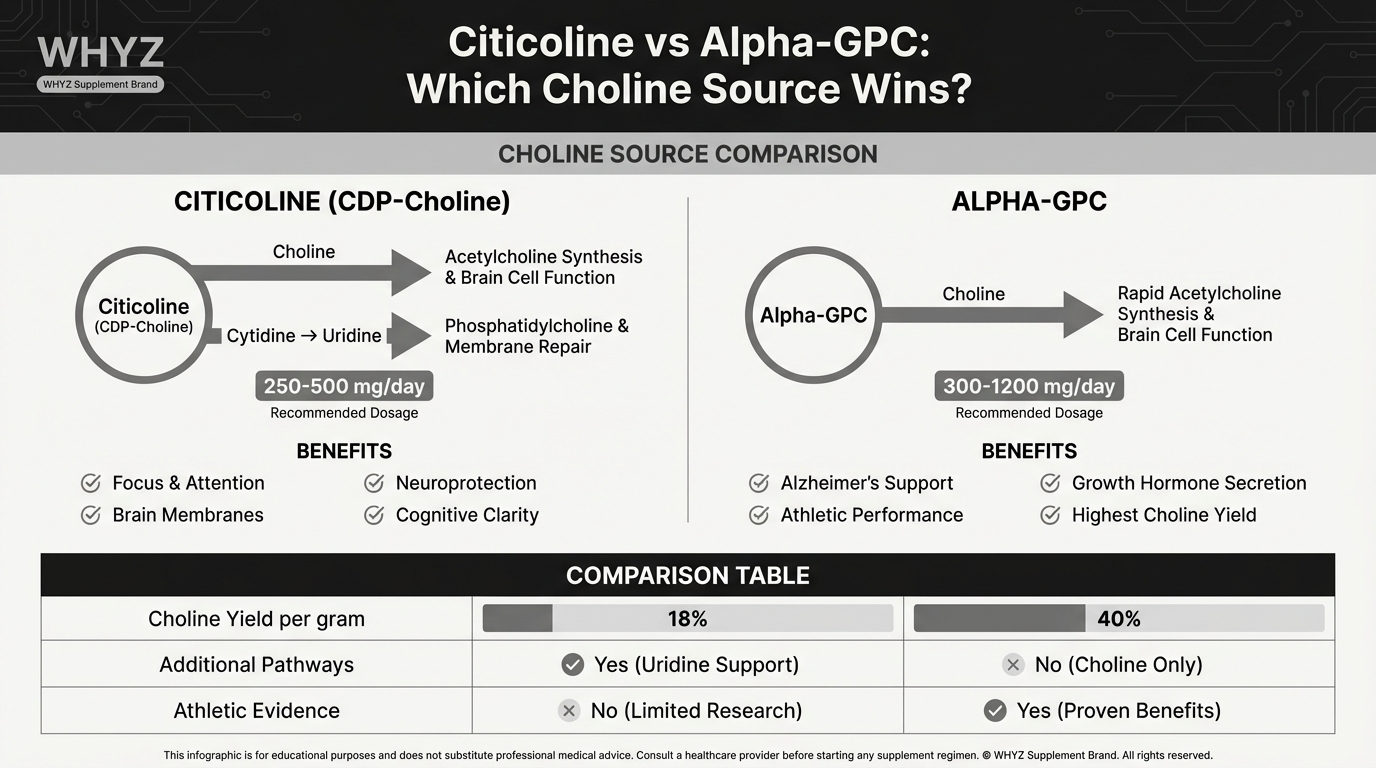
Quick Comparison
| Property | Citicoline (CDP-Choline) | Alpha-GPC |
|---|---|---|
| Full name | Cytidine 5-diphosphocholine | Alpha-glycerophosphocholine |
| What it delivers | Choline + cytidine (converts to uridine) | Choline only |
| Choline yield per gram | ~18% choline by weight | ~40% choline by weight |
| Blood-brain barrier crossing | Yes (as choline + cytidine) | Yes (high efficiency) |
| Growth hormone effect | No evidence | Documented in clinical trials |
| Athletic performance | Not studied | Improved power output in athletes |
| Alzheimer’s evidence | Strong (cognitive impairment focus) | Strong (Alzheimer’s disease focus) |
| Focus/attention evidence | Strong in healthy adults | Limited in healthy adults |
| Typical effective dose | 250-500 mg/day | 300-1,200 mg/day |
| Cost per serving | Lower | Higher |
What Is Citicoline?
Citicoline is the supplement form of cytidine 5-diphosphocholine, an intermediate molecule the body produces naturally during the synthesis of phosphatidylcholine. Every neuronal cell membrane requires phosphatidylcholine as a structural component, and citicoline feeds that synthesis pathway directly.
When taken orally, citicoline is cleaved in the gut and liver into two separate molecules: free choline and cytidine. These two components absorb independently and cross the blood-brain barrier via separate transport mechanisms. Cytidine then converts to uridine in the liver, and uridine enters the brain where it drives phosphatidylcholine production through the CDP-choline pathway. The compound also supplies choline for acetylcholine synthesis.
The dual-delivery mechanism is what makes citicoline distinct. Standard choline supplements (choline bitartrate, choline chloride) provide choline only. Alpha-GPC provides choline only. Citicoline provides choline plus a second neuroprotective pathway via uridine. Cansev (2008) demonstrated in controlled animal experiments that CDP-choline administration increased brain uridine levels and promoted new synaptic formation, effects that choline alone did not produce (PMID 18631994).
Citicoline has over 11,000 patients enrolled across clinical trials, making it one of the most researched nootropic compounds in existence (Secades, 2022). Japan and several European countries have approved it as a prescription drug for neurological conditions.
What Is Alpha-GPC?
Alpha-GPC is a choline compound naturally found in small amounts in the brain and in foods like soy lecithin. The name stands for alpha-glycerophosphocholine, reflecting its structure as choline attached to a glycerophosphate backbone.
Alpha-GPC is a more efficient choline donor than citicoline by weight. While citicoline contains roughly 18% choline by mass, alpha-GPC contains approximately 40% choline by mass. This means a lower-weight dose of alpha-GPC can deliver a comparable or higher choline payload to the brain.
The compound crosses the blood-brain barrier efficiently and raises plasma and brain choline levels rapidly after ingestion. Unlike basic choline salts (choline bitartrate), which show poor brain uptake, alpha-GPC is reliably detected in cerebrospinal fluid following oral administration in research settings.
Alpha-GPC has two clinical applications that citicoline does not: growth hormone stimulation and physical performance enhancement. These applications stem from choline’s role in stimulating acetylcholine release in the central nervous system, which triggers growth hormone-releasing hormone (GHRH) secretion from the hypothalamus. This neuroendocrine pathway does not appear to be relevant for citicoline.
One practical note on purchasing alpha-GPC: it is hygroscopic and becomes oily and difficult to work with at room temperature. Commercial alpha-GPC supplements are typically sold as a 50% active compound blended with silica to stabilize it into a powder. A product labeled 600 mg of alpha-GPC at 50% active delivers 300 mg of actual alpha-glycerophosphocholine. Verify whether the label dose reflects total product weight or active compound.
The Mechanism Difference That Matters
Both compounds raise brain choline. But the downstream effects differ because citicoline provides two neuroprotective inputs while alpha-GPC provides one at higher efficiency.
Citicoline’s dual pathway:
- Choline for acetylcholine synthesis and phosphatidylcholine production
- Uridine for an independent phospholipid synthesis pathway that supports dendritic growth and synaptic structure
Alpha-GPC’s single pathway:
- Choline for acetylcholine synthesis and phosphatidylcholine production (but at higher choline yield per dose)
Grieb (2014) reviewed the neuroprotective mechanisms of citicoline in detail, noting that the uridine component appears responsible for citicoline’s evidence in preserving brain structure during ischemia and neurodegenerative conditions (PMID 24504829). Alpha-GPC lacks this mechanism entirely.
The flip side: alpha-GPC’s efficient choline delivery supports the neuroendocrine pathway for growth hormone more reliably. Ceda et al. (1992) showed that alpha-GPC significantly increased growth hormone-releasing hormone responses in young healthy adults, an effect that basic choline did not replicate (PMID 1392192). No parallel research exists for citicoline and growth hormone.
Clinical Evidence: Citicoline
Healthy Adults and Attention
McGlade et al. (2019) conducted a randomized, double-blind, placebo-controlled study in 60 healthy adults aged 40-60 (PMID 31279789). Participants received 250 mg or 500 mg of citicoline daily for 28 days. Both doses improved sustained attention compared to placebo on the Continuous Performance Test. The 250 mg dose performed comparably to 500 mg, suggesting that lower doses are effective in cognitively intact adults.
An earlier study by McGlade et al. (2015) tested citicoline at 250 mg and 500 mg/day in male adolescents (PMID 25693964). Attention and psychomotor speed improved at both doses, with the 500 mg dose producing larger effect sizes on motor speed measures. These findings suggest citicoline is effective across a wide age range in healthy populations.
Older Adults and Memory
Spiers et al. (1996) studied citicoline in older adults with age-related memory impairment in a double-blind crossover trial (PMID 8624220). Participants who took 1,000 mg/day showed significant improvements in verbal memory retrieval compared to placebo. The memory-impaired subgroup showed the strongest response, suggesting that individuals with some degree of cognitive decline benefit more than those with intact function.
Alzheimer’s and Cognitive Impairment
Fioravanti and Yanagi (2004) published a Cochrane systematic review analyzing 14 randomized trials of citicoline for cognitive and behavioral disturbances in chronic cerebral disorders (PMID 15106147). Citicoline produced consistent improvements in memory and behavior compared to placebo across the included studies, with an adverse event profile comparable to placebo. The review supported citicoline as a well-tolerated cognitive support compound with a meaningful evidence base.
Clinical Evidence: Alpha-GPC
Alzheimer’s Disease
De Jesus Moreno Moreno (2003) conducted a multicenter, randomized, double-blind, placebo-controlled trial of alpha-GPC at 1,200 mg/day in 261 patients with mild-to-moderate Alzheimer’s disease (PMID 12637119). After 180 days, the alpha-GPC group showed statistically significant improvements on the Alzheimer’s Disease Assessment Scale cognitive subscale (ADAS-cog) and Global Assessment compared to placebo. The authors concluded alpha-GPC was a well-tolerated and effective cognitive support compound in this population.
The Alzheimer’s evidence for alpha-GPC is strong within this clinical population. The mechanism is straightforward: Alzheimer’s disease involves progressive cholinergic neuron loss, and alpha-GPC supplies choline to maximize acetylcholine production from the neurons that remain.
Physical Performance
Bellar et al. (2015) examined the effect of alpha-GPC on lower-body power output in trained athletes (PMID 26175657). In a double-blind crossover design, 250 mg of alpha-GPC taken 90 minutes before a bench press protocol produced a statistically significant 14% increase in peak power output compared to placebo. The proposed mechanism involves alpha-GPC stimulating acetylcholine release at the neuromuscular junction, potentially improving motor unit recruitment and muscle fiber activation.
No comparable physical performance evidence exists for citicoline.
Growth Hormone
Ceda et al. (1992) showed alpha-GPC enhanced GHRH-stimulated growth hormone release in a controlled trial (PMID 1392192). This finding is referenced frequently in bodybuilding and anti-aging contexts. The clinical relevance in healthy middle-aged adults supplementing for general health is unclear. The growth hormone increase observed in acute studies does not necessarily translate to meaningful body composition changes over time in healthy populations.
Head-to-Head: What Does the Research Compare?
Parnetti et al. (2001) reviewed both citicoline and alpha-GPC as choline precursors for Alzheimer’s disease management, acknowledging that direct comparative trials were lacking (PMID 11289239). The review concluded both compounds had evidence of cognitive benefit in Alzheimer’s populations through cholinergic mechanisms, but that citicoline had the advantage of additional neuroprotective pathways via cytidine and uridine.
No published randomized trial has directly compared citicoline and alpha-GPC on the same cognitive endpoint in the same population. The choice between them is therefore based on mechanistic reasoning and what each compound’s individual evidence base shows.
Which Should You Choose?
The decision depends on your primary goal.
Choose citicoline if:
- Your goal is focus and attention during cognitively demanding work
- You are 40 or older and want broad brain health support
- You want the lower-risk dosing approach (effective at 250-500 mg/day)
- You prefer a compound with additional mechanisms beyond acetylcholine support (uridine pathway)
- Budget is a consideration (citicoline is less expensive per effective dose)
Choose alpha-GPC if:
- You have Alzheimer’s disease or moderate cognitive decline (higher evidence at 1,200 mg/day)
- You are an athlete looking for pre-workout cognitive and neuromuscular support
- You want the highest choline delivery per milligram of supplement
- You are stacking with other nootropics and want a reliable, high-efficiency choline source
For general brain health in a healthy adult under 60: citicoline at 250-500 mg/day is the better-supported starting point based on current evidence. It is effective at lower doses, has two neuroprotective mechanisms, and has direct trial data in healthy adults on attention endpoints.
For someone with documented cognitive impairment or Alzheimer’s: both compounds have clinical evidence at higher doses. Alpha-GPC at 1,200 mg/day has direct RCT data in Alzheimer’s patients. Either compound is a reasonable choice here, and a healthcare provider should be involved in the decision.
Dosage Guidelines
Citicoline:
- Healthy adults (focus and attention): 250-500 mg/day, taken in the morning
- Cognitive support in older adults: 500-1,000 mg/day
- Clinical trials in cognitive impairment: 1,000-2,000 mg/day
Alpha-GPC:
- Cognitive support: 300-600 mg/day (verify active compound percentage on the label)
- Alzheimer’s clinical dose: 1,200 mg/day in three divided doses
- Athletic performance: 250-600 mg taken 90 minutes before training
- Note: 50% alpha-GPC powders require double the stated dose to reach active compound targets
Both compounds are generally well-tolerated. Excess choline from any source may cause fishy body odor, headaches, and nausea at doses well above clinical recommendations. The tolerable upper intake level for choline is 3.5 g/day in adults. Stacking both compounds is not necessary and increases total choline load without additional proven benefit.
FAQs
Can I take alpha-GPC or citicoline every day? Yes. Both compounds have been administered daily in clinical trials running from 4 weeks to 6 months without significant safety concerns. Long-term daily use at standard doses is considered safe based on available evidence.
Does citicoline help with brain fog? No published trial has used “brain fog” as a primary endpoint. The attention and cognitive processing speed improvements seen in clinical trials suggest it may be relevant for people experiencing cognitive fatigue, but this is an indirect inference.
Which has fewer side effects? Both show adverse event profiles comparable to placebo in most trials. Citicoline may cause mild insomnia if taken late in the day. Alpha-GPC at doses above 1,200 mg may cause headache and dizziness in some individuals. Neither compound has serious safety signals in healthy adults at recommended doses.
Does alpha-GPC build muscle? Not directly. The growth hormone and performance effects are real in acute studies, but there is no long-term RCT showing alpha-GPC supplementation increases muscle mass compared to training alone.
Explore more: