
Home → Guides → D-Mannose Dosage for UTI Prevention and Treatment
D-mannose is one of the most searched supplement topics for women who deal with recurrent urinary tract infections. The research is real, the proposed mechanism makes biological sense, and the supplement is widely sold. But the evidence is also genuinely mixed, and a landmark 2024 JAMA study changed how the field views D-mannose’s effectiveness. Getting the dosage right also means understanding what the clinical data actually shows.
This guide covers the doses used in published trials, what each one found, and how to use D-mannose in a way that is consistent with the current evidence.
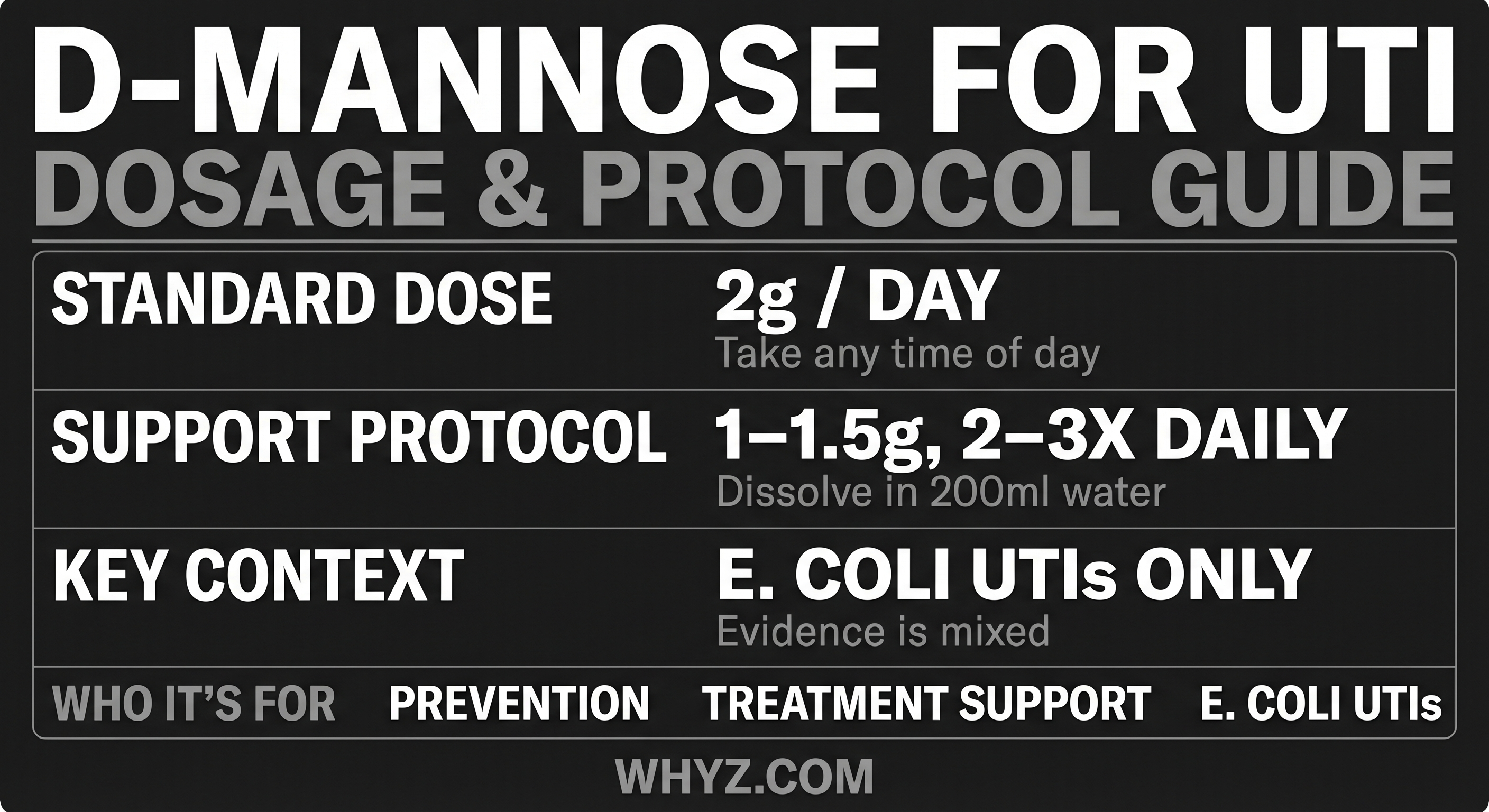
Dosage Summary
| Purpose | Dose | Duration | Evidence |
|---|---|---|---|
| Prevention (recurrent UTI) | 2 g once daily | 3-6 months | Mixed: one positive RCT, one negative JAMA RCT |
| Active infection support | 1-1.5 g, 2-3x daily | Days to 2 weeks | No rigorous RCT evidence |
| Maintenance | 2 g once daily | Ongoing | Not formally studied beyond 6 months |
There is no FDA-approved dosing standard for D-mannose. The figures above reflect what has been tested in controlled trials, not regulatory guidance.
How D-Mannose Is Thought to Work
Escherichia coli causes roughly 80-85% of uncomplicated urinary tract infections. To establish infection, E. coli must adhere to the urothelial cells lining the bladder. It does this using Type 1 fimbriae tipped with FimH adhesins, which bind specifically to mannose residues on the surface of bladder cells.
D-mannose is a simple six-carbon sugar that, when swallowed, is rapidly absorbed and excreted in urine with high urinary recovery. The theory is that mannose in the urine acts as a decoy target, saturating the FimH adhesins on E. coli before the bacteria can bind to the bladder wall. Bacteria coated in mannose are then flushed out with urination rather than establishing infection.
This mechanism is well-characterized in laboratory settings and has been confirmed in animal models. The important caveat: direct confirmation in living humans remains elusive. No study has proven the FimH-blocking mechanism operates as described in vivo. The clinical trials test whether D-mannose reduces UTI recurrence, not whether the proposed mechanism is the reason.
For a side-by-side comparison of D-mannose and cranberry (which targets a different bacterial adhesion pathway), see: D-Mannose vs Cranberry for UTIs: What the Research Shows
For the full D-mannose ingredient overview including pharmacokinetics and safety profile, see the D-Mannose ingredient page.
The Clinical Evidence
The Kranjcec 2014 Trial (The Landmark Positive RCT)
The study that put D-mannose on the map is still the most frequently cited in this category.
Kranjcec B et al. (2014) randomized 308 women with recurrent UTI into three groups: 2 g of D-mannose powder dissolved in water once daily, 50 mg nitrofurantoin once daily, or no prophylaxis. The trial ran for 6 months.
Results: 15 of 103 women in the D-mannose group had a recurrent UTI (14.6%), compared to 21 of 103 in the nitrofurantoin group (20.4%) and 62 of 102 in the no-prophylaxis group (60.8%). The difference between D-mannose and no prophylaxis was statistically significant. The difference between D-mannose and nitrofurantoin was not statistically significant. D-mannose performed comparably to a low-dose antibiotic. Crucially, the D-mannose group had fewer side effects than the nitrofurantoin group. This study provides the strongest published evidence that 2 g/day D-mannose may reduce UTI recurrence (Kranjcec B et al., 2014. World J Urol. PMID: 23633128).
The 2024 JAMA Internal Medicine RCT (The Negative Trial)
This trial changed the picture considerably.
Price TK et al. (2024) conducted a randomized, double-blind, placebo-controlled trial in 598 women with recurrent UTI in primary care settings. Participants received either 2 g/day of D-mannose powder or matched placebo for 6 months. The primary outcome was whether participants experienced a medically attended UTI during the trial period.
Results: 51.0% of the D-mannose group experienced a subsequent UTI, compared to 55.7% in the placebo group. This difference (risk difference: -4.7 percentage points) was not statistically significant. The authors concluded that daily D-mannose did not reduce the proportion of women with recurrent UTI in primary care who experienced a subsequent clinically suspected UTI (Price TK et al., 2024. JAMA Intern Med. PMID: 38587819).
This was a large, well-powered trial in a generalizable real-world population. Its null result is not easily dismissed.
Meta-Analysis Evidence (2025)
A 2025 systematic review and meta-analysis in the Journal of Brazilian Nephrology pooled data from randomized controlled trials comparing D-mannose to control or antibiotics in women at high risk for recurrent UTI. The pooled analysis found that D-mannose was not associated with a reduction in recurrent UTI compared to control (relative risk: 0.57, 95% CI: 0.29-1.15), a result that crossed the null. Subgroup analyses did not improve the overall picture. The authors concluded that D-mannose did not reduce the incidence of recurrent UTIs compared to control or antibiotics in high-risk patients (J Bras Nefrol. 2025. PMID: 41004704).
A 2025 expert review from UT Southwestern Medical Center classified D-mannose among nonantibiotic options for recurrent UTI management alongside cranberry, methenamine hippurate, and probiotics, while characterizing evidence across this category as “mixed.” The reviewers noted that individualized treatment based on risk factors and microbiological patterns is more appropriate than a one-size-fits-all supplement recommendation (Sze C et al., 2025. Expert Opin Pharmacother. PMID: 41175137).
How to Interpret the Conflicting Evidence
The discrepancy between the Kranjcec 2014 trial (positive) and the 2024 JAMA trial (negative) is real and not fully resolved. Several differences between the studies may explain the gap:
Study setting: Kranjcec 2014 was conducted in Croatia in a specialist urology population. The 2024 JAMA trial enrolled women through primary care in the UK. Real-world primary care populations may have more heterogeneous bacterial profiles, different rates of antibiotic resistance, and different baseline UTI etiologies.
Sample size and power: The 2024 JAMA trial (598 participants) was substantially larger and had more statistical power than Kranjcec 2014 (308 participants). Larger trials with rigorous blinding tend to produce more conservative results.
Outcome definition: Kranjcec 2014 used microbiologically confirmed UTI. The JAMA trial used “clinically suspected UTI attended in primary care,” which captures a broader population including some who may not have had a true infection.
The honest interpretation: D-mannose at 2 g/day may help some women with recurrent UTI, particularly those with E. coli-dominated infection profiles. It does not appear to produce the broad, consistent prevention benefit that early enthusiasm suggested. It is not a replacement for medical evaluation.
Dosage for Prevention
The 2 g once daily dose is the only one tested in rigorous human trials. Both the positive and negative large RCTs used this dose.
Practical considerations:
- D-mannose powder dissolves easily in water (200 ml is standard in the Kranjcec protocol)
- Some products use capsule form at 500-1,000 mg, requiring 2-4 capsules to reach the 2 g threshold
- Timing has not been studied formally but morning dosing with adequate water intake (which promotes urinary flushing) is a practical approach
- Taking D-mannose consistently daily throughout the desired prevention period matters more than the exact time of day
Dosage During an Active Infection
No large RCT has tested D-mannose specifically for treating an active UTI. The protocols that circulate (1.5 g twice daily for 3 days, then once daily for 10 days, or 1 g three times daily for 14 days) reflect smaller pilot studies and practitioner conventions, not established clinical standards.
What the current evidence supports saying: D-mannose may reduce symptoms and urinary discomfort during a mild uncomplicated UTI. What it does not support: using D-mannose as the sole treatment for an active UTI, particularly any infection with systemic symptoms.
Active UTIs can ascend to the kidneys if untreated. Any UTI accompanied by fever (above 38 degrees C), lower back or flank pain, nausea, vomiting, or chills warrants prompt medical attention. These signs suggest pyelonephritis (kidney infection), which requires antibiotics and sometimes hospitalization.
Who May Benefit Most from D-Mannose
Based on the Kranjcec 2014 data and the mechanistic rationale, D-mannose is most likely to be useful for women whose recurrent UTIs are:
- Culture-confirmed as E. coli (the organism whose FimH adhesins D-mannose targets)
- Uncomplicated lower urinary tract infections (cystitis), not upper tract or kidney infections
- Part of a recurrent pattern (two or more per year) in otherwise healthy women
- Not driven by anatomical abnormalities, foreign bodies (like catheters), or antibiotic-resistant organisms
D-mannose has little theoretical basis for UTIs caused by Klebsiella, Proteus, Enterococcus, or other non-fimbriated organisms. If your UTI cultures show organisms other than E. coli, discuss the relevance of D-mannose with your physician.
Safety
D-mannose appears safe at 2 g/day for the studied durations (up to 6 months). Common side effects reported across trials:
- Mild gastrointestinal discomfort (loose stools, bloating)
- These effects were mild and did not require stopping supplementation in either major trial
Blood sugar considerations: D-mannose is a sugar, but it is metabolized differently than glucose. Only a small percentage (~20-25%) is retained in the body after ingestion. At 2 g/day, the blood glucose impact in healthy individuals appears minimal. However, people with diabetes or impaired kidney function should consult a physician before regular use, as mannose clearance depends on kidney function and could accumulate in those with impaired renal handling.
Pregnancy: No safety data exists for D-mannose in pregnancy. Urinary tract infections are common during pregnancy and require medical management. Do not use D-mannose as a substitute for prenatal care or antibiotic treatment of UTIs during pregnancy.
When to See a Doctor Instead
D-mannose is appropriate to consider for recurrent UTI prevention after evaluation by a physician. It is not appropriate as a substitute for medical care in these situations:
- First UTI (should be evaluated and cultured)
- UTI with fever, chills, back pain, or systemic symptoms (possible kidney infection)
- UTI during pregnancy
- UTI in men (less common, requires urological evaluation)
- UTI that is not responding to current management
- Recurrent UTIs without knowing the causative organism
Antibiotic resistance is a genuine public health concern, and the interest in nonantibiotic UTI prevention is well-founded. But D-mannose works best as an adjunct within a comprehensive management plan, not as a first-line or sole intervention outside of medical guidance.
The Bottom Line on D-Mannose Dosage
2 grams daily is the dose with human clinical trial data behind it. One well-designed 2014 RCT showed meaningful UTI recurrence reduction. A larger 2024 JAMA RCT found no statistically significant benefit. A 2025 meta-analysis of pooled RCTs found no significant reduction overall.
D-mannose is a legitimate option for women with recurrent E. coli UTIs who want a nonantibiotic approach and understand the mixed evidence. It is not a proven, reliable substitute for antibiotic prophylaxis or medical evaluation. The current evidence justifies cautious use, not confident recommendation.
Frequently Asked Questions
How much D-mannose should I take to prevent a UTI?
The dose used in the only large positive RCT (Kranjcec et al., 2014) was 2 grams of D-mannose powder dissolved in water, taken once daily. This is the standard reference dose for prevention. A 2024 JAMA RCT using the same dose found no statistically significant benefit in a primary care population, so results are not guaranteed.
Can I take D-mannose every day long-term?
Trials have studied continuous daily use for up to 6 months. Long-term data beyond 6 months is limited. The available trial data does not raise safety concerns at 2 g/day over 6 months. Discuss extended use with your physician if you are managing a chronic recurrence pattern.
Does D-mannose work as fast as antibiotics?
Antibiotics typically reduce UTI symptoms within 24-48 hours. D-mannose has no proven speed advantage for treating active infection. Its potential role is in prevention over time, not acute treatment. Do not delay antibiotic treatment for an active UTI in favor of D-mannose if symptoms are present.
Can men take D-mannose for UTIs?
Virtually all clinical research on D-mannose for UTIs has been conducted in women. UTIs in men are less common and often associated with underlying anatomical or prostatic issues that D-mannose would not address. Men with UTIs need urological evaluation. D-mannose is not validated for use in men.
Is D-mannose safe with antibiotics?
No clinical interactions between D-mannose and antibiotics have been identified. Some practitioners use both concurrently during an active infection. This is not standard practice with evidence-based support, but it is unlikely to cause harm based on the mechanism and safety profile of D-mannose. Discuss any combination approach with your prescribing physician.
Will D-mannose help if my UTI is not caused by E. coli?
Probably not. D-mannose targets FimH adhesins on Type 1 fimbriae, which are a feature of E. coli. Other uropathogens like Klebsiella, Staphylococcus saprophyticus, and Enterococcus faecalis use different adhesion mechanisms that D-mannose does not block. Knowing your culture results is essential before investing in D-mannose prevention.
References
- Kranjcec B, et al. D-mannose powder for prophylaxis of recurrent urinary tract infections in women: a randomized clinical trial. World J Urol. 2014;32(1):79-84. PMID: 23633128
- Price TK, et al. Effect of daily D-mannose on recurrent urinary tract infection in women: a randomized clinical trial. JAMA Intern Med. 2024;184(6):619-628. PMID: 38587819
- Sze C, et al. Effective risk reduction strategies and pharmacological treatment for uncomplicated recurrent urinary tract infections. Expert Opin Pharmacother. 2025;26(16):1699-1711. PMID: 41175137
- Meta-analysis: D-mannose as prophylaxis of recurrent urinary tract infection: a systematic review and meta-analysis. J Bras Nefrol. 2025. PMID: 41004704