
Home → Guides → D-Mannose vs Cranberry for UTIs: What the Research Shows
Urinary tract infections are one of the most common bacterial infections, affecting an estimated 150 million people worldwide each year. For women who deal with recurrent UTIs, the cycle of antibiotics, temporary relief, and reinfection is frustrating. That frustration has driven interest in two natural supplements: D-mannose and cranberry.
Both target the same pathogen, Escherichia coli, and both aim to prevent bacteria from sticking to the bladder wall. But they work through different mechanisms, carry different levels of clinical evidence, and may suit different people. This guide puts the research side by side.
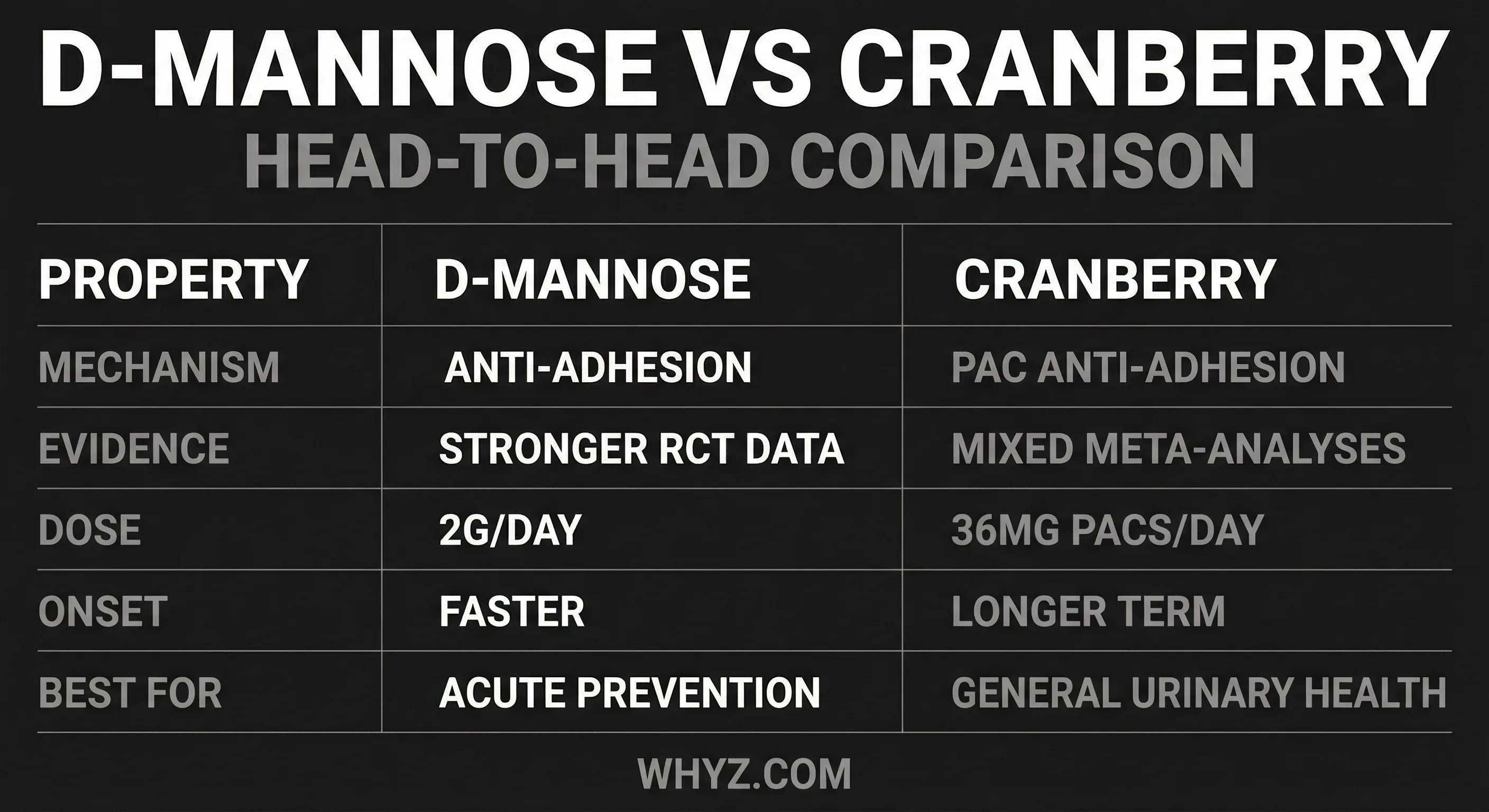
Quick Comparison
| Property | D-Mannose | Cranberry |
|---|---|---|
| What it is | Simple sugar (monosaccharide) | Fruit extract (proanthocyanidins) |
| Mechanism | Blocks Type 1 fimbriae on E. coli | Blocks Type 1 and P-type fimbriae |
| Evidence level | One landmark RCT, mixed newer data | Multiple RCTs, Cochrane review |
| Effective dose | 2 g/day for prevention | 36 mg PACs/day |
| Onset | Rapid urinary excretion | Requires consistent daily intake |
| Best for | Recurrent UTI prevention | General urinary health support |
| Side effects | Mild GI discomfort, possible blood sugar effect | Minimal at supplement doses |
| Cost | Moderate ($15-25/month) | Low to moderate ($10-20/month) |
The UTI Problem: Why These Two Supplements?
E. coli causes roughly 80% of uncomplicated UTIs. The infection starts when bacteria from the gut colonize the urethra, travel upward, and attach to the lining of the bladder. That attachment step is critical. If the bacteria cannot stick, urine flow washes them out before infection takes hold.
This is why both D-mannose and cranberry have attracted research attention. They do not kill bacteria. Instead, they aim to prevent bacterial adhesion, the step that turns harmless bacterial presence into active infection.
Antibiotics remain the standard treatment for active UTIs. But for prevention, particularly in women with recurrent infections (defined as two or more UTIs in six months or three or more in twelve months), non-antibiotic options are appealing. Repeated antibiotic courses contribute to resistance, disrupt the microbiome, and can cause side effects of their own.
What Is D-Mannose?
D-mannose is a simple sugar closely related to glucose. It occurs naturally in small amounts in cranberries, apples, and peaches. When taken as a supplement, it is absorbed in the upper GI tract but not metabolized the way glucose is. Most of the ingested D-mannose passes through the body and is excreted in urine, which is exactly why it may be useful for UTI prevention.
The mechanism is specific and well-characterized. E. coli uses hair-like projections called Type 1 fimbriae to grab onto mannose receptors on the surface of bladder epithelial cells. D-mannose in the urine acts as a decoy. The bacteria bind to the free-floating mannose molecules instead of the bladder wall, and the next urination flushes them out.
This mechanism is narrow by design. D-mannose targets only E. coli strains that use Type 1 fimbriae for adhesion. It does not affect bacteria that use other adhesion mechanisms, and it does not work against UTIs caused by non-E. coli pathogens like Klebsiella, Proteus, or Enterococcus.
One common concern: does D-mannose raise blood sugar? Because it is a sugar, people with diabetes or insulin resistance ask this question often. D-mannose is absorbed but largely excreted unchanged. At typical supplement doses (2 g), the effect on blood glucose appears minimal in healthy individuals, though people with diabetes should monitor and consult their provider.
What Is Cranberry?
Cranberry supplements deliver proanthocyanidins (PACs), a class of polyphenolic compounds concentrated in cranberry fruit. Not all PACs are equal. Cranberry contains A-type proanthocyanidins, which have a specific molecular structure that enables anti-adhesion activity. B-type PACs, found in many other fruits like grapes and chocolate, do not have this property.
The anti-adhesion mechanism of cranberry PACs is broader than D-mannose. Cranberry PACs interfere with both Type 1 fimbriae (the same target as D-mannose) and P-type fimbriae, a separate adhesion system that E. coli uses to bind to kidney and bladder tissue. This dual mechanism gives cranberry theoretical coverage against a wider range of uropathogenic E. coli strains.
The key challenge with cranberry research has been standardization. “Cranberry” can mean juice cocktail (often loaded with sugar and containing minimal PACs), pure cranberry juice, cranberry extract capsules, or standardized PAC supplements. Study outcomes vary dramatically based on the form and dose used. The most reliable results come from studies using cranberry products standardized to deliver at least 36 mg of soluble PACs per day.
Clinical Evidence: D-Mannose
The landmark D-mannose study is Kranjcec et al. (2014), a randomized clinical trial published in World Journal of Urology. The study enrolled 308 women with a history of recurrent UTIs and randomized them to three groups: D-mannose (2 g/day in water), nitrofurantoin (a prophylactic antibiotic at 50 mg/day), or no treatment (Kranjcec et al., 2014).
The results were notable. During the six-month treatment period, 15% of women in the D-mannose group experienced a recurrent UTI, compared to 20% in the nitrofurantoin group and 60% in the no-treatment group. D-mannose performed comparably to the antibiotic for prevention, with fewer side effects. This study is widely cited and is the primary basis for most D-mannose supplement marketing.
Domenici et al. (2016) published a pilot study examining D-mannose for acute UTI management and recurrence prevention. The results were promising, showing reduced recurrence over a six-month follow-up period, though the study was smaller and not placebo-controlled (Domenici et al., 2016).
More recent data has introduced some uncertainty. A larger, placebo-controlled JAMA trial found no significant difference between D-mannose and placebo for UTI prevention, calling into question whether the earlier positive results would replicate at scale. This does not invalidate the Kranjcec findings, but it means D-mannose efficacy should not be treated as settled science.
The overall picture: D-mannose has a biologically plausible mechanism, one strong positive RCT, supporting pilot data, and at least one larger trial that did not confirm the benefit. More research is needed.
Clinical Evidence: Cranberry
Cranberry has been studied for UTI prevention for decades, producing a mixed but informative evidence base.
The Cochrane systematic review by Jepson et al. (2012) analyzed multiple RCTs of cranberry products for UTI prevention. The review concluded that cranberry products did not significantly reduce the incidence of symptomatic UTIs, though the authors noted substantial variability in product type, dose, and study quality across the included trials (Jepson et al., 2012). This Cochrane review is often cited as evidence that cranberry does not work, but the conclusion is more nuanced. Many of the included studies used cranberry juice cocktails or low-dose products that may not have delivered sufficient PACs.
Barbosa-Cesnik et al. (2011) conducted a rigorous RCT with 319 college women, finding that cranberry juice (8 oz twice daily of 27% cranberry juice) did not reduce six-month UTI recurrence compared to placebo (Barbosa-Cesnik et al., 2011). This was a well-designed negative trial, though the cranberry dose in juice form may have been insufficient in PAC content.
Stapleton et al. (2012) tested cranberry juice in women with recurrent UTIs in a randomized trial published in Mayo Clinic Proceedings. The results showed a protective trend for cranberry but did not reach statistical significance, with the authors noting that a larger study was warranted (Stapleton et al., 2012).
The pattern across cranberry research: studies using standardized, high-PAC cranberry extracts tend to show more consistent benefit than studies using juice or unstandardized products. The American Urological Association (AUA) now includes cranberry with bioavailable PACs as a non-antibiotic option for UTI prevention in their clinical guidelines, a notable endorsement.
Head-to-Head: What the Research Shows
Direct comparison data between D-mannose and cranberry is limited. The Kranjcec et al. (2014) trial compared D-mannose to nitrofurantoin and no treatment, but did not include a cranberry arm (Kranjcec et al., 2014).
Mechanistically, cranberry has broader coverage. D-mannose blocks only Type 1 fimbriae adhesion. Cranberry PACs block both Type 1 and P-type fimbriae. Since uropathogenic E. coli can use either or both adhesion systems, cranberry’s dual mechanism is theoretically more comprehensive.
On clinical evidence, D-mannose has one strong positive RCT but inconsistent replication. Cranberry has a larger total body of research, including a Cochrane review, multiple RCTs, and AUA guideline inclusion, though individual trial results are mixed.
Neither supplement has bulletproof evidence. Both have plausible mechanisms and some clinical support. The question is less “which one works” and more “which one fits your situation.”
Who Should Take D-Mannose?
D-mannose may be most appropriate for:
- Women with recurrent UTIs specifically caused by E. coli (confirmed by urine culture)
- Those looking for a targeted anti-adhesion approach
- People who want to avoid long-term prophylactic antibiotics
- Those who tolerate the supplement well and observe fewer recurrences while using it
D-mannose is less likely to help if your UTIs are caused by non-E. coli bacteria, or if the E. coli strains involved primarily use P-type fimbriae rather than Type 1.
Who Should Take Cranberry?
Cranberry may be most appropriate for:
- Women with recurrent UTIs who want broad-spectrum anti-adhesion coverage
- Those who prefer a supplement with a longer research history
- People whose UTI pathogens are not culture-confirmed (since cranberry covers more adhesion types)
- Anyone looking for additional urinary health support beyond UTI prevention, as cranberry PACs also have antioxidant properties
Choose a cranberry supplement standardized to deliver at least 36 mg of soluble A-type PACs per day. Cranberry juice cocktails and unstandardized capsules are unlikely to deliver a therapeutic dose.
Can You Take Both Together?
Yes. There is no known interaction between D-mannose and cranberry, and their mechanisms are complementary. D-mannose saturates the mannose receptors that E. coli Type 1 fimbriae target. Cranberry PACs interfere with a separate adhesion pathway (P-type fimbriae) while also contributing to Type 1 blockade.
Some practitioners recommend combining both for women with frequent recurrences who have not achieved adequate prevention with either supplement alone. This is a reasonable approach, though no published RCT has tested the combination against either supplement individually.
Dosage for Each
D-Mannose
| Use | Dose | Frequency |
|---|---|---|
| Prevention | 2 g | Once daily, dissolved in water |
| Active UTI support | 2 g | Every 2-3 hours for first 48 hours, then taper |
| Post-intercourse | 2 g | Within 2 hours after intercourse |
Take D-mannose with a full glass of water to support urinary excretion. It is typically well tolerated, with occasional reports of loose stools or mild bloating at higher doses.
Cranberry
| Use | Dose | Form |
|---|---|---|
| Prevention | 36 mg PACs/day | Standardized extract capsule |
| Alternative | 500 mg cranberry extract | If PAC content is not specified |
| Juice (less reliable) | 8-16 oz unsweetened | Daily, but PAC dose is variable |
Look for products that specify A-type PAC content. Generic “cranberry extract” without PAC standardization makes it impossible to know if you are getting a therapeutic dose.
The Bottom Line
D-mannose and cranberry both target E. coli adhesion in the urinary tract, but they do it differently and carry different evidence profiles.
D-mannose is more targeted (Type 1 fimbriae only) and has one strong positive RCT, but newer research has not consistently confirmed the benefit. It acts quickly, is well tolerated, and makes biological sense for E. coli-specific UTIs.
Cranberry covers more ground (Type 1 and P-type fimbriae) and has more total research, including guideline recognition from the AUA. Individual trials are mixed, largely because of inconsistent product standardization. When PAC content is controlled, the results trend positive.
For women with confirmed E. coli recurrent UTIs, either supplement is a reasonable addition to a prevention strategy that also includes adequate hydration, post-intercourse urination, and medical follow-up. Combining both is an option when single-supplement prevention is insufficient. Neither replaces antibiotics for treating an active infection.
FAQ
Does D-mannose work for all types of UTIs? No. D-mannose targets E. coli that use Type 1 fimbriae to adhere to the bladder wall. It does not work against UTIs caused by Klebsiella, Proteus, Enterococcus, or E. coli strains that primarily use P-type fimbriae. A urine culture can help identify your pathogen.
How long does it take for cranberry to work? Cranberry is a preventive supplement, not a treatment. The anti-adhesion effect builds with consistent daily use. Most clinical trials assess outcomes over 6 to 12 months of daily supplementation. Do not expect immediate results from a single dose.
Can men take D-mannose or cranberry for UTIs? Yes. Although UTIs are far more common in women, men can develop them, particularly after age 50 or with prostate conditions. The anti-adhesion mechanisms apply regardless of sex. However, male UTIs often involve different bacterial strains or structural factors, so medical evaluation is more important.
Is cranberry juice as effective as cranberry extract capsules? Probably not. Most cranberry juice products, including “100% juice” varieties, contain low and variable levels of A-type PACs. Clinical trials using juice have generally shown weaker or null results compared to studies using standardized extracts. A capsule delivering 36 mg of soluble PACs is more reliable than juice for UTI prevention.
Should I stop taking D-mannose if I have diabetes? D-mannose is a sugar, but at a typical dose of 2 g, the impact on blood glucose appears minimal in most people. That said, if you have diabetes or insulin resistance, monitor your blood sugar when starting D-mannose and discuss it with your healthcare provider. Cranberry extract capsules (not juice) are a low-sugar alternative.
{
  "@context": "https://schema.org",
  "@type": "FAQPage",
  "mainEntity": [
    {
      "@type": "Question",
      "name": "Does D-mannose work for all types of UTIs?",
      "acceptedAnswer": {
        "@type": "Answer",
        "text": "No. D-mannose targets E. coli that use Type 1 fimbriae to adhere to the bladder wall. It does not work against UTIs caused by Klebsiella, Proteus, Enterococcus, or E. coli strains that primarily use P-type fimbriae. A urine culture can help identify your pathogen."
      }
    },
    {
      "@type": "Question",
      "name": "How long does it take for cranberry to work?",
      "acceptedAnswer": {
        "@type": "Answer",
        "text": "Cranberry is a preventive supplement, not a treatment. The anti-adhesion effect builds with consistent daily use. Most clinical trials assess outcomes over 6 to 12 months of daily supplementation. Do not expect immediate results from a single dose."
      }
    },
    {
      "@type": "Question",
      "name": "Can men take D-mannose or cranberry for UTIs?",
      "acceptedAnswer": {
        "@type": "Answer",
        "text": "Yes. Although UTIs are far more common in women, men can develop them, particularly after age 50 or with prostate conditions. The anti-adhesion mechanisms apply regardless of sex. However, male UTIs often involve different bacterial strains or structural factors, so medical evaluation is more important."
      }
    },
    {
      "@type": "Question",
      "name": "Is cranberry juice as effective as cranberry extract capsules?",
      "acceptedAnswer": {
        "@type": "Answer",
        "text": "Probably not. Most cranberry juice products contain low and variable levels of A-type PACs. Clinical trials using juice have generally shown weaker or null results compared to studies using standardized extracts. A capsule delivering 36 mg of soluble PACs is more reliable than juice for UTI prevention."
      }
    },
    {
      "@type": "Question",
      "name": "Should I stop taking D-mannose if I have diabetes?",
      "acceptedAnswer": {
        "@type": "Answer",
        "text": "D-mannose is a sugar, but at a typical dose of 2 grams, the impact on blood glucose appears minimal in most people. If you have diabetes or insulin resistance, monitor your blood sugar when starting D-mannose and discuss it with your healthcare provider. Cranberry extract capsules (not juice) are a low-sugar alternative."
      }
    }
  ]
}
References
- Kranjcec et al., 2014. D-mannose powder for prophylaxis of recurrent urinary tract infections in women: a randomized clinical trial.
- Domenici et al., 2016. D-mannose: a promising support for acute urinary tract infections in women. A pilot study.
- Jepson et al., 2012. Cranberries for preventing urinary tract infections (Cochrane review).
- Barbosa-Cesnik et al., 2011. Cranberry juice fails to prevent recurrent urinary tract infection: results from a randomized placebo-controlled trial.
- Stapleton et al., 2012. Recurrent urinary tract infection and urinary Escherichia coli in women ingesting cranberry juice daily: a randomized controlled trial.