
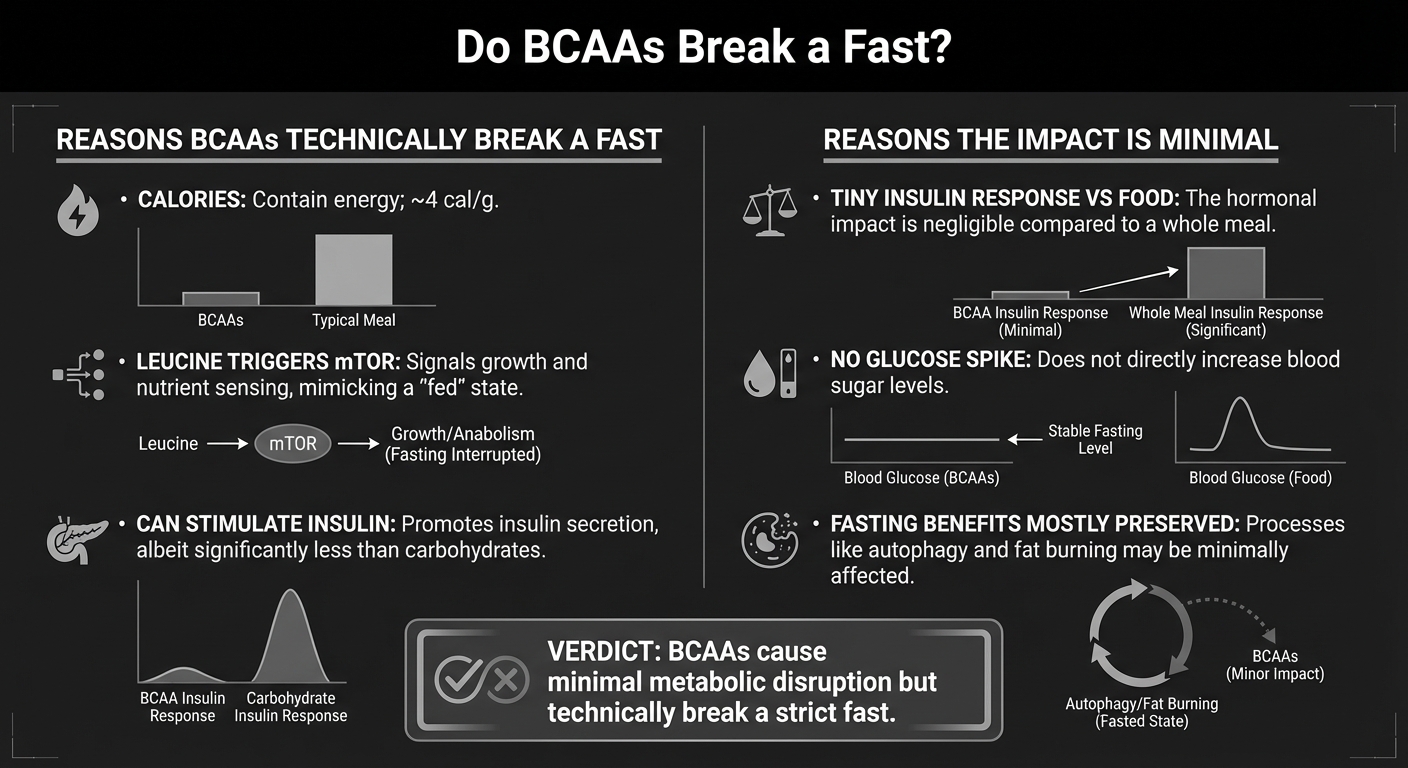
Technically, yes. BCAAs break a fast. They contain calories (roughly 4 per gram), stimulate insulin release, and activate the mTOR pathway. But the real question is whether that matters for your goals. For most people practicing intermittent fasting, the metabolic disruption from a standard 5-10 g BCAA dose is small enough that the practical impact on fat loss, ketosis, or autophagy is minimal.
The answer depends entirely on why you are fasting and how strict your definition of “fasted” is. Let’s break down the science.
BCAAs Have Calories (Even If the Label Says Zero)
This catches a lot of people off guard. Many BCAA supplements list zero calories on the label. That is a labeling technicality, not a biological reality.
BCAAs are amino acids. Amino acids contain roughly 4 calories per gram, just like other protein sources. A typical 5 g serving of BCAAs delivers about 20 calories. A 10 g serving delivers about 40 calories. The FDA allows supplement manufacturers to list certain amino acid products as zero-calorie because they are classified differently than whole food protein, but your body processes them the same way.
Those 20-40 calories are real. Your metabolism recognizes them. And any caloric intake, no matter how small, ends a true zero-calorie fast by definition.
Leucine Triggers an Insulin Response
Of the three branched-chain amino acids (leucine, isoleucine, and valine), leucine is the one with the most metabolic significance during fasting.
Leucine directly stimulates insulin secretion from pancreatic beta cells. Research by Kalogeropoulou et al., 2008 demonstrated that leucine ingestion synergistically stimulates insulin secretion when consumed with glucose, and produces a measurable insulin response even on its own. The magnitude of this response is far smaller than what you would see after a full meal, but it is not zero.
For strict fasting protocols that define “fasted” as producing no insulin response, this matters. For 16:8 or 20:4 intermittent fasting focused on calorie restriction, a small leucine-driven insulin bump is unlikely to meaningfully alter your results.
mTOR Activation and Autophagy
This is where the debate gets more nuanced. One of the proposed benefits of fasting is upregulated autophagy, the cellular “cleanup” process that recycles damaged proteins and organelles. Autophagy is suppressed when the mTOR (mechanistic target of rapamycin) pathway is activated.
Leucine is a potent mTOR activator. It is one of the strongest dietary signals for mTOR stimulation, triggering the pathway that initiates muscle protein synthesis (Jeong et al., 2025). This is the same pathway that drives the anabolic response from protein intake.
Here is the trade-off: mTOR activation and autophagy sit on opposite ends of a metabolic seesaw. When mTOR goes up, autophagy goes down. A 5-10 g dose of BCAAs will push this seesaw toward the mTOR side.
However, the degree of suppression matters. A small BCAA dose produces a brief, modest mTOR activation compared to a 40 g protein meal or a mixed macronutrient feeding. Research on intermittent fasting suggests that the primary health benefits of fasting (improved insulin sensitivity, reduced inflammation, metabolic flexibility) are driven more by the overall caloric restriction pattern than by achieving perfect zero-nutrient windows (de Cabo and Mattson, 2019).
The Insulin Response in Context
Understanding how small the BCAA insulin response is compared to actual food helps frame the practical impact.
A full meal containing carbohydrates and protein produces a large, sustained insulin spike that lasts hours. A 5 g BCAA dose produces a brief, modest insulin elevation that resolves quickly. The difference is not subtle. It is orders of magnitude apart.
Barazzoni et al., 2012 showed that insulin’s ability to enhance mTOR phosphorylation and muscle protein synthesis in human skeletal muscle depends heavily on the overall amino acid environment. Isolated amino acids without a full meal context produce a much more limited metabolic cascade than complete protein feeding.
For fat oxidation specifically, a small insulin response from BCAAs is unlikely to significantly suppress the lipolysis (fat breakdown) that occurs during a fasted state. Insulin is a spectrum, not a binary switch. A tiny bump does not shut down fat burning the way a carbohydrate-rich meal does.
Do BCAAs Provide Any Benefit During Fasted Training?
This is the practical reason most people ask about BCAAs and fasting in the first place. They want to train in a fasted state for fat loss or schedule convenience, but worry about muscle protein breakdown.
There is a reasonable argument for using BCAAs during fasted training. Wolfe, 2017 reviewed the evidence on BCAAs and muscle protein synthesis and concluded that BCAAs alone cannot fully stimulate muscle protein synthesis (you need all nine essential amino acids for that). But BCAAs can reduce muscle protein breakdown during exercise by providing a direct substrate, which may help preserve lean mass during fasted sessions.
The practical scenario looks like this: you train fasted, take 5-10 g BCAAs before or during your session, and accept a minor technical break in your fast. The trade-off is reduced muscle catabolism during training at the cost of 20-40 calories and a brief metabolic signal. For most people who are fasting for body composition rather than maximum autophagy, this trade-off makes sense.
If you are already consuming adequate daily protein (1.6-2.2 g/kg), you could also consider EAAs as an alternative to BCAAs for fasted training. EAAs provide all nine essential amino acids, giving your muscles the complete toolkit for protein synthesis rather than just the initiation signal.
What Counts as “Breaking” a Fast?
The answer depends on your fasting goals:
Strict water fast (therapeutic or autophagy-focused): Yes, BCAAs break this fast. Any caloric intake, amino acid intake, or mTOR stimulation disrupts the metabolic state you are trying to achieve. Stick to water, plain black coffee, and plain tea.
Intermittent fasting for fat loss (16:8, 20:4, OMAD): BCAAs cause minimal disruption. The 20-40 calories and brief insulin response are unlikely to meaningfully affect your fat loss trajectory. The total caloric deficit over the full day matters far more than whether you had a small amino acid dose during your fasting window.
Fasted training for body composition: BCAAs may actually help by reducing muscle breakdown during exercise. The minor technical fast-break is a worthwhile trade-off for most trainees. Consider timing your BCAA intake around your training window for maximum benefit.
Religious or protocol-strict fasting: This depends on the specific rules of the fast. BCAAs are a supplement, not food, but they do contain calories and nutrients.
Alternatives That Do Not Break a Fast
If you want the benefits of fasted training without any metabolic disruption:
- Black coffee: Contains zero calories and may actually enhance fat oxidation and autophagy. Caffeine activates AMPK, which promotes autophagy.
- Green tea: Minimal calories, contains catechins that may support metabolic rate.
- Water with electrolytes: Sodium, potassium, and magnesium have no caloric impact and prevent the fatigue and cramping that fasted training can cause.
- Creatine monohydrate: Zero calories, does not stimulate insulin, and does not affect autophagy. Can be taken during a fasted window without concern.
Frequently Asked Questions
Do BCAAs spike insulin?
Yes, but the spike is small compared to a meal. Leucine stimulates insulin secretion from the pancreas (Kalogeropoulou et al., 2008). A typical 5-10 g BCAA dose produces a brief, modest insulin elevation that resolves within 30-60 minutes. This is far less than the insulin response from carbohydrates or a complete protein meal.
Can I take BCAAs during a 16:8 intermittent fast?
For most people, yes. If your goal is fat loss through caloric restriction, a 5-10 g BCAA dose during your fasting window will not meaningfully impact your results. The total daily calorie balance matters far more than whether you technically maintained a zero-calorie state for the full 16 hours.
Do BCAAs stop autophagy?
BCAAs activate mTOR, which suppresses autophagy (Jeong et al., 2025). The suppression from a small BCAA dose is less pronounced and shorter-lived than from a full meal, but if maximizing autophagy is your primary fasting goal, avoid BCAAs during your fasting window.
Are EAAs better than BCAAs for fasted training?
EAAs provide all nine essential amino acids, which gives your body the complete set of building blocks for muscle protein synthesis. BCAAs provide only three. Wolfe, 2017 argued that BCAAs alone cannot maximally stimulate muscle protein synthesis because the remaining essential amino acids must come from muscle breakdown. EAAs solve this problem, though they also break a fast. Read our full BCAA vs EAA comparison for a deeper breakdown.
How many calories are in BCAAs?
About 4 calories per gram, similar to protein. A 5 g BCAA dose contains roughly 20 calories. A 10 g dose contains roughly 40 calories. Many labels show zero calories due to FDA labeling rules for amino acid supplements, but the calories are real and metabolized by your body.
Will BCAAs kick me out of ketosis?
Unlikely at standard doses. BCAAs are amino acids, not carbohydrates. They do not directly raise blood glucose in a way that would disrupt ketone production. The small insulin response from leucine is not sufficient to suppress ketogenesis in someone who is already fat-adapted. Ketosis is primarily driven by carbohydrate restriction and liver glycogen depletion, neither of which is meaningfully affected by 5-10 g of amino acids.
Should I take BCAAs before or after fasted training?
If you choose to use BCAAs around fasted training, taking them 15-30 minutes before your session ensures elevated blood amino acid levels during training, which helps reduce muscle protein breakdown. Taking them immediately after provides substrate for early recovery. Either approach works. For more details on optimal BCAA timing around workouts, see our dedicated guide.
The Bottom Line
BCAAs technically break a fast. They contain calories, stimulate insulin, and activate mTOR. But the metabolic impact of a typical 5-10 g dose is minimal compared to actual food. For the majority of people using intermittent fasting as a fat loss strategy, BCAAs during fasted training are a reasonable trade-off that preserves muscle while causing negligible disruption to the fasting state. If you are fasting specifically for autophagy or following a strict therapeutic fast, skip the BCAAs and stick to water, coffee, or tea.
The science supports a nuanced view: “breaking a fast” is not a binary event with a single threshold. It is a spectrum of metabolic responses, and BCAAs fall on the mild end of that spectrum (de Cabo and Mattson, 2019, Cholewa et al., 2017).