
Home → Guides → L-Carnitine for Weight Loss: What the Studies Say
L-carnitine has been marketed as a fat-burning supplement for decades. The mechanism sounds compelling: it transports fatty acids into mitochondria where they are burned for energy. Theoretically, more carnitine means more fat oxidized, which should mean less fat stored. The supplement industry has run hard with this narrative.
Reality is more complicated. The clinical evidence for L-carnitine as a weight loss aid exists, but it is smaller in effect size and more conditional than most marketing implies. The 2020 meta-analysis that pooled 37 randomized controlled trials found real but modest effects on body weight and fat mass. Understanding what those effects are, under what conditions they appear, and what limitations exist is essential before spending money on the supplement.
This guide covers the mechanism, the meta-analyses, what the individual trials show, and how to dose it if you decide to use it.
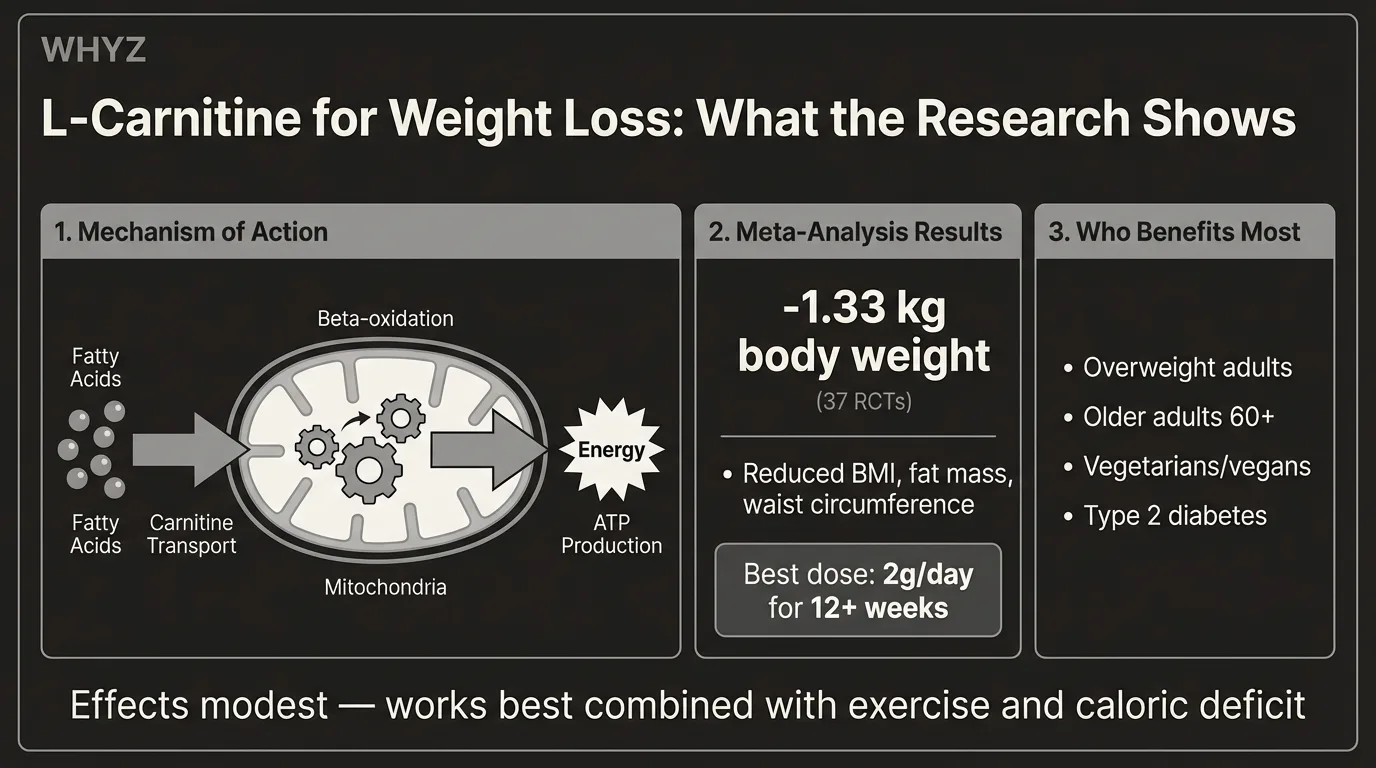
How L-Carnitine Could Support Weight Loss
To understand whether L-carnitine affects body weight, you need to understand why it could in principle.
The mitochondria are the cellular structures that produce energy from fuel. Long-chain fatty acids (the predominant type in body fat) cannot cross the inner mitochondrial membrane on their own. They need a carrier. That carrier is carnitine. Without adequate carnitine, fatty acids accumulate outside the mitochondria and cannot be oxidized. With adequate carnitine, they enter and are combusted through beta-oxidation to produce ATP.
Wutzke and Lorenz (2004) reviewed L-carnitine’s role in fat metabolism and noted that carnitine also performs a secondary function: buffering excess acetyl-CoA during high-intensity exercise by forming acetylcarnitine, which releases free CoA to maintain carbohydrate metabolism (PMID 15212756). This dual role means carnitine is relevant both at low-to-moderate intensities where fat is the primary fuel and at high intensities where carbohydrate metabolism dominates.
The theoretical case for supplementation is built on this biochemistry: if carnitine transport is a rate-limiting step for fat oxidation, then increasing carnitine availability should increase the rate at which fat is burned. In populations with low carnitine status (vegetarians, elderly adults, people with insulin resistance), this logic has more support. In well-nourished omnivores with normal carnitine levels, the supplementation case is weaker.
Stephens et al. (2006) demonstrated through a carefully controlled trial that insulin plays a critical role in carnitine uptake into muscle (PMID 16782842). Oral L-carnitine alone does not significantly increase muscle carnitine stores without co-ingestion of carbohydrate. This finding reshaped how researchers think about L-carnitine supplementation protocols and is often ignored in marketing materials.
What the Meta-Analyses Show
2020 Meta-Analysis: Body Weight, BMI, and Fat Mass
Talenezhad et al. (2020) published a systematic review and meta-analysis in Clinical Nutrition ESPEN pooling data from 37 randomized controlled trials (PMID 32359762). The combined analysis found:
- Body weight: significant reduction favoring L-carnitine (weighted mean difference approximately -1.33 kg)
- BMI: significant reduction
- Fat mass: significant reduction
- Waist circumference: significant reduction
The effects were consistent across studies but small in absolute magnitude. A reduction of 1.33 kg in body weight across trials spanning 8-24 weeks is real but modest. The review noted that the effects were more pronounced in studies involving populations with metabolic conditions (obesity, type 2 diabetes, nonalcoholic fatty liver disease) than in healthy-weight adults.
2021 Meta-Analysis: Overweight and Obese Adults
Askarpour et al. (2020) conducted a separate meta-analysis specifically in overweight and obese adults, examining L-carnitine’s effect on body composition markers (PMID 33342818). Analysis of 43 trials found significant reductions in body weight, BMI, fat mass, and waist circumference versus control. The magnitude was small but consistent. Subgroup analyses found that doses of 2 g/day and trial durations of 12 weeks or more produced stronger effects than lower doses or shorter trials.
2016 Meta-Analysis: Type 2 Diabetes and Obesity
A focused meta-analysis by Pooyandjoo et al. (2016) examined L-carnitine specifically in overweight and obese subjects, pooling 9 RCTs (PMID 27335245). Mean reduction in body weight was -1.33 kg in the carnitine groups versus controls. The authors found the effect was statistically significant and consistent, suggesting that overweight and insulin-resistant populations are the most likely to benefit from supplementation.
What Individual Trials Show
Trials Showing Benefit
A frequently cited study by Villani et al. (2000) in International Journal of Sport Nutrition and Exercise Metabolism tested 2 g/day of L-carnitine for 8 weeks in moderately overweight women engaged in a walking program (PMID 11088746). The study found no significant change in body composition despite exercise. However, fat oxidation was not directly measured, and the trial duration may have been too short for body composition changes to manifest even if fat oxidation was altered.
Crucially, longer and better-powered trials have found different results. Pistone et al. (2003) randomized 36 elderly subjects (mean age 76) to 2 g/day of L-carnitine or placebo for 30 days (PMID 14523727). The L-carnitine group showed significant reductions in total fat mass alongside increases in total muscle mass. In elderly individuals, carnitine production declines with age, making this population more likely to respond to supplementation.
Brandsch and Eder (2002) found that L-carnitine supplementation in rats altered body fat distribution by reducing visceral adipose tissue, with the effects mediated through changes in gene expression in fat tissue (PMID 12107216). While animal data cannot directly transfer to humans, the finding suggested carnitine’s effects on fat mass may involve mechanisms beyond simple mitochondrial transport, including changes in how adipose tissue handles fatty acid storage.
Trials Showing No Benefit
Not all trials have found positive effects. Wutzke and Lorenz (2004) reviewed stable isotope studies tracking fat oxidation in healthy adults supplemented with L-carnitine and found that supplementation did not reliably increase fat oxidation at rest or during low-intensity exercise in well-nourished subjects. The conclusion: baseline carnitine status matters. In people who are not carnitine-deficient, adding more does not proportionally increase fat burning.
Broad and colleagues also found that acute L-carnitine supplementation without insulin stimulation did not meaningfully increase muscle carnitine content, explaining the inconsistent results in trials that did not control carbohydrate co-ingestion.
Who Is Most Likely to Benefit
The evidence consistently points to specific populations where L-carnitine supplementation is most likely to produce fat-related effects:
People who are overweight or have obesity. Multiple meta-analyses show stronger effects in this group versus lean healthy adults. Adipose tissue metabolism and mitochondrial function are impaired in overweight states, and carnitine supplementation may partially address this.
Older adults. Carnitine biosynthesis declines with age. Pistone et al. (2003) showed improvements in both fat mass and muscle mass in elderly subjects that younger trial participants did not match. If you are over 60, the supplementation case is stronger.
Vegetarians and vegans. Dietary carnitine comes almost exclusively from meat. Red meat provides 56-162 mg per 100 grams; plant foods provide virtually none. Vegetarians and vegans have lower plasma and muscle carnitine levels than omnivores. Supplying carnitine through supplementation has a clearer rationale in this group.
People with type 2 diabetes or insulin resistance. Impaired fatty acid oxidation is a hallmark of insulin resistance. Multiple trials in diabetic populations show more consistent carnitine effects on body composition than trials in metabolically healthy adults.
People supplementing with carbohydrates. Stephens et al. (2006) showed that 80 g of carbohydrate co-ingested with L-carnitine significantly increased muscle carnitine accumulation over 24 weeks compared to L-carnitine alone (PMID 16782842). The insulin response from carbohydrate drives carnitine into muscle. If you take L-carnitine without adequate carbohydrates, you may not be getting the muscle delivery that makes it effective.
How to Dose L-Carnitine for Weight Management
Target dose: 2,000 mg (2 g) per day. This is the dose most consistently used in positive trials and the dose identified in subgroup analyses as producing stronger effects than lower amounts.
Timing: Take with a meal containing carbohydrates to support insulin-driven muscle uptake. Pre-workout is a common protocol, but the key is co-ingestion with carbs rather than the specific workout timing.
Form: L-carnitine (levocarnitine) and L-carnitine L-tartrate (LCLT) are the two forms used in most weight-related research. LCLT may have marginally better bioavailability. Acetyl-L-carnitine (ALCAR) is brain-targeted and is not the appropriate form for fat metabolism goals.
Duration: Based on the meta-analyses, trials of 8 weeks or less show weaker effects than trials of 12 weeks or more. Plan for a minimum of 12 weeks before assessing results.
Stacking with exercise: All the trials showing meaningful body composition changes combined L-carnitine with some level of physical activity. It is not a passive fat burner. The mechanism requires fatty acid delivery to mitochondria that are being used. Regular exercise drives mitochondrial activity.
Realistic Expectations
The honest summary from the evidence base: L-carnitine produces modest but real reductions in body weight and fat mass in overweight adults, with the effects most consistent at 2 g/day over 12+ weeks and most pronounced in populations with compromised carnitine status or metabolic conditions.
The average weight reduction across meta-analyses is approximately 1-1.5 kg compared to control. This is meaningful when combined with diet and exercise but should not be the primary strategy for weight management. L-carnitine is a potential enhancer of fat metabolism, not a replacement for caloric deficit.
For lean, healthy, well-nourished omnivores, the evidence is weaker. The biological rationale is sound but the practical ceiling is low when baseline carnitine status is already adequate.
TMAO: A Safety Consideration
Koeth et al. (2013) published findings in Nature Medicine showing that gut bacteria convert dietary L-carnitine into trimethylamine (TMA), which the liver oxidizes to trimethylamine N-oxide (TMAO) (PMID 23770734). Elevated plasma TMAO has been associated with cardiovascular disease risk in observational studies.
The clinical significance of TMAO from L-carnitine supplements is debated. The absolute TMAO increases from typical supplement doses are small, and the observational associations do not establish causation. Gut microbiome composition also determines how much TMA is produced from carnitine, and this varies significantly between individuals.
This is not a reason to avoid L-carnitine at standard doses, but it is a relevant data point for people with existing cardiovascular risk. Current evidence does not support L-carnitine as a cardiovascular risk factor at supplement doses, but individuals with pre-existing heart disease should discuss this with their physician.
FAQs
Can L-carnitine help with belly fat specifically? Multiple trials have measured waist circumference as an endpoint, and the meta-analyses show significant reductions. This suggests L-carnitine may have some effect on abdominal fat, but it is not specific to belly fat versus fat elsewhere.
Does L-carnitine work without exercise? Some trials have shown body composition changes even in participants not following a specific exercise protocol, but effects are consistently stronger when combined with exercise. The mechanism of L-carnitine involves mitochondrial fat oxidation, which is higher during physical activity.
Is L-carnitine a stimulant? No. It does not contain caffeine or other stimulants. It does not increase heart rate or blood pressure. Energy-boosting effects, if any, come from improved fatty acid metabolism.
Can women take L-carnitine? Yes. Multiple trials have enrolled female participants and found no sex-specific safety concerns. The dosing and effects appear similar across sexes.
Explore more: