
When is the Best Time to Take L-Carnitine?
Timing matters more with L-carnitine than most people realize. Not because a specific hour of the day unlocks fat-burning mode, but because how and when you take it affects whether it actually reaches your muscle tissue at meaningful concentrations.
This guide cuts through the timing myths and explains what clinical research says about pre-workout, post-workout, and daily supplementation windows.
What Does L-Carnitine Do?
Before timing makes sense, the mechanism needs to be clear.
L-carnitine is a naturally occurring compound synthesized in the body from the amino acids lysine and methionine. Its primary job is to shuttle long-chain fatty acids across the inner mitochondrial membrane, where they are oxidized to produce ATP.
Without adequate carnitine, fatty acids cannot enter the mitochondria efficiently. This is the basis for carnitine’s role in fat metabolism and energy production. It is also why carnitine deficiency, which is rare but real, causes significant fatigue and muscle weakness.
For people who are not deficient, the picture is more nuanced. Carnitine levels in muscle tissue are already close to saturation under normal conditions. Raising them through supplementation is possible but requires sustained effort, not a single dose.
The Absorption Problem (and Why It Changes Your Timing Strategy)
Here is the part that most supplement marketing skips entirely.
Oral bioavailability of supplemental L-carnitine is low. Studies estimate absorption of roughly 14 to 18 percent for typical L-carnitine supplements, compared to 63 to 75 percent from dietary sources like red meat. The difference is partly due to gut processing and partly due to the fact that dietary carnitine comes packaged with other proteins and fats that may assist absorption.
More important: getting carnitine into plasma is not the same as getting it into muscle. The limiting factor for muscle carnitine elevation appears to be insulin. Insulin drives carnitine transport into skeletal muscle tissue. Without an adequate insulin response, much of the carnitine that does absorb stays in circulation rather than entering the muscle where it does its work.
This is why carbohydrate co-ingestion is consistently cited as important for effective L-carnitine supplementation.
Pre-Workout: The Most-Studied Timing Window
Taking L-carnitine 30 to 60 minutes before training is the most common protocol in sports nutrition research, and the one with the most clinical support for performance outcomes.
A 2014 randomized controlled trial published in the Journal of Strength and Conditioning Research tested acute L-carnitine supplementation in trained athletes before exercise. The carnitine group showed improved endurance performance compared to placebo during the exercise bout, suggesting a pre-workout window can produce measurable acute effects in conditioned individuals (Orer and Guzel, 2014 [PMID: 24263659]).
An older but frequently cited RCT by Volek et al. (2002), published in the American Journal of Physiology, examined how L-carnitine L-tartrate supplementation affected recovery markers following exercise stress. Subjects who received carnitine showed significantly better recovery outcomes including reduced muscle damage markers and lower oxidative stress compared to placebo (Volek et al., 2002 [PMID: 11788381]).
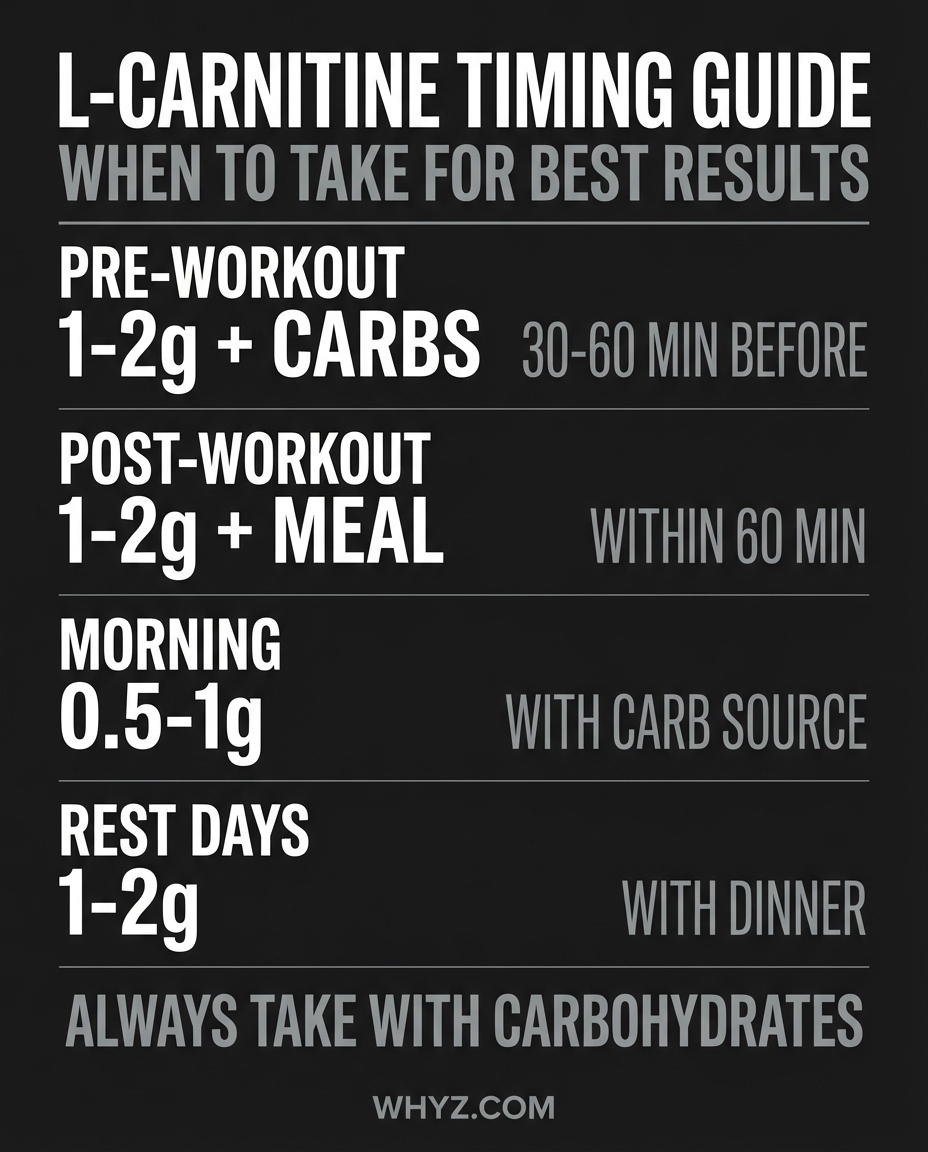
Pre-workout timing takeaway: 1 to 2 grams of L-carnitine or L-carnitine tartrate, taken 30 to 60 minutes before training with a small carbohydrate source (30 to 40 grams), represents the most evidence-aligned approach for performance and recovery support.
Post-Workout: Recovery-Focused Use
Post-workout carnitine use centers on muscle recovery rather than performance enhancement during the session itself.
A 2021 randomized, double-blind, placebo-controlled trial published in Nutrients found that L-carnitine tartrate supplementation for 5 weeks significantly improved recovery markers in both men and women who engaged in regular resistance training. Participants taking carnitine showed reduced muscle soreness and better recovery between sessions compared to those on placebo (Stefan et al., 2021 [PMID: 34684429]).
The post-workout insulin window also makes this timing practical. A meal or shake following exercise typically includes carbohydrates, which creates the insulin response that drives carnitine uptake into muscle. This means post-workout carnitine with a recovery meal is physiologically sound.
Post-workout timing takeaway: 1 to 2 grams after training alongside a balanced recovery meal containing carbohydrates may support next-day soreness reduction and recovery quality.
Morning Use: The Empty Stomach Question
Many people take L-carnitine first thing in the morning, often on an empty stomach, expecting it to accelerate fat burning. The logic sounds reasonable on the surface. The evidence, however, is more complicated.
Without a carbohydrate source, insulin levels are low. Low insulin means reduced carnitine transport into muscle. Taking carnitine in a fasted state may raise plasma carnitine, but the carnitine likely stays in circulation rather than loading muscle tissue.
This does not mean morning use is useless. For general metabolic support or as part of a weight management approach, daily carnitine use across any window appears to provide cumulative benefit with consistent supplementation. A meta-analysis published in the Journal of the American College of Nutrition (2020) reviewing randomized clinical trials found that L-carnitine supplementation was associated with significant reductions in muscle damage markers across studies, regardless of specific timing protocols (Yarizadh et al., 2020 [PMID: 32154768]).
Morning timing takeaway: If you take L-carnitine in the morning, consider pairing it with a small carbohydrate source rather than taking it purely fasted. The effect may be modest, but the physiological rationale is stronger than fasted use.
The L-Carnitine Timing Chart at a Glance
| Timing | Dose | With Food? | Best For |
|---|---|---|---|
| Pre-workout (30-60 min before) | 1-2 g | Yes, with carbs | Exercise performance, endurance |
| Post-workout (within 60 min) | 1-2 g | Yes, with recovery meal | Muscle recovery, soreness reduction |
| Morning | 0.5-1 g | Ideally with carbs | Daily metabolic support |
| Evening (rest days) | 1-2 g | With dinner | Consistent daily loading |
How Long Does It Take to Work?
This is where expectations often need recalibration.
Research on muscle carnitine loading in healthy adults suggests that meaningful increases in muscle carnitine content require weeks of supplementation combined with carbohydrate co-ingestion, not days. This is why short-term or single-dose studies often find minimal effects, while longer interventions of 4 to 12 weeks tend to show more consistent benefits.
If you start L-carnitine today and expect to feel different tomorrow, the evidence does not support that expectation. Consistent daily use for at least 4 to 8 weeks is a more realistic frame for evaluating whether it is working for you.
Which Form of L-Carnitine for Which Goal?
Not all carnitine forms are the same. The timing window also depends partly on which form you are taking.
L-Carnitine Tartrate (LCLT): The most common sports nutrition form. Rapid absorption rate. Used in most exercise performance and recovery trials. Best for pre- or post-workout use.
Acetyl-L-Carnitine (ALCAR): Crosses the blood-brain barrier. Used more often for cognitive and neurological support than physical performance. Can be taken earlier in the day for mental focus. For a full comparison, see our ALCAR vs L-Carnitine guide.
Propionyl-L-Carnitine: Studied more in the context of cardiovascular support than athletic performance. Less commonly used in sports supplementation.
For performance and recovery goals, L-carnitine tartrate is the most clinically supported form. For mixed cognitive and physical goals, some people use a combination of LCLT pre-workout and ALCAR earlier in the day.
Who Benefits Most from L-Carnitine Timing Optimization?
Timing optimization matters more for some people than others.
Active individuals: If you train regularly at moderate to high intensity, taking carnitine around your workouts with carbohydrates gives you the best shot at muscle carnitine elevation over time.
Older adults: Carnitine synthesis may decline with age. Older individuals may have more room to benefit from supplementation. The timing principles remain the same.
Vegetarians and vegans: Dietary carnitine comes almost entirely from animal products, particularly red meat. Plant-based eaters tend to have lower baseline carnitine levels and may respond more noticeably to supplementation.
Highly active individuals with poor recovery: The recovery literature is where carnitine shows some of its most consistent effects. If soreness and recovery time are your primary concerns, post-workout timing with a carbohydrate-containing meal is the protocol to prioritize.
Dosage Reference
Most clinical trials use:
- L-Carnitine Tartrate: 1,000 to 4,000 mg per day (split into 1-2 doses)
- Acetyl-L-Carnitine: 600 to 2,500 mg per day
For most healthy adults focused on exercise performance and recovery, 1 to 2 grams of L-carnitine tartrate around workouts is a reasonable starting point. Going higher adds cost but not necessarily proportional benefit for non-clinical populations.
For a complete breakdown of dosage by goal and population, see our L-Carnitine Dosage Guide. And for information on L-carnitine as part of a weight management approach, see our L-Carnitine for Weight Loss guide.
Safety and Considerations
L-carnitine has a strong safety record at standard supplemental doses. Common mild side effects include nausea, vomiting, and a fishy body odor at high doses due to bacterial conversion of carnitine to trimethylamine.
More recently, researchers have raised questions about whether gut bacteria-mediated conversion of carnitine to trimethylamine N-oxide (TMAO) might have cardiovascular implications for some individuals. This is an active research area, and current evidence does not support concern at typical supplement doses for otherwise healthy people. However, individuals with pre-existing cardiovascular conditions should discuss carnitine supplementation with their healthcare provider.
The Bottom Line on L-Carnitine Timing
The best time to take L-carnitine is when you can pair it with carbohydrates, and preferably around your training sessions. Pre-workout with a small carbohydrate source is the most evidence-supported timing. Post-workout with a recovery meal is a close second, particularly if recovery is your primary goal.
Morning fasted use is not without value, but pairing it with at least a small carbohydrate source will likely improve the practical benefit.
None of these windows matter much without consistent, daily use over weeks to months. The single biggest predictor of L-carnitine effectiveness is not the timing. It is the consistency.
Related Guides
- L-Carnitine Dosage: How Much Should You Take?
- L-Carnitine for Weight Loss: What the Research Shows
- ALCAR vs L-Carnitine: Which Form Is Right for You?
- When to Take BCAAs
References
- Stefan M et al. (2021). L-Carnitine Tartrate Supplementation for 5 Weeks Improves Exercise Recovery in Men and Women: A Randomized, Double-Blind, Placebo-Controlled Trial. Nutrients. [PMID: 34684429]
- Volek JS et al. (2002). L-Carnitine L-tartrate supplementation favorably affects markers of recovery from exercise stress. American Journal of Physiology - Endocrinology and Metabolism. [PMID: 11788381]
- Orer GE and Guzel NA. (2014). The effects of acute L-carnitine supplementation on endurance performance of athletes. Journal of Strength and Conditioning Research. [PMID: 24263659]
- Yarizadh H et al. (2020). The Effect of L-Carnitine Supplementation on Exercise-Induced Muscle Damage: A Systematic Review and Meta-Analysis of Randomized Clinical Trials. Journal of the American College of Nutrition. [PMID: 32154768]