
Home → Guides → NMN Dosage: How Much Should You Take Daily?
The most practical question anyone asks before starting NMN is also the one that takes the most digging to answer correctly. Published human trials have used doses from 250 mg to 900 mg per day, and they do not all point to the same number. Getting the dosage right depends on what you are trying to achieve and which studies are actually relevant to your situation.
This guide covers every dose that has been tested in human clinical trials, what each one produced, and how to interpret the evidence without the marketing spin.
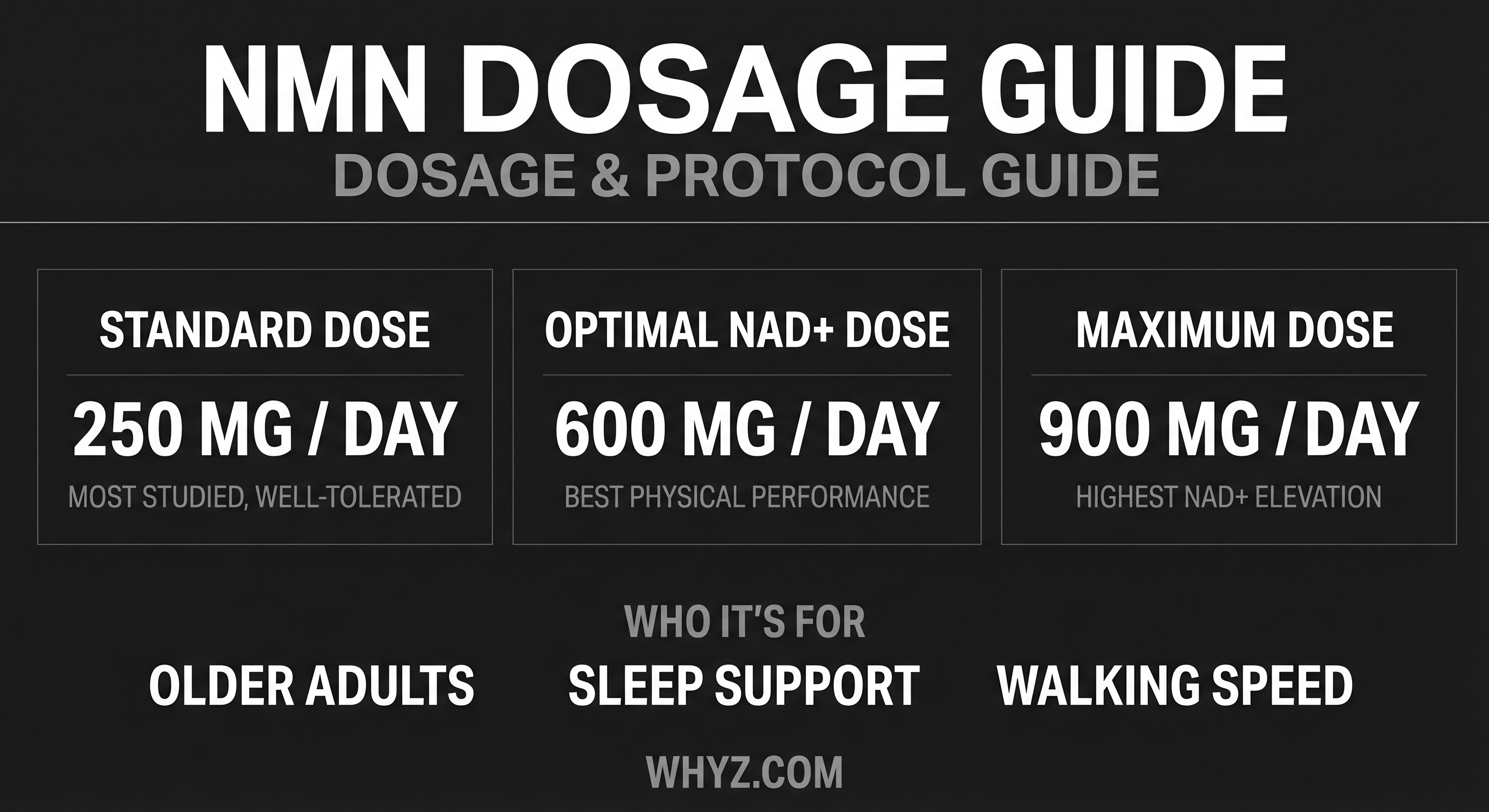
At a Glance
| Dose | Key Evidence | Best For |
|---|---|---|
| 250 mg/day | Most extensively human-trialed | Starting dose, older adults, postmenopausal women |
| 300 mg/day | Blood NAD+ increase confirmed | Stepping up from 250 mg |
| 600 mg/day | Best NAD+ + physical performance in 2023 RCT | General adult supplementation |
| 900 mg/day | NAD+ raised, tolerated, lesser performance gains | Higher end of studied range |
| Above 900 mg | Not studied in rigorous human RCTs | Not supported by clinical evidence |
What NMN Does in the Body
NMN (nicotinamide mononucleotide) is a direct precursor to NAD+, a coenzyme found in every living cell. NAD+ is required for sirtuin activity, DNA repair via PARP enzymes, and mitochondrial energy production. Blood NAD+ levels fall roughly 50% between ages 40 and 60.
The rationale for supplementing NMN is that raising NMN availability gives the body more raw material to synthesize NAD+. This mechanism is well-supported in cellular and animal research. The open question in the human literature is whether raising NAD+ in adults produces meaningful clinical outcomes, and at what doses.
To understand the difference between NMN, NR (nicotinamide riboside), and direct NAD+ supplementation, see our guide: NMN vs NAD+: What’s the Difference?
You can also compare the two leading NAD+ precursors here: NMN vs NR: Which Precursor Works Better?
The Clinical Trials at Each Dose
250 mg/day
This is the most-tested dose in peer-reviewed human trials.
Yoshino M et al. (2021) in Science conducted a 10-week, double-blind, placebo-controlled RCT in postmenopausal women with prediabetes who were overweight or obese. Participants received 250 mg/day of NMN. Results showed increased insulin-stimulated glucose disposal and improved skeletal muscle insulin signaling compared to placebo. Expression of genes related to muscle remodeling also increased in the NMN group. This study was notable for being published in one of the most peer-reviewed journals in science and for providing direct evidence of a physiological effect in a metabolically compromised population (Yoshino M et al., 2021. Science. PMID: 33888596).
Morifuji M et al. (2024) in Geroscience studied 60 older adults in a randomized, placebo-controlled, double-blind parallel-group trial. The NMN group received 250 mg/day for 12 weeks. At 12 weeks, the NMN group had a shorter 4-meter walking time than the placebo group and blood NAD+ levels were elevated along with its metabolites. The NMN group also showed improved sleep quality as measured by the Pittsburgh Sleep Quality Index, specifically lower scores for daytime dysfunction and global PSQI. No adverse effects were observed (Morifuji M et al., 2024. Geroscience. PMID: 38789831).
Irie J et al. (2024) in the Endocrine Journal examined 250 mg/day (administered as two 125 mg capsules once daily before breakfast) in 11 healthy middle-aged Japanese men over 8 weeks. NAD+ levels in peripheral blood mononuclear cells increased over the course of NMN administration. In participants with insulin oversecretion after oral glucose loading, NMN modestly attenuated postprandial hyperinsulinemia. The regimen was well-tolerated throughout (Irie J et al., 2024. Endocr J. PMID: 38191197).
The pattern across these studies: 250 mg/day raises NAD+, is consistently well-tolerated, and produces measurable functional effects in older adults and people with metabolic challenges. Results in healthy younger adults appear more modest.
300 mg/day
Yi L et al. (2023) in Geroscience ran a randomized, multicenter, double-blind, placebo-controlled, parallel-group clinical trial across 80 healthy middle-aged adults for 60 days. Participants received once-daily oral doses of placebo, 300 mg, 600 mg, or 900 mg NMN. At the 300 mg dose, blood NAD+ concentrations increased compared to placebo at both day 30 and day 60. Walking distance also improved in the 300 mg group. The 300 mg dose was well-tolerated without safety concerns (Yi L et al., 2023. Geroscience. PMID: 36482258).
600 mg/day
In the same Yi et al. 2023 trial, 600 mg/day produced the highest blood NAD+ concentrations alongside the 900 mg group, and showed the strongest improvements in physical performance measures and quality-of-life scores. The 600 mg dose also improved SF-36 quality of life scores at both day 30 and day 60 compared to placebo, with statistically significant differences. The authors noted that clinical efficacy expressed by blood NAD+ and physical performance was highest at 600 mg daily oral intake.
This makes 600 mg the dose with the best evidence for the combination of measurable NAD+ elevation and functional outcomes in healthy middle-aged adults.
900 mg/day
The 900 mg arm of Yi et al. 2023 also produced statistically significant NAD+ increases at both day 30 and day 60. However, the added physical performance benefit over 600 mg was not proportionally greater. The dose was well-tolerated, with no safety signals from monitoring adverse events, laboratory values, or clinical measures.
For most people, escalating from 600 mg to 900 mg raises blood NAD+ measurably but does not appear to produce proportionally greater functional improvements based on the available evidence.
Above 900 mg/day
The 1,200 mg/day dose appears in one exercise study using blood flow restriction training, where NMN attenuated inflammatory signaling in exercised human skeletal muscle (Yang DL et al., 2026. J Int Soc Sports Nutr. PMID: 41705654). This was a 7-day protocol in 11 untrained men and was not designed to evaluate dosage optimization. No multi-week RCT has established that doses above 900 mg produce better outcomes in healthy adults.
Does NMN Affect Blood Pressure?
A 2026 systematic review and meta-analysis pooling 10 randomized controlled trials (349 participants) found that NMN supplementation was associated with a modest but statistically significant reduction in resting diastolic blood pressure (weighted mean difference: -2.15 mmHg; 95% CI: -3.68 to -0.61). Subgroup analysis found a significant reduction in systolic blood pressure specifically in adults aged 60 and older. The authors noted that these findings are preliminary and that long-term, large-scale trials are needed to confirm whether NMN has a meaningful role in blood pressure management (Zhang M et al., 2026. Nutrients. PMID: 41901064).
What About Glucose and Metabolic Health?
A 2024 meta-analysis of eight human RCTs (250–2,000 mg/day, 14 days to 12 weeks) in middle-aged and older adults found no statistically significant effect of NMN on fasting glucose, fasting insulin, HbA1c, HOMA-IR, or lipid profile on aggregate. The one exception in the literature is the Yoshino et al. Science trial, which found improved insulin sensitivity in a specific population (postmenopausal women with prediabetes) using a hyperinsulinemic-euglycemic clamp method. The aggregate null finding reflects the heterogeneity of the populations studied and the sensitivity limits of standard metabolic markers (Chen F et al., 2024. Curr Diab Rep. PMID: 39531138).
The takeaway: do not choose NMN primarily for glucose control unless you match the specific population studied by Yoshino et al. The broader metabolic evidence is weak.
When to Take NMN
Every published human trial administered NMN once daily in the morning. No study has directly compared morning versus evening or split dosing.
The theoretical argument for morning dosing relates to circadian biology. NAD+ metabolism is tied to circadian clock function, with NAMPT (the rate-limiting enzyme in the NAD+ salvage pathway) showing peak activity in alignment with daylight hours. Taking NMN in the morning is consistent with this rhythm. It is also practical: a single daily dose removes compliance complexity.
With or without food: Published trials have not specified consistent fasting requirements. NMN is water-soluble, and food is unlikely to dramatically affect absorption at typical doses. Take it with whatever is consistent for your routine.
Sublingual NMN: Some products are marketed as sublingual (dissolved under the tongue) for faster absorption. Human pharmacokinetic data comparing oral versus sublingual NMN is limited. The oral form is what the published clinical trials used.
Safety and Side Effects
Across all published human trials using doses from 250 mg to 900 mg/day over periods of 4 to 12 weeks, NMN has been consistently described as well-tolerated with no serious adverse events.
Potential side effects reported anecdotally (not in trial data at clinical doses):
- Mild nausea or digestive discomfort
- Headache in some individuals at higher doses
- Flushing (rare at NMN doses, more common with niacin, a related compound)
No trials report hepatotoxic, nephrotoxic, or cardiovascular harms at studied doses. The longest human trials so far run 12 weeks. Long-term safety data beyond 3 months in humans is limited.
Note on cancer research: Some preclinical (cell and animal) studies have raised questions about NAD+ precursors in cancer contexts because cancer cells use NAD+ for rapid proliferation. This is an active research area. No human trial data establishes risk in oncology contexts, but people with a history of cancer should discuss NAD+ precursor supplements with their oncologist before starting.
Practical Dosage Guidance
Starting out: 250 mg/day is the most studied dose with consistent evidence of NAD+ elevation and functional benefits. This is a logical starting point, especially for people over 50 or those with metabolic health goals.
If you want stronger NAD+ elevation: The 600 mg dose produced the best combination of NAD+ increase and functional outcomes in the most rigorous multi-dose human RCT available. Escalating from 250 mg to 600 mg over several weeks is a practical approach.
Above 600 mg: Evidence that 900 mg outperforms 600 mg in functional terms is thin. The added cost and incremental NAD+ benefit above 600 mg does not appear to translate proportionally into measurable health improvements based on current data.
Product quality matters: NMN can degrade when exposed to heat, moisture, and light. Look for products that store NMN in airtight, opaque packaging, ideally refrigerated after opening. Third-party purity testing is a minimum standard for any NMN product.
What to Realistically Expect
NMN raises blood NAD+ at doses from 250 mg upward. That part is well-established in human trials. What is less clear is how much that translates into the outcomes people are after.
The human evidence shows NMN may support:
- Muscle insulin sensitivity in women with prediabetes (at 250 mg/day)
- Maintained walking speed and improved sleep quality in older adults (at 250 mg/day)
- Physical performance scores and quality-of-life measures in healthy middle-aged adults (at 600 mg/day)
- Modest blood pressure reduction, particularly diastolic (across multiple doses)
The human evidence does not yet support:
- A proven anti-aging effect in healthy younger adults
- Specific longevity outcomes
- Dramatic metabolic improvements in people without baseline metabolic dysfunction
- Dose-dependent benefits above 600-900 mg/day
For the NMN ingredient overview including production, bioavailability, and full mechanism detail, see our NMN ingredient page.
Frequently Asked Questions
What is the best NMN dosage for anti-aging?
No dose has been clinically validated as the optimal anti-aging dose. The 600 mg/day dose in Yi et al. 2023 produced the best combination of NAD+ elevation and physical performance improvements in healthy middle-aged adults. Most longevity researchers working with NMN use doses in the 500-1,000 mg range, but these are not supported by comparative outcome data in humans.
Can you take NMN every day?
Yes. All human clinical trials used daily dosing, and no evidence suggests that daily use over the studied periods (up to 12 weeks) causes tolerance or harm. Long-term daily use beyond 3 months has not been formally studied in rigorous trials.
Does NMN work better with resveratrol?
This combination is popular in longevity circles, but no human RCT has tested NMN plus resveratrol against NMN alone for comparable outcomes. The theoretical basis comes from animal research where resveratrol activates sirtuins that NAD+ fuels. No human trial confirms synergistic benefit, so this is speculative.
How long does NMN take to work?
Blood NAD+ elevation is measurable within days in human studies. Functional changes (walking speed, insulin sensitivity, sleep quality) emerged over 4 to 12 weeks in the trials that measured them. Do not expect meaningful functional benefits from fewer than 4 weeks of consistent use.
Is NMN better than NR (nicotinamide riboside)?
Both are NAD+ precursors with human clinical data. NMN has more recent dose-ranging data and some evidence of direct tissue absorption via the Slc12a8 transporter in the gut. Head-to-head comparative trials in humans are limited. See our detailed comparison: NMN vs NR: Which Precursor Works Better?
Should I get my NAD+ levels tested before starting NMN?
Baseline NAD+ testing can help you track whether supplementation is working, but it is not required. Direct-to-consumer NAD+ blood tests are available through specialty labs. The practical alternative is to use 250-600 mg/day for 8-12 weeks and assess functional changes (energy, sleep, exercise recovery) as your primary feedback.
References
- Yoshino M, et al. Nicotinamide mononucleotide increases muscle insulin sensitivity in prediabetic women. Science. 2021;372(6547):1224-1229. PMID: 33888596
- Yi L, et al. The efficacy and safety of β-nicotinamide mononucleotide (NMN) supplementation in healthy middle-aged adults: a randomized, multicenter, double-blind, placebo-controlled, parallel-group, dose-dependent clinical trial. Geroscience. 2023;45(1):29-43. PMID: 36482258
- Morifuji M, et al. Ingestion of β-nicotinamide mononucleotide increased blood NAD levels, maintained walking speed, and improved sleep quality in older adults in a double-blind randomized, placebo-controlled study. Geroscience. 2024;46(5):4671-4688. PMID: 38789831
- Irie J, et al. Safety and efficacy of long-term nicotinamide mononucleotide supplementation on metabolic function, sleep, and nicotinamide adenine dinucleotide biosynthesis in healthy, middle-aged Japanese men. Endocr J. 2024;71(2):153-169. PMID: 38191197
- Zhang M, et al. Effects of Nicotinamide Mononucleotide Supplementation on Blood Pressure: A Systematic Review and Meta-Analysis of Randomized Controlled Trials. Nutrients. 2026;18(6):890. PMID: 41901064
- Chen F, et al. Effects of Nicotinamide Mononucleotide on Glucose and Lipid Metabolism in Adults: A Systematic Review and Meta-analysis of Randomised Controlled Trials. Curr Diab Rep. 2024;25(1):4. PMID: 39531138
- Yang DL, et al. Anti-inflammatory effects of nicotinamide mononucleotide (NMN) in human skeletal muscle after BFR-exercise. J Int Soc Sports Nutr. 2026;23(1):2632284. PMID: 41705654