
What Is Chlorella Made From?
Chlorella is a single-celled freshwater green microalgae belonging to the division Chlorophyta. The entire organism — the whole cell — is used as the source material, though the cell wall must be mechanically disrupted before the nutritional content becomes bioavailable to humans. Chlorella is exceptionally dense in chlorophyll, complete proteins (containing all essential amino acids), vitamins B12, iron, and omega-3 fatty acids.
The key active compound is Chlorella Growth Factor (CGF), a water-soluble complex concentrated in the cell nucleus that contains nucleotides, peptides, polysaccharides, and glycoproteins. CGF is understood to be responsible for chlorella’s unusually rapid cellular reproduction rate — dividing up to four times every 24 hours — and is the primary driver of its attributed health benefits, including immune modulation and cellular repair support.
Where Is It Grown?
Japan has historically dominated high-quality chlorella cultivation, particularly through controlled indoor photobioreactor facilities and outdoor raceway pond systems in regions like Yaeyama (Okinawa Prefecture) and Hokkaido. Japanese producers benefit from a culture of rigorous quality standards and have led commercial production since the 1960s. Japan accounts for an estimated 20–25% of global premium-grade chlorella output by value, though its share of total tonnage has declined as lower-cost Asian producers have scaled.
Taiwan is the second major production hub, contributing approximately 20–25% of global supply, with cultivation concentrated around the flat, sunny plains of central and southern Taiwan, including Yunlin and Chiayi counties. Taiwan’s warm subtropical climate — consistent temperatures between 25–30°C and high solar irradiance — allows year-round outdoor pond cultivation, reducing energy costs and supporting large-scale production. Several of the world’s largest and longest-established chlorella producers are headquartered in Taiwan.
China now accounts for the largest share of global chlorella volume — estimated at 40–50% of total world production — with major cultivation in Hainan Province, Yunnan Province, and coastal Shandong Province. South Korea contributes a smaller but growing share, particularly in certified organic and specialty grades, produced primarily in Jeollanam-do Province in the southwest. The dominance of East Asia reflects the combination of ideal subtropical and temperate climates, existing aquaculture infrastructure, and established downstream processing expertise.
The Manufacturing Process
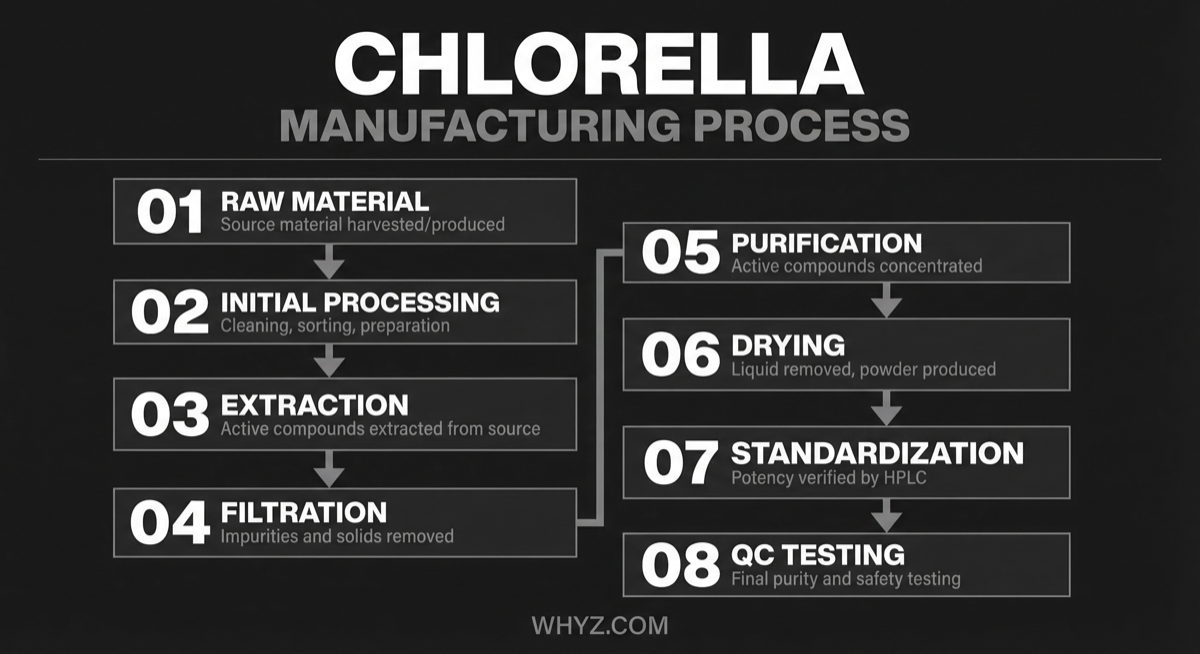
-
Strain Selection & Inoculation: Production begins with a certified seed culture of Chlorella vulgaris, typically maintained in sterile laboratory conditions. The strain is screened for growth rate, CGF yield, and contamination resistance before being used to inoculate larger culture tanks.
-
Cultivation: Algae are grown in either outdoor raceway open ponds (for high-volume, lower-cost production) or closed photobioreactor systems (for premium, contamination-controlled output). Water temperature is maintained between 25–30°C. CO₂ is continuously injected to accelerate photosynthesis, and nutrient media (nitrogen, phosphorus, trace minerals) are carefully balanced. Continuous LED or natural sunlight drives biomass accumulation over a 5–10 day growth cycle.
-
Harvesting: Once the culture reaches target density (typically 1–3 g/L dry weight), cells are harvested via centrifugation at 5,000–10,000 RPM. This concentrates the algae into a dense green paste, separating it from the growth medium. Some producers use drum filtration as a lower-cost alternative.
-
Cell Wall Disruption: Chlorella’s tough cellulose-based cell wall makes raw cells largely indigestible. Disruption is achieved through high-pressure jet milling (dyno-mill), bead milling, or spray drying with mechanical shear. This step is critical — “broken cell wall” chlorella has dramatically higher bioavailability of proteins, CGF, and micronutrients.
-
Washing & Purification: The disrupted biomass is washed with purified water to remove growth medium residues, heavy metals, and microbial byproducts. Some manufacturers perform additional activated-carbon filtration at this stage to reduce any potential contaminants.
-
Drying: The washed paste is spray-dried or freeze-dried. Spray drying uses inlet air temperatures of 150–180°C with very brief residence times (preserving heat-sensitive compounds). Freeze-drying operates at −40 to −50°C under vacuum and better preserves CGF integrity, though at significantly higher cost.
-
Milling & Standardization: Dried chlorella powder is milled to a target particle size (typically 200–300 mesh) and blended to standardized levels of chlorophyll content (typically ≥1.5–2.5% chlorophyll by dry weight) or protein content (≥55–60% protein). CGF-rich extracts may undergo additional hot-water extraction at 80–95°C.
-
Quality Testing & Packaging: Each batch undergoes full COA testing before release. Finished powder is nitrogen-flushed and vacuum-sealed to prevent oxidative degradation of chlorophyll and omega-3 content.
The Chemistry of Extraction
The most chemically significant challenge in chlorella processing is breaching the rigid cell wall, which is composed of a sporopollenin-like outer layer and an inner cellulose-glucosamine matrix — bonds that resist standard enzymatic and acidic digestion. Mechanical disruption (bead or jet milling) physically fractures glycosidic bonds holding the cell wall polymers together, releasing intracellular contents without chemical solvents. For CGF extraction specifically, hot aqueous extraction at 80–95°C in purified water solubilizes the nucleotide-peptide complexes from the nucleus; the elevated temperature denatures surface proteins, increasing solubility of polar CGF constituents. Chlorophyll, being fat-soluble (a magnesium-centered porphyrin coordinated to hydrophobic phytol chains), partitions into lipid fractions during processing — producers targeting high chlorophyll standardization may use ethanol-water co-solvent systems (typically 70–80% ethanol) to increase chlorophyll yield. Byproducts of processing include spent growth medium (typically recovered as agricultural fertilizer) and lipid fractions containing omega-3 fatty acids, which are sometimes isolated separately.
Quality & Standardization
High-quality chlorella powder is standardized primarily on chlorophyll content (typically ≥2% by dry weight, verified by UV-Vis spectrophotometry at 664 nm and 647 nm using the Lichtenthaler equation) and protein content (≥55% by Kjeldahl or Dumas nitrogen combustion methods). HPLC is used to confirm the identity and quantity of specific carotenoids (lutein, zeaxanthin, beta-carotene) and to screen for microcystin contamination — a critical safety marker given that blue-green algae (cyanobacteria) can co-contaminate open pond systems. A complete COA should include heavy metal panels (lead, arsenic, mercury, cadmium — with arsenic below 1 ppm for dietary supplement use), aerobic plate count, yeast and mold counts, and confirmed absence of E. coli and Salmonella. Certifications to look for include GRAS status (US), EU Novel Food authorization, and Organic (USDA/EU) where applicable. Grades range from food-grade whole powder to pharmaceutical-grade CGF extracts standardized to defined nucleotide profiles.
Major Global Producers
East Asia dominates global chlorella production at every tier, from commodity powder to premium CGF-standardized extracts. Taiwan and Japan hold the strongest reputations for quality and traceability, while China leads in raw volume. Key producers include:
- Sun Chlorella Corporation (Japan) — one of the world’s oldest and most recognized chlorella companies, producing in Osaka with proprietary DYNO-Mill cell disruption technology
- Taiwan Chlorella Manufacturing Co. (TCMC) (Taiwan) — world’s largest single chlorella producer by volume; supplies bulk ingredient globally
- Febico (Far East Bio-Tec Co.) (Taiwan) — major certified organic chlorella and spirulina producer; strong EU and US export presence
- Yaeyama Shokusan Co., Ltd. (Japan/Okinawa) — specialist Okinawan outdoor pond producer known for high CGF content
- Hainan Simai Pharmacy and Tianjin Norland Biotech (China) — leading Chinese commodity-grade producers
- Korea Ginseng Corp / CJ BioScience (South Korea) — growing presence in certified specialty-grade chlorella
WHYZ Sourcing Standards
WHYZ sources chlorella exclusively from suppliers maintaining US-based warehousing with validated cold-chain storage, ensuring consistent potency on arrival. Every lot requires a current COA with HPLC-verified chlorophyll and protein standardization, as well as confirmed heavy metal and microbial testing within specification. All finished product is independently third-party tested prior to use in any WHYZ formulation.