
Quick Facts
| Property | Details |
|---|---|
| What it is | Creatine bonded to hydrochloric acid, forming a hydrochloride salt with high water solubility |
| Primary Benefits | Strength and power output, lean muscle mass, improved mixability, reduced GI discomfort |
| Standard Dosage | 1-2 g daily (no loading phase typically used) |
| Best Time to Take | Any consistent time daily |
| Form | Unflavored powder |
| Evidence Grade | B — Moderate (creatine mechanism well-established, HCL-specific RCTs limited but positive) |
| Key Studies | Eghbali et al. 2024 — HCL vs monohydrate RCT (PMID: 39545789), Kreider et al. 2017 — ISSN creatine position stand (PMID: 28615996) |
What Is Creatine HCL?
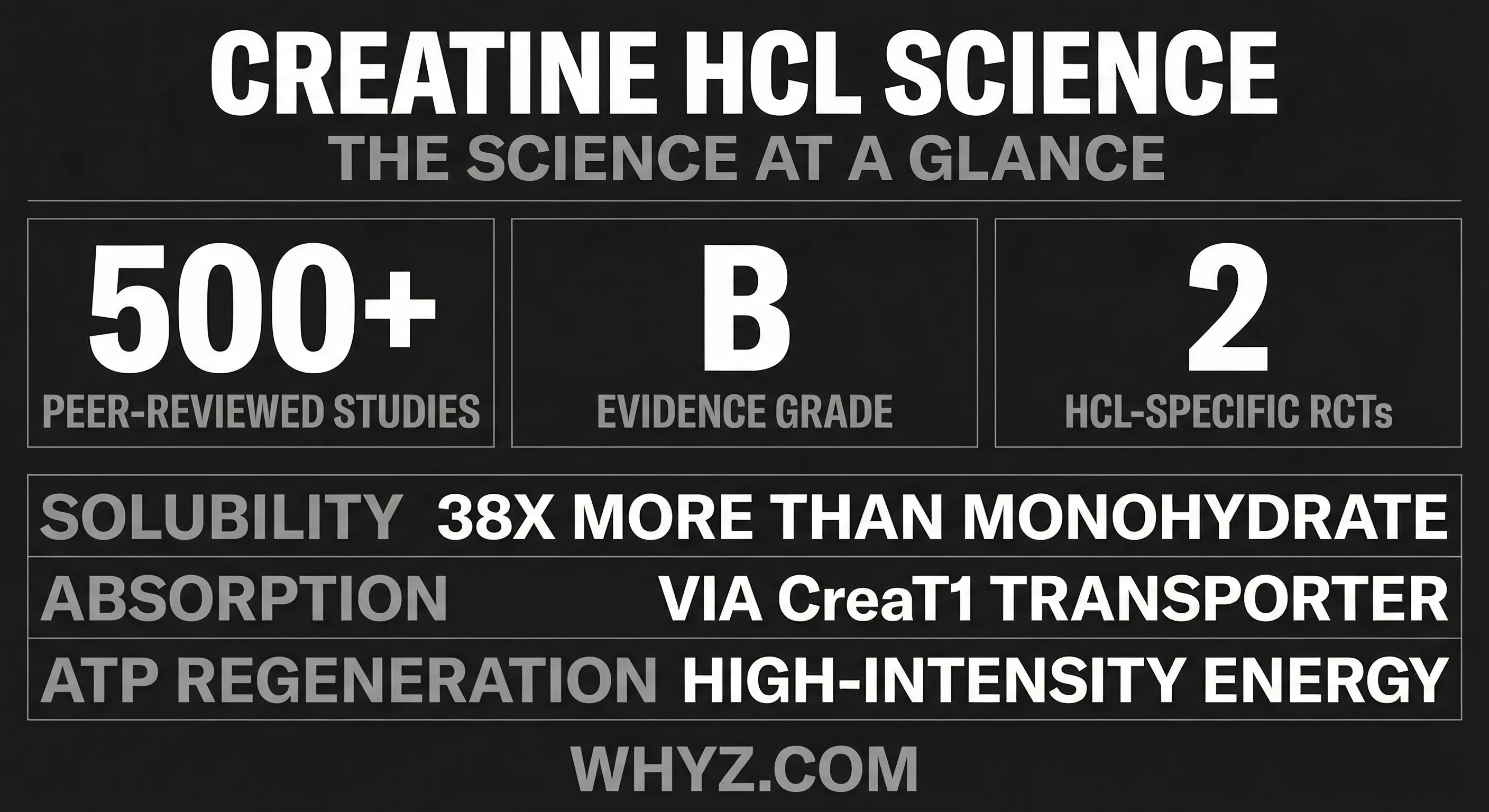
Creatine HCL (creatine hydrochloride) is a form of creatine in which the creatine molecule is bonded to hydrochloric acid. This chemical modification creates a hydrochloride salt that dissolves far more readily in water than the standard monohydrate form. The active compound, creatine itself, is identical in both forms. Once absorbed, creatine HCL delivers the same molecule to muscle cells, where it is phosphorylated into phosphocreatine and used to regenerate ATP during high-intensity muscular contractions.
The hydrochloride bonding changes one property above all others: solubility. Creatine monohydrate has limited water solubility at room temperature, often leaving gritty residue at the bottom of a glass. Creatine HCL dissolves rapidly and completely, producing a clear solution with no sediment. This practical difference matters for people who dislike the texture of monohydrate or who experience gastrointestinal discomfort from undissolved creatine particles sitting in the gut.
Creatine HCL entered the supplement market in the late 2000s as an alternative to monohydrate. It was developed to address two common consumer complaints: poor mixability and the bloating some users experience during monohydrate loading phases. The compound has gained traction among athletes and general supplement users who prioritize convenience and tolerability.
How Does Creatine HCL Work?
Creatine HCL works through the same biochemical pathway as every other form of creatine. When you ingest creatine HCL, the hydrochloride bond dissociates in the stomach’s acidic environment, releasing free creatine. That free creatine enters the bloodstream via intestinal absorption and is transported into muscle cells through the sodium-dependent creatine transporter (CreaT1).
Inside the muscle cell, creatine kinase phosphorylates roughly two-thirds of the incoming creatine into phosphocreatine (PCr). This phosphocreatine pool serves as a rapid-access energy reserve. During a heavy squat, a sprint start, or a vertical jump, ATP is consumed within 2-3 seconds. Phosphocreatine donates its phosphate group to ADP, regenerating ATP almost instantly through the phosphagen energy system. A larger phosphocreatine pool means more ATP can be regenerated before the system is exhausted.
Supplementing with creatine increases total intramuscular phosphocreatine stores by 10-40%, depending on baseline levels (Kreider et al., 2017). Individuals with lower initial stores, including vegetarians and people who eat little red meat, tend to see the largest increases. The downstream training effects include more reps per set, faster recovery between bouts, and a greater cumulative training stimulus that drives strength and hypertrophy adaptations over weeks.
What Makes HCL Different from Monohydrate?
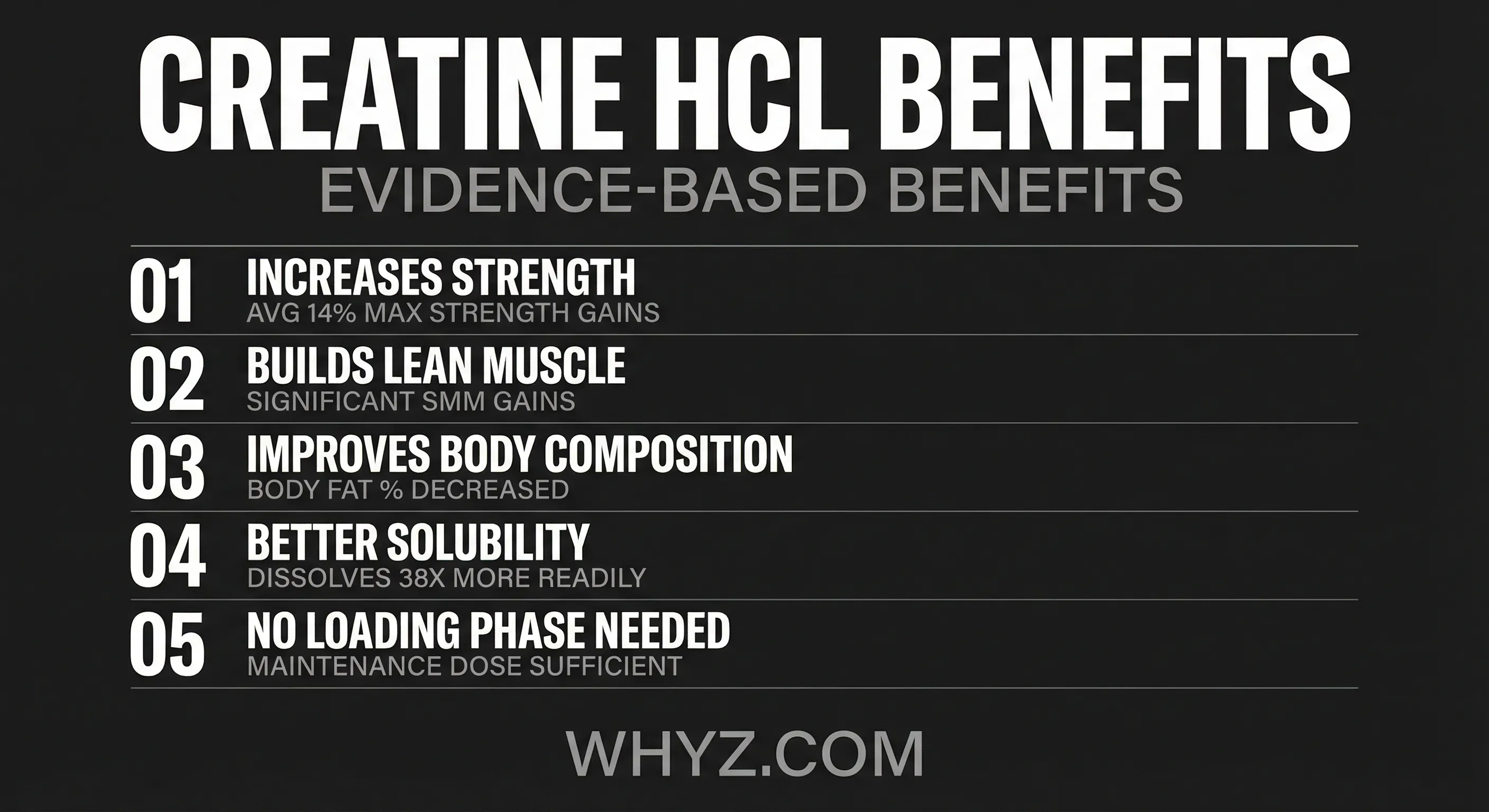
The difference is physical, not pharmacological. Creatine HCL and creatine monohydrate deliver the same active molecule. The hydrochloride salt form dissolves in water at concentrations roughly 38 times higher than monohydrate, based on solubility testing data. This has two practical implications:
First, the powder mixes completely into beverages without clumping, settling, or leaving residue. For users who travel, mix creatine into small volumes of water, or simply dislike gritty textures, this is a meaningful quality-of-life improvement.
Second, the improved solubility is often cited as the basis for lower dosing recommendations. The reasoning is that a fully dissolved creatine solution may encounter less unabsorbed material in the gut, potentially reducing GI side effects. However, Alraddadi et al. (2018) demonstrated that creatine monohydrate already has near-complete oral bioavailability in animal models (Alraddadi et al., 2018). This means that solubility and bioavailability are not the same thing, and the clinical evidence does not support claims that HCL is absorbed more efficiently than monohydrate on a gram-for-gram basis.
What Does the Clinical Research Show?
Does Creatine HCL Build Strength and Muscle?
Eghbali et al. (2024) published the most direct head-to-head comparison of creatine HCL and creatine monohydrate in a peer-reviewed journal. This randomized controlled trial enrolled 40 young men (ages 18-25) who were divided into four groups of 10: creatine HCL at 0.03 g/kg/day, creatine monohydrate with a loading phase (0.3 g/kg for 5 days then 0.03 g/kg maintenance), creatine monohydrate without loading at 0.03 g/kg/day, and placebo. All groups performed the same 8-week resistance training program at 70-85% of 1RM (Eghbali et al., 2024).
The results showed that all three creatine groups, regardless of form, experienced significant increases in 1RM strength, skeletal muscle mass (SMM), and muscle cross-sectional area (MCSA) compared to placebo. Body fat percentage decreased in the creatine groups as well. Creatine HCL performed comparably to both monohydrate protocols. The study also measured hormonal responses: growth hormone, IGF-1, and the testosterone-to-cortisol ratio all improved in the creatine groups, while cortisol and ACTH decreased. These hormonal shifts were statistically significant versus placebo but did not differ between creatine forms.
The key finding: creatine HCL at a maintenance-only dose (no loading phase) produced outcomes statistically equivalent to monohydrate with a loading phase. For users who want to skip the loading protocol entirely, this is noteworthy. However, the study’s small sample size (n=10 per group) means these findings need replication before drawing definitive conclusions.
Does Creatine HCL Support Cognitive Function?
Korovljev et al. (2026) conducted an RCT examining 8 weeks of creatine HCL supplementation on cognition and brain creatine levels in perimenopausal and menopausal women. This is one of the first studies to investigate creatine HCL specifically for cognitive outcomes in a population where brain creatine may be declining due to hormonal changes (Korovljev et al., 2026). The study represents an expansion of creatine research beyond the typical young male athlete population. Full results should be interpreted in the context of the broader creatine-cognition literature, which has shown consistent benefits for short-term memory and reasoning under stress (Avgerinos et al., 2018).
What About the General Creatine Evidence Base?
Creatine as a molecule has been studied in over 500 peer-reviewed publications. The International Society of Sports Nutrition (ISSN) 2017 position stand, authored by Kreider et al., affirms creatine’s safety and efficacy for increasing high-intensity exercise capacity, lean body mass, and muscle strength (Kreider et al., 2017). A meta-analysis by Rawson and Volek (2003) found that creatine supplementation increased maximal strength by an average of 14% and weightlifting performance by 8% compared to placebo (Rawson & Volek, 2003).
Because creatine HCL delivers the same active molecule, the extensive monohydrate evidence base applies to the underlying mechanism. The HCL-specific question is not whether creatine works, but whether the hydrochloride form offers practical advantages in mixability, dosing convenience, or tolerability.
How Should You Dose Creatine HCL?
The commonly recommended dose for creatine HCL is 1-2 grams per day. This is lower than the standard 3-5 g/day for monohydrate, and the rationale is based on the improved solubility and the assumption that fully dissolved creatine may be utilized more efficiently. The Eghbali (2024) study used a weight-adjusted dose of 0.03 g/kg/day, which works out to approximately 2.1-2.4 g for a 70-80 kg person.
No loading phase is typically recommended for creatine HCL. The Eghbali study demonstrated that HCL at maintenance-level doses produced comparable results to monohydrate with a 5-day loading phase, though this is a single study finding.
Take creatine HCL at any consistent time of day. As with all forms of creatine, the performance benefits come from chronic saturation of muscle phosphocreatine stores, not from acute pre-workout timing. Taking it with a meal that contains carbohydrates or protein may modestly enhance uptake via insulin-stimulated creatine transport, but this effect is small.
Is Creatine HCL Safe?
Creatine HCL has not been studied long-term as a distinct compound, but the active molecule (creatine) has one of the most extensive safety records of any dietary supplement. The ISSN position stand states that there is no scientific evidence of detrimental effects from short- or long-term creatine use in healthy individuals (Kreider et al., 2017).
Poortmans and Francaux (2000) reviewed the kidney safety question directly and concluded that creatine does not impair renal function in healthy people (Poortmans & Francaux, 2000). Creatine supplementation does raise serum creatinine levels (a metabolic byproduct used as a kidney function marker), which can superficially appear abnormal on a blood test. This increase reflects greater creatine turnover, not kidney damage.
GI tolerability is one area where creatine HCL may have an advantage. Because it dissolves fully in water, there is less undissolved powder reaching the lower GI tract. Some users who experience bloating, cramping, or loose stools with monohydrate (particularly during loading phases) report fewer of these issues with HCL. This has not been formally tested in a controlled trial, but it is a plausible consequence of the improved solubility.
Individuals with pre-existing kidney disease should consult a physician before using any form of creatine.
Who Should Consider Creatine HCL?
Creatine HCL is a good fit for several specific use cases:
GI-sensitive users. If standard creatine monohydrate causes bloating, cramping, or stomach discomfort, HCL’s complete solubility may reduce or eliminate these issues. Many of these GI problems stem from unabsorbed monohydrate powder drawing water into the intestinal lumen.
People who want smaller serving sizes. At 1-2 g/day versus 3-5 g/day for monohydrate, the serving size is roughly half. For people who mix creatine into small amounts of water or add it to coffee, this is a practical advantage.
Travelers and convenience-focused users. A fully soluble powder that mixes clear and leaves no residue is easier to work with on the go.
Users who want to skip loading. The Eghbali (2024) data suggests HCL at maintenance doses may reach effective levels without a high-dose loading phase.
For users who are happy with their monohydrate routine and experience no GI issues, there is no strong evidence-based reason to switch. Creatine monohydrate remains the most researched and most affordable form.
Related Ingredients
- Creatine Monohydrate — The gold standard form with 500+ peer-reviewed studies
- L-Theanine — Cognitive support compound, complementary to creatine for brain health
References
-
Kreider RB, Kalman DS, Antonio J, et al. International Society of Sports Nutrition position stand: safety and efficacy of creatine supplementation in exercise, sport, and medicine. J Int Soc Sports Nutr. 2017. 14:18. PMID: 28615996
-
Eghbali E, Arazi H, Suzuki K. Supplementing with which form of creatine (hydrochloride or monohydrate) alongside resistance training can have more impacts on anabolic/catabolic hormones, strength and body composition? Physiol Res. 2024. 73(5):739-753. PMID: 39545789
-
Korovljev D, et al. The effects of 8-week creatine hydrochloride and creatine ethyl ester supplementation on cognition, clinical outcomes, and brain creatine levels in perimenopausal and menopausal women. J Am Nutr Assoc. 2026. PMID: 40854087
-
Alraddadi EA, et al. Absolute oral bioavailability of creatine monohydrate in rats: debunking a myth. Pharmaceutics. 2018. 10(1):31. PMID: 29518030
-
Rawson ES, Volek JS. Effects of creatine supplementation and resistance training on muscle strength and weightlifting performance. J Strength Cond Res. 2003. 17(4):822-831. PMID: 14636102
-
Avgerinos KI, Spyrou N, Bougioukas KI, Kapogiannis D. Effects of creatine supplementation on cognitive function of healthy individuals: a systematic review of randomized controlled trials. Exp Gerontol. 2018. 108:166-173. PMID: 29704637
-
Poortmans JR, Francaux M. Adverse effects of creatine supplementation: fact or fiction? Sports Med. 2000. 30(3):155-170. PMID: 10999421