
What Is Spirulina Made From?
Spirulina is derived from Arthrospira platensis, a filamentous, multicellular cyanobacterium (blue-green microalgae) that grows in warm, alkaline freshwater environments. Unlike plant-based ingredients harvested from roots or leaves, the entire organism is used — harvested as a whole biomass, then processed into powder or concentrated extract. Because spirulina is cultivated in controlled aquatic systems and its bioactive compounds are produced through cellular biosynthesis, it is classified as a fermentation-derived ingredient.
The primary active compound of commercial interest is phycocyanin, a water-soluble biliprotein pigment responsible for spirulina’s characteristic blue-green color. Phycocyanin functions as a light-harvesting antenna pigment within the cyanobacterium’s photosynthetic apparatus and is a potent antioxidant with demonstrated anti-inflammatory properties. Whole spirulina biomass also provides a dense nutritional profile — approximately 60–70% protein by dry weight, along with gamma-linolenic acid (GLA), B vitamins, iron, and beta-carotene — though standardized extracts typically focus on phycocyanin concentration.
Where Is It Grown?
China dominates global spirulina production, accounting for an estimated 60–70% of world supply. Major cultivation hubs are concentrated in Yunnan Province (particularly around Chuxiong and the Dianchi Lake region), Inner Mongolia, and Hainan Province. Yunnan’s high-altitude plateau climate, with intense solar radiation and year-round mild temperatures (18–28°C), creates near-ideal conditions for A. platensis growth. Large state-affiliated and private cultivation facilities operate open raceway pond systems spanning tens of hectares, enabling the economies of scale that keep Chinese spirulina competitively priced on global markets.
India is the second-largest producer, contributing roughly 15–20% of global output. Production is concentrated in Tamil Nadu (around Madurai and Chennai) and parts of Andhra Pradesh, where tropical temperatures, high solar irradiance, and access to alkaline groundwater support year-round cultivation. Indian producers have increasingly targeted export markets in Europe and the United States, often investing in organic certification and improved heavy metal testing protocols to meet international quality standards.
The United States produces a small but premium-positioned share of global supply, primarily in Hawaii (Kona region, operated by Cyanotech Corporation) and to a lesser extent in Southern California. Hawaiian production benefits from consistent tropical sunshine, mineral-rich deep-sea water access, and a regulatory environment that supports clean-label positioning. Chad, particularly the Lake Chad basin, hosts traditional wild-harvesting of spirulina (locally called dihe) by indigenous communities and some semi-commercial operations, though this represents a minor fraction of global commercial supply.
The Manufacturing Process
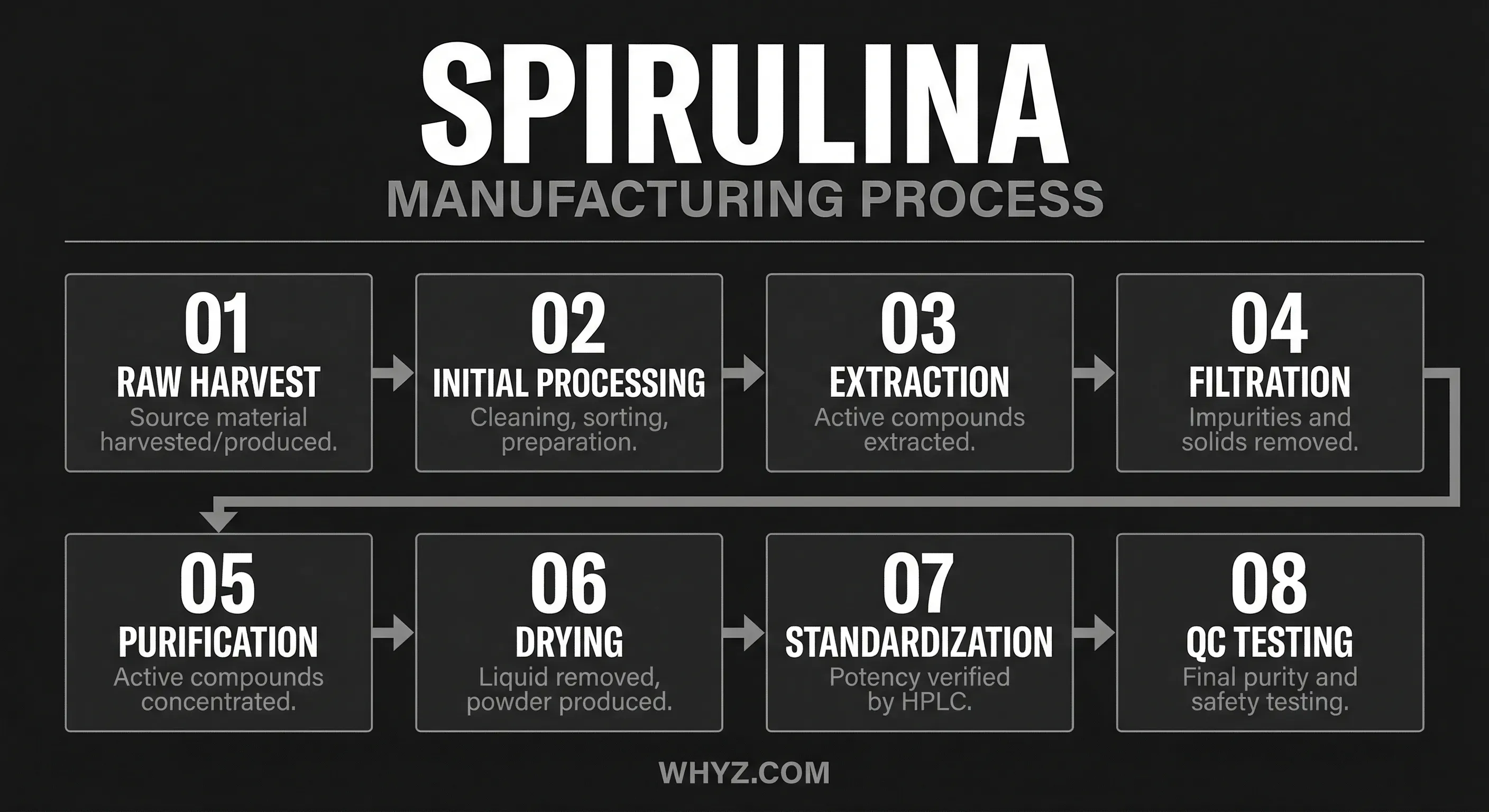
-
Culture Preparation & Inoculation — A starter culture of authenticated Arthrospira platensis is propagated in small laboratory photobioreactors using a defined alkaline growth medium (typically Zarrouk’s medium, pH 9–11, containing sodium bicarbonate, sodium nitrate, and trace minerals). This seed culture is scaled up in stages before transfer to production ponds.
-
Open Raceway Pond Cultivation — The inoculum is transferred to large open raceway ponds (0.2–1 hectare), where the culture is continuously circulated by paddle wheels at 15–30 cm/s to ensure light exposure and gas exchange. Water temperature is maintained between 30–35°C. CO₂ is supplemented to support photosynthetic growth. Biomass doubling time is approximately 2–5 days.
-
Harvesting by Filtration — When biomass density reaches target levels (0.5–1.0 g dry weight/L), the culture is pumped through vibrating screen filters (20–50 µm mesh) or vacuum drum filters. A. platensis’s multicellular filament structure allows filtration without centrifugation, differentiating it from single-cell algae species.
-
Washing & Concentration — Harvested biomass is washed with purified water to remove residual growth medium salts and then concentrated into a slurry (approximately 10–15% solids) via further mechanical pressing or centrifugation.
-
Drying — The concentrated slurry is dried using spray drying (inlet temperature ~180°C, outlet ~80°C) or low-temperature drum drying to produce a fine powder. Spray drying is fastest and most common for commodity production; drum drying is preferred when minimizing phycocyanin degradation is prioritized, as phycocyanin is heat-sensitive above 60°C.
-
Phycocyanin Extraction (for standardized extracts) — Whole spirulina powder is resuspended in cold purified water or phosphate buffer (pH 6.5–7.0), then subjected to repeated freeze-thaw cycles, high-pressure homogenization, or bead milling to rupture cell walls and release phycocyanin into solution. The aqueous extract is clarified by centrifugation and microfiltration to remove cell debris.
-
Concentration & Purification — The crude phycocyanin solution is concentrated via ultrafiltration (molecular weight cutoff ~10–30 kDa) and may be further purified through ammonium sulfate precipitation or ion-exchange chromatography to achieve higher purity grades (food vs. reagent grade).
-
Final Drying & Milling — The purified phycocyanin solution is spray-dried under reduced temperatures to yield a standardized powder, which is then milled to specification, blended for batch homogeneity, tested, and packaged under nitrogen flush to minimize oxidative degradation.
The Chemistry of Extraction
Phycocyanin is a phycobiliprotein — a covalent conjugate of a protein scaffold and open-chain tetrapyrrole chromophores called phycocyanobilins, linked via thioether bonds to cysteine residues. Because these chromophores are covalently bound to the protein and the whole complex is highly water-soluble, aqueous extraction is both sufficient and preferred. Cell disruption (bead milling, freeze-thaw, or homogenization) breaks the cyanobacterial peptidoglycan cell wall and plasma membrane, releasing intracellular contents into the aqueous phase. No organic solvents are required for phycocyanin isolation, which is a significant advantage from both a safety and regulatory standpoint. The primary byproducts of extraction are chlorophyll-containing cell debris (removed by centrifugation) and other phycobiliproteins such as allophycocyanin, which co-elute at lower purification grades. Heat and low pH are the principal degradation vectors — below pH 5 or above 60°C, the protein scaffold denatures and the phycocyanobilin chromophores lose their characteristic 620 nm absorbance.
Quality & Standardization
Phycocyanin content in spirulina extracts is expressed as a purity ratio (E ratio): A₆₂₀/A₂₈₀, where A₆₂₀ is absorbance at 620 nm (phycocyanin’s peak) and A₂₈₀ reflects total protein. Food-grade phycocyanin typically achieves an E ratio of 0.5–3.0; reagent-grade material exceeds 4.0. HPLC analysis is used to confirm identity and quantify phycocyanin alongside potential adulterants or co-extracted pigments. A reliable Certificate of Analysis (COA) for spirulina extract should include: phycocyanin content (% by dry weight or E ratio), heavy metal panels (lead, arsenic, mercury, cadmium per USP <232>), microbial counts (total aerobic bacteria, yeast, mold, Salmonella, E. coli), moisture content, and pesticide residue screens. Whole spirulina powder is typically standardized to a minimum of 15–20% protein; phycocyanin-enriched extracts are sold at 20–35% phycocyanin (food grade) or higher.
Major Global Producers
China leads manufacturing by volume, with India second. A small number of vertically integrated producers control the bulk of globally traded supply.
- Cyanotech Corporation (Kona, Hawaii, USA) — Premium Hawaiian-grown spirulina and phycocyanin, publicly traded
- DIC Corporation / Earthrise (Japan/California, USA) — One of the world’s longest-operating spirulina producers
- Parry Nutraceuticals (Tamil Nadu, India) — Major Indian exporter with organic certifications
- Yunnan Green A Biological Engineering (Yunnan, China) — One of China’s largest spirulina producers by volume
- Now Health Group / private-label Chinese manufacturers — Significant volume of bulk commodity spirulina powder sold through contract manufacturing channels
The global spirulina market was valued at approximately USD 500–600 million as of the mid-2020s, with continued growth driven by demand in functional foods, natural colorants (phycocyanin as a EU/FDA-approved natural blue colorant), and sports nutrition.
WHYZ Sourcing Standards
WHYZ sources spirulina exclusively from suppliers maintaining US-based warehousing to ensure supply chain traceability and reduce transit-related degradation risk. Every batch requires a current Certificate of Analysis with HPLC-verified phycocyanin quantification and full heavy metal panels. All incoming material is third-party tested at an accredited US laboratory prior to use in finished products.