
What Is NMN (Nicotinamide Mononucleotide) Made From?
NMN is a nucleotide molecule derived biosynthetically from nicotinamide (a form of vitamin B3) and ribose-5-phosphate. The key active compound is β-Nicotinamide mononucleotide, a naturally occurring molecule found in trace amounts in foods like edamame, broccoli, and avocado - but present in concentrations far too low to be commercially extracted from plant material. Instead, commercial NMN is produced almost entirely through microbial fermentation, using engineered yeast or bacterial strains that enzymatically assemble the molecule from precursor substrates.
The fermentation process uses nicotinamide riboside (NR) or nicotinamide phosphoribosyltransferase (NAMPT) enzyme pathways to catalyze the phosphorylation of nicotinamide riboside into β-NMN. The result is a high-purity, bioidentical molecule that matches the NMN found endogenously in human cells, where it serves as a direct precursor to NAD⁺ (nicotinamide adenine dinucleotide) - a coenzyme central to cellular energy metabolism.
Where Is It Grown?
Commercial NMN is not grown in the agricultural sense but is fermented in industrial bioreactor facilities, making “origin” a function of manufacturing infrastructure rather than climate. China dominates global NMN production, accounting for an estimated 80–90% of world supply. Key manufacturing hubs are concentrated in Zhejiang Province (particularly Hangzhou and Shaoxing), Jiangsu Province (Nanjing and Suzhou), and Shandong Province. These regions have dense pharmaceutical and fine-chemical manufacturing ecosystems, government-supported biotech zones, and established supply chains for fermentation inputs like glucose, yeast extract, and phosphate salts.
Japan is the second significant producer, representing approximately 5–10% of global output. Japanese manufacturers - primarily in the Kanagawa and Osaka prefectures - are known for producing higher-purity grades oriented toward the domestic nutraceutical and pharmaceutical markets. Japanese production tends to command premium pricing due to stricter domestic regulatory oversight and quality documentation standards.
The remaining supply comes from a small number of facilities in the United States and Europe, which together represent less than 5% of global production. These facilities typically focus on GMP-certified, documentation-heavy batches for clinical and branded supplement markets rather than commodity-scale output.
The Manufacturing Process
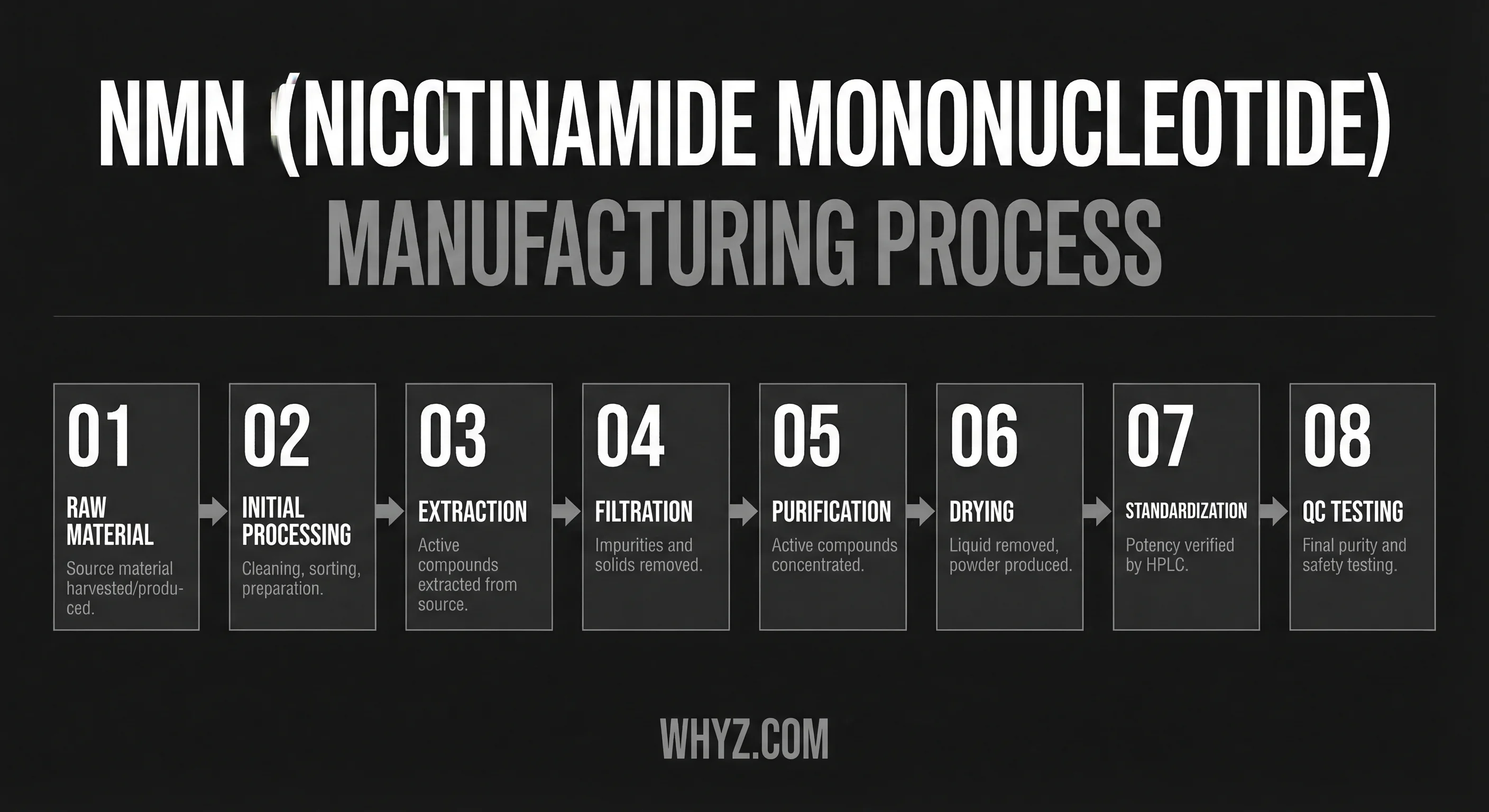
-
Substrate Preparation: Glucose, nicotinamide, and phosphate salts are dissolved in purified water and sterilized. These serve as carbon and nitrogen sources for the fermentation microorganisms.
-
Inoculation & Fermentation: An engineered microbial strain - typically Saccharomyces cerevisiae (yeast) or Escherichia coli - expressing NAMPT or NMN synthetase enzymes is introduced into the bioreactor. Fermentation runs at 30–37°C with controlled pH (6.8–7.2), dissolved oxygen levels, and agitation for 48–96 hours.
-
Cell Lysis & Clarification: At the end of fermentation, cells are disrupted (mechanically or via enzymatic lysis) to release intracellular NMN. The broth is then clarified through centrifugation and microfiltration (0.2–0.45 µm membrane) to remove cell debris.
-
Activated Carbon Treatment: The filtered solution is passed through activated carbon to adsorb pigments, residual proteins, and fermentation byproducts, yielding a colorless to pale-yellow intermediate solution.
-
Ion Exchange Chromatography: The clarified solution passes through anion and cation exchange resin columns to separate β-NMN from structurally similar impurities, including nicotinamide riboside (NR), NMN isomers, and nicotinic acid mononucleotide (NAMN).
-
Concentration & Crystallization: The purified NMN solution is concentrated under reduced pressure (vacuum evaporation at 40–55°C to protect thermosensitive bonds), then crystallized by controlled cooling or anti-solvent addition (ethanol).
-
Drying: Crystals are dried using spray drying or vacuum freeze-drying (lyophilization) to achieve moisture content below 1%, producing a white to off-white crystalline powder.
-
Milling & Blending: The dried material is milled to a uniform particle size, blended for homogeneity, and sampled for QC testing before release.
The Chemistry of Extraction
β-NMN is assembled via a phosphoribosylation reaction: the enzyme NAMPT (or bacterial NMN synthetase) catalyzes the transfer of a phosphoribosyl group from PRPP (5-phosphoribosyl-1-pyrophosphate) onto nicotinamide, forming the N-glycosidic bond that links the nicotinamide base to the ribose-5-phosphate moiety. This β-configuration at the anomeric carbon is critical - the α-isomer is biologically inert. During downstream purification, the challenge is isolating β-NMN away from structural analogs such as NAMN (which bears a carboxylic acid instead of an amide) and NR (the non-phosphorylated precursor), which co-elute under non-optimized chromatographic conditions.
The molecule is polar, water-soluble, and relatively heat-sensitive - the N-glycosidic bond can hydrolyze under acidic conditions or elevated temperatures, releasing free nicotinamide and ribose-5-phosphate. This is why processing steps are kept at or below 55°C and why pH is carefully controlled throughout. Ethanol is used as an anti-solvent during crystallization because NMN has low solubility in ethanol but high solubility in water, driving precipitation of pure crystals.
Quality & Standardization
Commercial NMN is typically standardized to ≥98% or ≥99% β-NMN purity by HPLC (high-performance liquid chromatography with UV detection at 260 nm). A COA for NMN should report: identity confirmation (HPLC retention time vs. reference standard), assay purity (%), specific optical rotation to confirm β-configuration, heavy metals (arsenic, lead, mercury, cadmium - USP limits), microbial counts (total aerobic, yeast/mold, E. coli, Salmonella), residual solvents (ICH Q3C limits), and moisture content. Watch for COAs that report purity by UV absorbance only without chromatographic separation - this method cannot distinguish β-NMN from UV-absorbing impurities. Pharmaceutical-grade NMN will additionally include particle size distribution, bulk/tapped density, and dissolution data.
Major Global Producers
China accounts for the majority of global NMN supply, with several manufacturers having achieved ISO, GMP, and NSF certification to serve international markets. Japanese producers hold a niche in ultra-high-purity grades.
- Effepharm (Shanghai) - one of the largest dedicated NMN manufacturers globally, supplies bulk NMN to brands internationally
- Herzo Health (Zhejiang) - significant bulk exporter with GMP certification
- Kingherbs / BioVerde (Hunan/Jiangsu) - multi-ingredient fine chemical producers with NMN lines
- Oriental Yeast Co. (Japan) - prominent Japanese producer focused on high-purity pharmaceutical applications
- Shinkowa Pharmaceutical (Japan) - Japanese manufacturer with proprietary fermentation NMN
WHYZ Sourcing Standards
WHYZ sources NMN exclusively from suppliers with verified US warehouse operations and current GMP certification. Every batch requires a full COA with HPLC-confirmed purity of ≥98% β-NMN and identity verification against a certified reference standard. All incoming material is third-party tested at an independent ISO-accredited laboratory before use in any WHYZ product.