
Shilajit vs Ashwagandha: Which Adaptogen Should You Take?
Two of the most popular adaptogens in modern wellness are shilajit and ashwagandha. Both come from Ayurvedic tradition. Both are marketed for stress, energy, and performance. But they work through different mechanisms and have different amounts of clinical support behind them.
This guide breaks down exactly what each adaptogen does, what the research says, and how to decide which one fits your goals.
What Is an Adaptogen?
An adaptogen is a natural compound that may help the body maintain stability under physical or psychological stress. The term comes from Soviet pharmacologist Nikolai Lazarev, who coined it in 1947 to describe substances that increase “non-specific resistance” to stress.
Shilajit and ashwagandha both carry that label. The key difference is how they earn it.
Shilajit: The Mineral-Rich Resin
Shilajit is a tar-like resin that seeps from rocks in high-altitude mountain ranges, primarily the Himalayas and the Altai. It forms over centuries from the decomposition of plant matter. The result is a dense concentrate of fulvic acid, humic substances, and over 80 trace minerals.
How Shilajit May Work
The proposed primary mechanism centers on fulvic acid. Fulvic acid is a small organic molecule that can interact with cell membranes, possibly improving nutrient transport into cells and supporting mitochondrial function. The idea is that better mitochondrial efficiency leads to more available energy and less fatigue.
A 2016 clinical trial published in the Journal of Medicinal Food examined how oral shilajit supplementation affected skeletal muscle gene expression in healthy volunteers. The researchers observed changes in transcriptome profiles related to mitochondrial biogenesis and extracellular matrix support (Das et al., 2016 [PMID: 27414521]).
A 2019 randomized controlled trial in the Journal of the International Society of Sports Nutrition tested shilajit against placebo in physically active men. The shilajit group showed significantly less fatigue-induced decline in muscular strength compared to placebo (Keller et al., 2019 [PMID: 30728074]).
A more recent double-blind RCT published in Phytomedicine in 2022 found that shilajit extract dose-dependently reduced oxidative stress and inflammatory markers in postmenopausal women with osteopenia, and also supported bone mineral density maintenance over 48 weeks (Pingali and Nutalapati, 2022 [PMID: 35933897]).
Shilajit: Evidence Summary
| Claim | Evidence Level |
|---|---|
| Reduces fatigue-induced strength decline | Moderate (RCT, n=63) |
| Supports mitochondrial gene expression | Preliminary (clinical transcriptomics) |
| Antioxidant and anti-inflammatory effects | Moderate (RCT, postmenopausal women) |
| Cognitive support | Theoretical / sparse |
| Testosterone support | Limited (small pilot studies only) |
The honest picture: shilajit has a few solid RCTs backing specific outcomes, particularly fatigue and oxidative stress. Broader claims about hormonal support and cognition lack robust human trial data.
Ashwagandha: The Stress-Modulating Root
Ashwagandha (Withania somnifera) is a shrub native to India and North Africa. Its root is the primary part used in supplementation. The bioactive compounds are called withanolides, a class of steroidal lactones that appear to modulate the hypothalamic-pituitary-adrenal (HPA) axis.
The HPA axis is the body’s central stress control system. When it fires repeatedly, cortisol rises, sleep degrades, and performance suffers. Ashwagandha may dampen this activation, not by blocking the stress response entirely, but by supporting a faster return to baseline.
What the Research Shows
Ashwagandha has more published randomized controlled trials than shilajit by a wide margin. Here are four of the most-cited human trials:
Chandrasekhar et al., 2012 (Indian Journal of Psychological Medicine): A double-blind RCT in 64 adults with chronic stress found that 300 mg of high-concentration ashwagandha root extract twice daily significantly reduced perceived stress scores, serum cortisol, and anxiety measures compared to placebo over 60 days (Chandrasekhar et al., 2012 [PMID: 23439798]).
Lopresti et al., 2019 (Medicine): A randomized double-blind placebo-controlled study with 60 adults found that 240 mg daily of ashwagandha extract significantly lowered cortisol and self-reported stress, fatigue, and anxiety compared to placebo after 60 days (Lopresti et al., 2019 [PMID: 31517876]).
Choudhary et al., 2017 (Journal of Evidence-Based Complementary and Alternative Medicine): An 8-week RCT in adults under chronic stress found ashwagandha root extract improved food cravings, body weight, and cortisol levels alongside stress reduction (Choudhary et al., 2017 [PMID: 27055824]).
Gopukumar et al., 2021 (Evidence-Based Complementary and Alternative Medicine): A randomized placebo-controlled trial found that 300 mg of ashwagandha extract twice daily for 90 days improved cognitive performance and psychological wellbeing in stressed adults (Gopukumar et al., 2021 [PMID: 34858513]).
Salve et al., 2019 (Cureus): A double-blind RCT in healthy adults found ashwagandha extract improved anxiety scores and cortisol by the end of an 8-week study period (Salve et al., 2019 [PMID: 32021735]).
Ashwagandha: Evidence Summary
| Claim | Evidence Level |
|---|---|
| Reduces perceived stress | Strong (multiple RCTs) |
| Lowers cortisol | Moderate to Strong (consistent across RCTs) |
| Improves sleep quality | Moderate (RCT data available) |
| Supports exercise performance | Moderate (separate RCTs on strength and VO2 max) |
| Reduces anxiety | Moderate (multiple RCTs, varies by measure) |
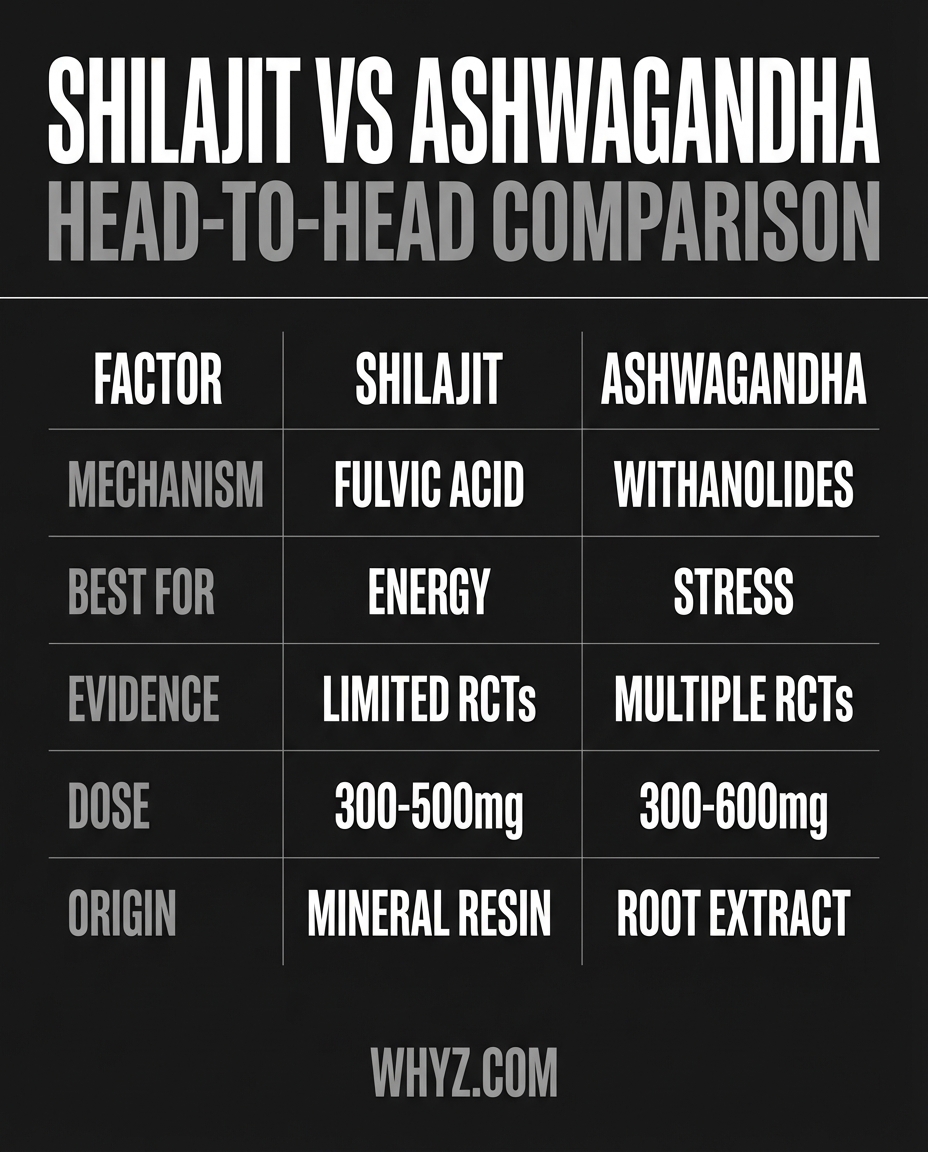
Shilajit vs Ashwagandha: Side-by-Side Comparison
| Factor | Shilajit | Ashwagandha |
|---|---|---|
| Primary mechanism | Fulvic acid / mitochondrial support | HPA axis modulation (withanolides) |
| Main use case | Physical energy, fatigue resistance | Stress, cortisol, sleep |
| Typical dose | 300-500 mg/day | 300-600 mg/day (root extract) |
| Onset | Weeks with consistent use | 4-8 weeks for measurable effects |
| RCT count (humans) | Limited (handful) | Higher (10+ published trials) |
| Vegetarian/Vegan | Check source (animal-free options exist) | Yes (root-derived) |
| Best combined with | Ashwagandha, creatine | Shilajit, magnesium |
Who Should Take Shilajit?
Shilajit may be the better fit if your primary goal is physical energy and resistance to exercise-related fatigue. It also appeals to people drawn to mineral-dense, traditional formulations.
Consider shilajit if you:
- Experience physical fatigue during or after training
- Want potential support for collagen synthesis and connective tissue (see Neltner et al., 2024 [PMID: 36546868])
- Are interested in mitochondrial support through a food-first lens
- Want a complement to your existing fitness supplementation
Shilajit is less appropriate as a standalone stress supplement. The cortisol and anxiety literature simply does not support it the way ashwagandha data does.
Who Should Take Ashwagandha?
Ashwagandha has the more documented record for people dealing with psychological stress, elevated cortisol, poor sleep, or anxiety. The evidence is not limited to one trial or one dose. Multiple well-designed RCTs across different populations show consistent directional benefits.
Consider ashwagandha if you:
- Feel chronically stressed or overwhelmed
- Struggle with sleep quality
- Have noticed stress-related weight changes or cravings
- Want cognitive support during high-pressure periods
For more on ashwagandha as part of a complete stress stack, see our guide on tongkat ali vs fadogia agrestis and our tongkat ali dosage guide.
Can You Combine Them?
Many people take both. The rationale is straightforward: shilajit targets the cellular and mitochondrial side of energy production, while ashwagandha targets the neuroendocrine side of stress regulation. They work through different pathways and are not known to interfere with each other.
That said, no published trial has tested the combination directly. Any synergy claim at this point is speculative. If you do combine them, start each individually at a lower dose to understand how your body responds before stacking.
Dosage and Timing
Shilajit: Most human RCTs use 250-500 mg daily of purified shilajit extract. Typically taken with a meal to support absorption.
Ashwagandha: The most-studied range is 300-600 mg daily of a standardized root extract. KSM-66 and Sensoril are two well-researched branded extracts used in multiple RCTs. Ashwagandha can be taken at any time; some people prefer it in the evening due to its calming effects.
Quality and Safety Notes
Both supplements vary in quality. Key things to look for:
Shilajit: Purified, lab-tested products with verified heavy metal screening. Raw shilajit from unknown sources can contain lead, mercury, or arsenic at harmful concentrations. Look for standardized fulvic acid percentages.
Ashwagandha: KSM-66 or Sensoril extracts have the most clinical backing. Avoid products that do not disclose the extract ratio or standardization. Ashwagandha may interact with thyroid medications, sedatives, and immunosuppressants. Not recommended during pregnancy.
The Bottom Line
Ashwagandha wins on evidence breadth, particularly for stress, cortisol reduction, and sleep. Shilajit offers a more targeted case for physical energy and fatigue resistance, with a growing but smaller RCT base.
If you are primarily stressed and underslept, start with ashwagandha. If you are an active individual looking for performance support and energy, shilajit has emerging evidence worth exploring. If you want both angles addressed, combining them is a reasonable approach at standard doses.
Neither is a cure-all. Both work best as part of consistent habits around sleep, nutrition, and training.
Related Guides
- Shilajit Benefits: What the Research Actually Says
- Shilajit for Women: Is It Worth It?
- Tongkat Ali vs Fadogia Agrestis
- When to Take BCAAs
References
- Das A et al. (2016). The Human Skeletal Muscle Transcriptome in Response to Oral Shilajit Supplementation. Journal of Medicinal Food. [PMID: 27414521]
- Keller JL et al. (2019). The effects of Shilajit supplementation on fatigue-induced decreases in muscular strength and serum hydroxyproline levels. Journal of the International Society of Sports Nutrition. [PMID: 30728074]
- Pingali U and Nutalapati C. (2022). Shilajit extract reduces oxidative stress, inflammation, and bone loss to dose-dependently preserve bone mineral density in postmenopausal women with osteopenia. Phytomedicine. [PMID: 35933897]
- Neltner TJ et al. (2024). Effects of 8 Weeks of Shilajit Supplementation on Serum Pro-c1a1, a Biomarker of Type 1 Collagen Synthesis: A Randomized Control Trial. Journal of Dietary Supplements. [PMID: 36546868]
- Chandrasekhar K et al. (2012). A prospective, randomized double-blind, placebo-controlled study of safety and efficacy of a high-concentration full-spectrum extract of ashwagandha root in reducing stress and anxiety in adults. Indian Journal of Psychological Medicine. [PMID: 23439798]
- Lopresti AL et al. (2019). An investigation into the stress-relieving and pharmacological actions of an ashwagandha (Withania somnifera) extract: A randomized, double-blind, placebo-controlled study. Medicine. [PMID: 31517876]
- Choudhary D et al. (2017). Body Weight Management in Adults Under Chronic Stress Through Treatment With Ashwagandha Root Extract: A Double-Blind, Randomized, Placebo-Controlled Trial. Journal of Evidence-Based Complementary and Alternative Medicine. [PMID: 27055824]
- Gopukumar K et al. (2021). Efficacy and Safety of Ashwagandha Root Extract on Cognitive Functions in Healthy, Stressed Adults: A Randomized, Double-Blind, Placebo-Controlled Study. Evidence-Based Complementary and Alternative Medicine. [PMID: 34858513]
- Salve J et al. (2019). Adaptogenic and Anxiolytic Effects of Ashwagandha Root Extract in Healthy Adults: A Double-blind, Randomized, Placebo-controlled Clinical Study. Cureus. [PMID: 32021735]